SPORT / MISCELLANY
Chinese Football Association issues new rules to regulate grassroots football
Cunchao Photo: VCG
The Chinese Football Association (CFA) has unveiled provisional measures on the management of discipline and conduct in regional football competitions, a comprehensive set of regulations aimed at bringing grassroots football events under stricter and more systematic governance.The document, consisting of six chapters and 28 articles, lays out management responsibilities, disciplinary procedures, and definitions of misconduct.
"The release marks a new stage of 'normalized and institutionalized' oversight of community-level football, as the sport gains traction in China under the national fitness strategy," Wang Dazhao, a Beijing-based commentator, told Global Times on Tuesday, noting that the CFA's intent is to send a clear deterrence. "Only with a fair and disciplined environment can grassroots football truly thrive."
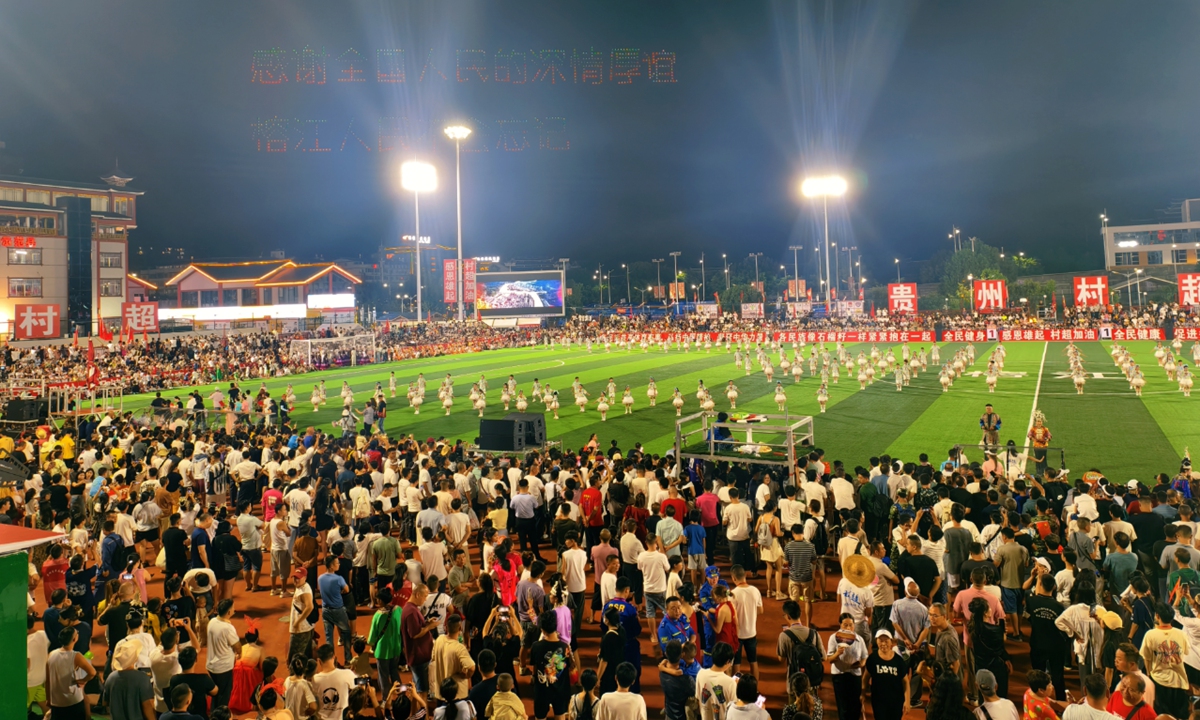
In recent years, grassroots leagues such as the Cunchao in Guizhou Province and Suchao in Jiangsu Province have seen strong participation, with Wuhan in Hubei Province also kicking off its own Hanchao earlier in August. But with this rapid growth have come recurring problems: falsifying player identities, age fraud, pitch violence, referee abuse, and even attempts to manipulate results.
In fact, at the provincial level, Suchao has adopted a fast, decisive disciplinary style. On August 4, the league's disciplinary committee handed down its third sanction of the season less than 24 hours after an altercation in a match between Lianyungang and Taizhou. Both teams received official criticism, while a Lianyungang player was suspended for one game.
The same swift and firm approach could have been seen earlier in July, when Nanjing's Yang Xiaotian was banned for one match after making a dangerous move against a Suzhou player. In May, Zhenjiang's Liu Dan was given a two-match suspension for violent conduct.
The new measures further seek to clarify who is responsible, what entails misconduct, and how it should be punished. The CFA itself will oversee nationwide policy and cross-regional cases, while provincial and municipal football associations are tasked with local enforcement. Event organizers bear "primary responsibility," while teams, players, and even spectators are brought into the accountability framework.
Crucially, the measures spell out zero tolerance for serious misconduct. Seven categories of "red line" violations are listed, including match-fixing, pitch violence, falsification of player information, disruption of order, and inflammatory remarks.
Penalties range from match bans and disqualification to lifetime suspensions and blacklisting, with criminal cases referred to police. Lesser infringements may be treated with leniency if those involved admit wrongdoing, compensate losses, or cooperate in investigations.
Spectators are also governed by measures and recent incidents indeed illustrate why such measures were deemed necessary. On August 22, the CFA issued two disciplinary decisions following the FA Cup semifinals. In Chengdu, where local team Rongcheng lost to Henan on penalties, fans were reported to have thrown cups and clashed briefly after the game. The CFA issued a formal criticism of the Chengdu match zone, while police confirmed later that three people were detained.
The measures also clarify that if foreign athletes or team officials violate rules of conduct and discipline while participating in competitions in China, the event organizers shall handle the matter in accordance with relevant regulations; if the case is suspected to involve illegal or criminal activity, it shall be transferred to public security authorities.
In another semifinal, Beijing Guoan thrashed Yunnan Yukun 7-0, but Yukun's foreign player Andrei Burca was sent off for violent conduct off the ball. The CFA suspended him for three matches and fined him 15,000 yuan ($2,097).
"The CFA's new national measures go beyond punishment, also stressing education and prevention, and event organizers are expected to promote values of fair play and respect. A nationwide information-sharing system will blacklist serious violators to ensure that one offense leads to restrictions everywhere," Wang said.
Looking ahead, the measures are meant to align Chinese football with international standards, drawing on FIFA's disciplinary frameworks.
"The document is as much about cultivation as it is about control," Wang said. "By setting red lines while promoting education, the CFA is laying a foundation for the long-term development of grassroots football."
RELATED ARTICLES