President Xi’s ‘three proposals’ highlight the historical responsibility of BRICS: Global Times editorial

Illustration: Tang Tengfei/Global Times
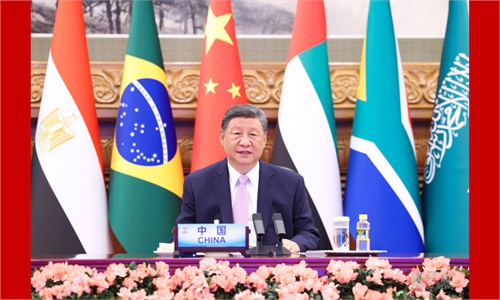
At the invitation of Brazilian President Luiz Inacio Lula da Silva, Chinese President Xi Jinping attended the BRICS Leaders Virtual Meeting via video link in Beijing on September 8. He held in-depth exchanges with leaders of various countries on the current economic environment and the multilateral system, BRICS cooperation and important issues of common concern, and delivered an important speech. President Xi pointed out that BRICS countries, standing at the forefront of the Global South, should act on the BRICS Spirit of openness, inclusiveness and win-win cooperation, jointly defend multilateralism and the multilateral trading system, advance greater BRICS cooperation, and build a community with a shared future for humanity. These important statements demonstrate China's responsibility and strategic vision as a major country, and also reflect BRICS countries' firm determination to push the global governance system toward a more just and equitable direction.
This virtual meeting was proposed by Brazil, the current rotating chair. Many analysts believe that the successive trade wars and tariff wars launched by some countries have severely impacted the world economy and seriously damaged international trade rules, which is one of the main backgrounds of this virtual meeting. The timely convening of the meeting demonstrates the growing sophistication and maturity of the BRICS mechanism and demonstrates the historic commitment of BRICS countries to jointly uphold multilateralism, defend fairness and justice, and promote common development, and that they are a positive and stable force for good.
President Xi made three proposals in his speech, including upholding multilateralism to defend international fairness and justice, upholding openness and win-win cooperation to safeguard the international economic and trade order, and upholding solidarity and cooperation to foster synergy for common development. These three proposals address the urgent needs of the international community. They represent both methodology and values, are highly relevant, and align with the current trends of the times. China, firmly standing on the right side of history, has injected new impetus into solidarity and cooperation within the Global South. This will also empower BRICS to better uphold multilateralism and improve global governance.
Multilateralism is the will of the people and the general trend of the times, and it is a crucial pillar for world peace and development. The XVI BRICS Summit Kazan Declaration reaffirmed commitment to multilateralism and explicitly promoted cooperation based on solidarity, mutual respect, justice and equality. This virtual meeting echoed the Kazan Declaration, demonstrating the stability and predictability of BRICS cooperation. Various sides have noticed that shortly before the meeting, China put forward the Global Governance Initiative (GGI), offering another important public good for promoting a more just and equitable global governance system. BRICS countries have actively responded to the GGI and strived to become a pioneering force in global governance. A BRICS committed to justice holds great promise.
Against the backdrop of rampant hegemonism, unilateralism, and protectionism, the firm defense of a multilateral trading system with the World Trade Organization (WTO) at its core and rejecting all forms of protectionism have offered the international community a predictable expectation. Since the first leaders' meeting in 2009, BRICS has borne rich fruit, with institutions and mechanisms such as the New Development Bank and the BRICS partnership on the new industrial revolution being established one after another. The fundamental reason lies in placing development at the heart of global economic governance and building a cooperation framework oriented toward development.
Naturally, this includes safeguarding the multilateral trading system with the WTO at its core and resisting all forms of protectionism. People have witnessed how the BRICS cooperation mechanism, born amid the historic rise of the Global South, has become a strategic force for building a more just and equitable global governance system.
BRICS countries account for nearly half of the world's population, around 30 percent of global economic output, and one-fifth of global trade, which gives BRICS cooperation immense potential. The China-proposed "BRICS Plus" cooperation model has been widely hailed by member states as "a creation full of wisdom and vision." With this model continuing to evolve, formats such as "BRICS+African Union," "BRICS+CELAC," "BRICS+ASEAN," and "BRICS+Arab League" are expected to enter the agenda of an expanded "Greater BRICS." Such innovation in cooperation paradigms not only injects new momentum into the development of the BRICS mechanism but also significantly enhances its representativeness and scale. As President Xi has said, the more closely we work together, the more resilient, resourceful and effective we are in addressing external risks and challenges.
"As long as we step up to take our responsibilities and look out for each other, the giant ship of BRICS will brave the shifting international tides and sail far and steady." As home to major natural resources, big manufacturers and vast markets, BRICS is not a closed and exclusive "small circle." Rather, they are a big family that looks out for each other and good partners in win-win cooperation. At this historic crossroads, BRICS will continue to uphold the vision of global governance featuring extensive consultation and joint contribution for shared benefit, promote solidarity and common progress of the Global South, and provide the world with a steady flow of certainty.
RELATED ARTICLES