Exploring China’s beautiful, harmonious countryside along Xi’s footsteps
From small village to infinite opportunities
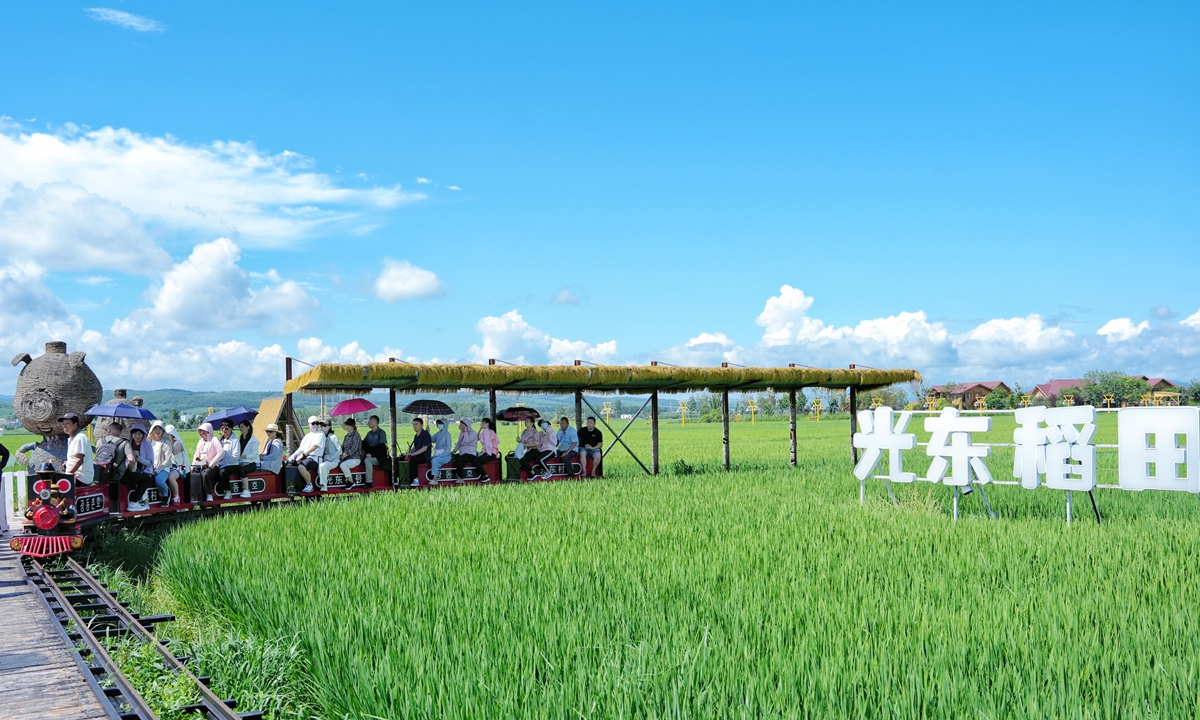
A small sightseeing train carrying tourists weaves through the rice fields of Guangdong village. Photo: Courtesy of China Rural Revitalization magazine
In 2015, when President Xi Jinping, also general secretary of the Communist Party of China Central Committee and chairman of the Central Military Commission visited Guangdong village in Dongcheng town, Helong city, Yanbian Korean autonomous prefecture, Northeast China's Jilin Province, he stressed that "no single ethnic minority group should be left behind in the country's building of a moderately prosperous society in all respects."
Guided by these instructions, Guangdong village has developed tourism and the rice-planting industry, replace traditional pit latrines with modern indoor sanitation facilities in every household, raising all villagers into moderate prosperity.
Ten years later, when a reporter from China Rural Revitalization magazine revisited the village, what left her the deepest impression were the people behind its transformation, including villagers, entrepreneurs returning to the village, officials stationed in village, and volunteers. For them, the countryside is neither a nostalgic sentiment nor a pastoral fantasy, but a vibrant home filled with the warmth of daily life.
Confidence in rural retirement
Seventy-year-old Fang Shunlie returned to Guangdong in 2019 after years of working in South Korea. When the reporter met him, he was leading a group of villagers practicing gateball - a sport similar to croquet at the cultural square, preparing for a friendly match against a neighboring village.
In Guangdong, gateball is immensely popular. Every afternoon at three, villagers gather punctually for practice. "Our team once ranked fifth among the three northeastern provinces [Liaoning, Jilin and Heilongjiang]," Fang said proudly.
Backed by a Yanbian prefectural project, the village now has a modern gateball venue built to international standards.
Fang, known as the village's "treasured old boy," is not only a gateball enthusiast, but also a member of the dance team and a skilled musician. In his courtyard, he has crafted a miniature landscape with flowing water, which he says reflects where life feels most vibrant.
Guangdong lies on the banks of the Hailan River, where water shapes daily life. Bringing water indoors and replacing traditional pit latrines with flush toilets marked a turning point for villagers. "My toilet was moved indoors in 2016. Before, in winter, it was freezing to use the outdoor one. Now it's just flush and clean - no smell," Fang said, showing his tiled bathroom with a water heater and washbasin.
Walking through Guangdong today, visitors encounter white-walled, black-tiled houses with flower beds, neat asphalt roads, garbage-sorting bins, and public service facilities such as health centers, elderly canteens, smart streetlights, and fitness squares - all blending modern convenience with rural charm.
Another villager, 67-year-old Jin Zhenshu, also returned from South Korea. She recalled that her family could only install an indoor flush toilet after the sewage network and garbage collection system were completed in the village.
Following Xi's call for the "toilet revolution," Guangdong invested 3.5 million yuan ($491,000) to upgrade all toilets, 16 million yuan to build sewage pipelines, and constructed two sewage treatment stations, finally resolving long-standing environmental issues.
For Fang and Jin, coming back to the village was not only a return to familiar surroundings but also a step into a peaceful spiritual homeland.
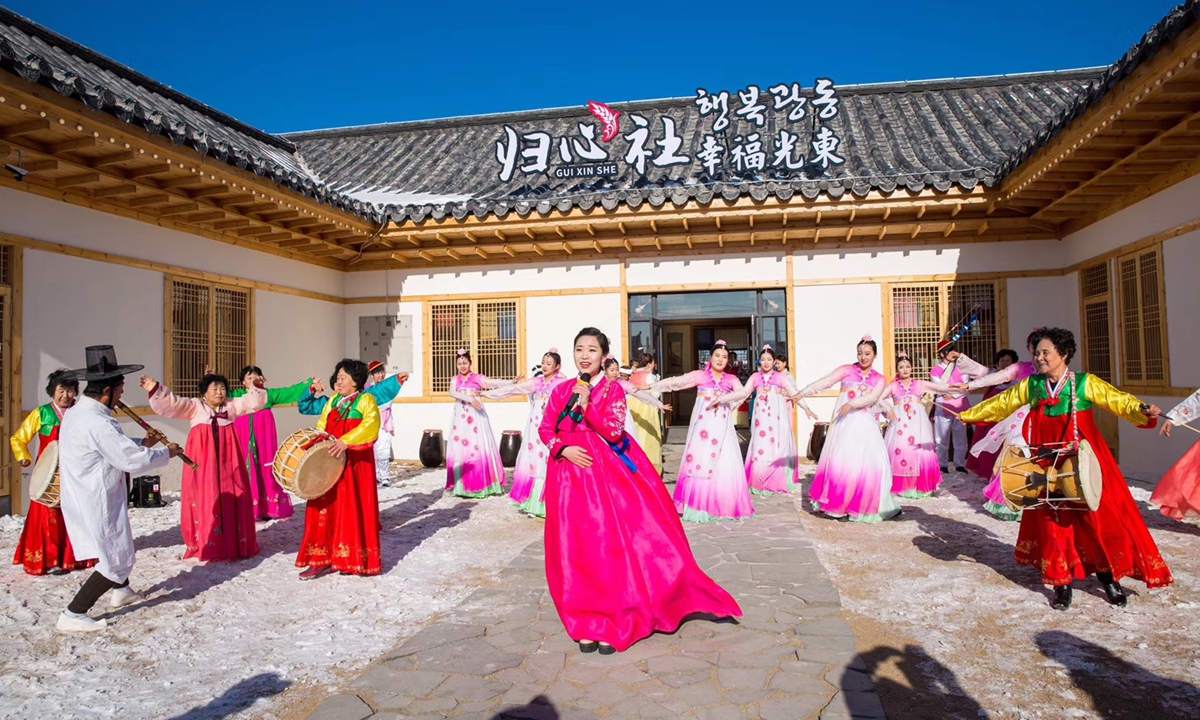
Performers in Guangdong village stage a traditional Korean ethnic welcome ceremony to greet tourists. Photo: Courtesy of China Rural Revitalization magazine
Striving for dreams
Rice cultivation, Guangdong's pillar industry, was highlighted during Xi's 2015 visit.
Jin Jun, a local entrepreneur, once left the village for Japan after high school. There, seeing Japan's rice similar to his hometown's fetched good prices, he resolved to bring Guangdong's rice to broader markets.
In 2009, he founded a rice company after he returned to his native town. Backed by the village, he expanded land transfers and organized large-scale production. His company supplies seeds and organic fertilizers, provides technical guidance, and buys rice at 0.2 yuan above the market price, deducting costs afterward. Farmers thus earn stable incomes regardless of market fluctuations.
By 2024, his company sold over 1,200 tons of organic rice, six to seven times more than a decade earlier, at prices rising from 6 yuan to 15 yuan per kilogram. Sales now reach markets nationwide and abroad in Japan and South Korea, benefiting more 500 households in Guangdong and neighboring villages. "Our village used to be backward, but now it is among Yanbian's most beautiful. I'm proud to be part of this," Jin Jun said.
Like Jin, entrepreneur Yang Lina believes the countryside needs ambitious young people. She founded a Korean ethnic tourism service company that integrates tourism with village life. The company buys vegetables from home gardens, connects tourists with family-run homestays, and hires the elderly dance team for performances.
In 2024, Guangdong received nearly 400,000 tourists, generating 4.36 million yuan in income. Today, original villagers, returnees, and newcomers live and work together, all striving for a better life.
Youthful vitality
The party chief of the village Shi Yanpeng said that Guangdong's development relies on party members' leadership and villagers' participation. To address an aging population, his first step was to work with the village committee to cultivate younger officals. In recent years, the party membership grew from 35 to 41, with youth under 35 rising to 38 percent. Volunteer programs have further expanded the pool of young participants, injecting vitality into the organization.
Volunteers Song Nana and Wang Wen embody this youthful energy.
Song, a 2024 marketing graduate, came from Taiyuan University of Technology, in North China's Shanxi Province, to experience rural life for the first time. She was impressed by the village's cleanliness and the youthful spirit of its residents. Over time, she began managing tourism and enterprise cooperation, engaging with visitors from across the country. "Many tourists don't just check in - they stay for a period of time to experience rural life," she said.
Wang Wen, a Yanbian native, chose rural service after graduation instead of working in the city or further study. "This is a rare opportunity. The countryside excites me more than the city, with its beautiful landscapes and stronger sense of belonging," Wang said.
When their one-year contracts ended in August, both chose to renew for another year.
In their view, what began as a chance decision has opened a gateway from the countryside to boundless possibilities for the future.
Interviewing in Guangdong leaves a clear sense of vitality. The village reflects life's true colors and transformations, imprinting warmth and resilience on all who set foot here. It offers peace, rekindles original aspirations, and, most importantly, gives people the courage to restart their lives.
RELATED ARTICLES