China’s nuclear capabilities contribute to regional peace: arms control association’s head on nuclear missiles reviewed at V-Day parade
By and Guo Yuandan Published: Sep 10, 2025 12:26 PM

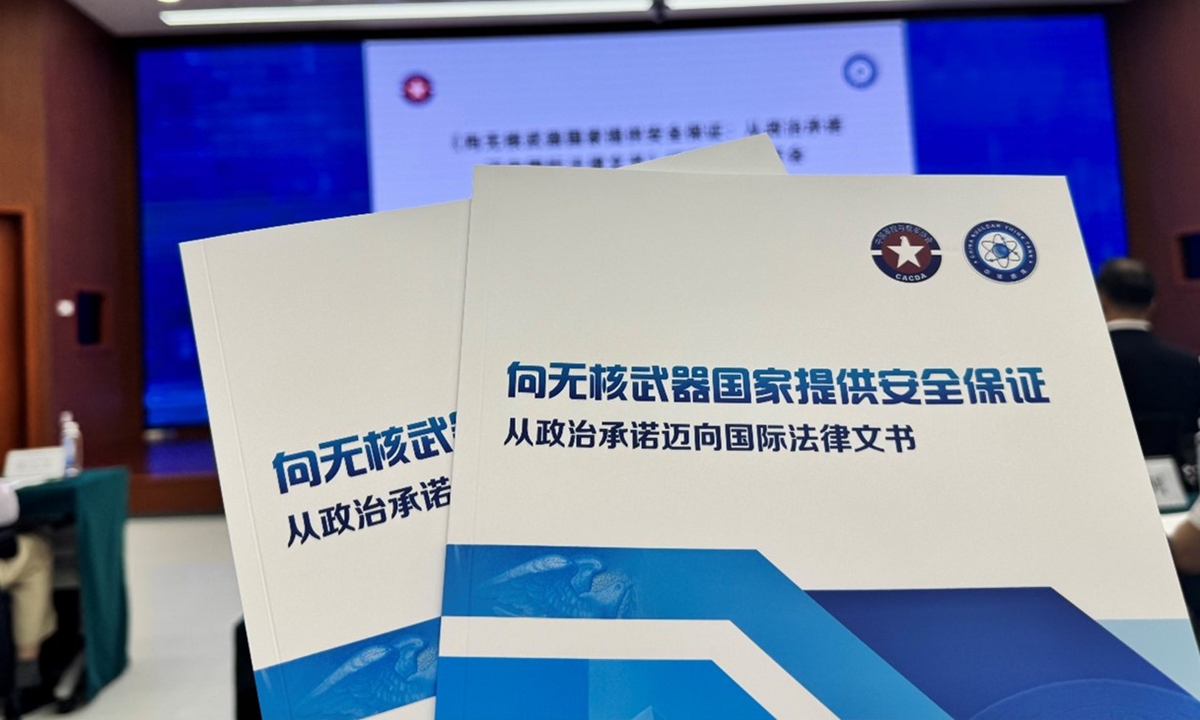
A report on security assurances to non-nuclear-weapon states Photo: Chen Qingqing/GT
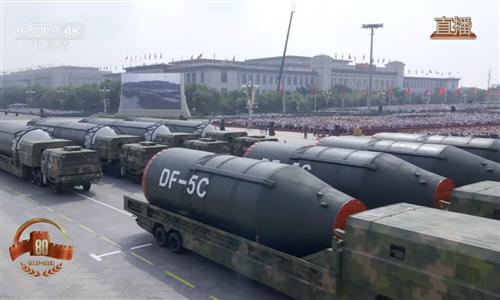
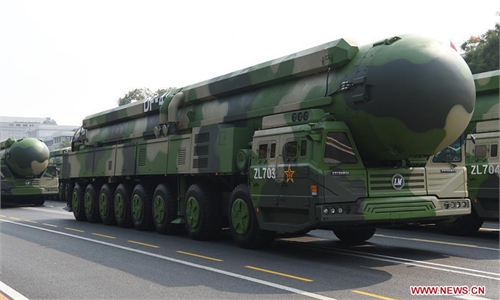
In response to the world's attention to the nuclear missile formation at China's V-Day military parade on September 3, consisting of JL-1 air-launched long-range missile, JL-3 submarine-launched intercontinental missile, as well as DF-61 and DF-31BJ land-based intercontinental missiles, Cheng Jingye, head of China's Arms Control and Disarmament Association, said on Wednesday that China's nuclear policy has been consistent, guided by the goal of protecting national security, territorial integrity and independence."I feel truly encouraged and proud of the development and strengthening of China's national defense capabilities. This not only reflects the growth of China's peaceful strength, but also represents an important means and tool for safeguarding our national sovereignty and security. It is something every one of us can take pride in," Cheng told reporters at a press conference about the release of a report on security assurances to non-nuclear-weapon states on Wednesday in Beijing.
In enhancing China's nuclear deterrence capability in a measured way, the country has always been guided by the goal of protecting its own national security, territorial integrity, and independence, Cheng said.
Secondly, the development of China's nuclear capabilities also contributes to regional peace, he said.
From the very first day when China possessed nuclear weapons, the country has made it clear that these weapons are for self-defense, aiming to break the monopoly and nuclear blackmail of other nuclear powers. This principle remains unchanged today, Cheng said.
"At the same time, China has always adhered to a clear policy of 'no first use' of nuclear weapons and an unconditional commitment not to use them against non-nuclear-weapon states. These policies have been consistent, and I do not believe they will change in the future," Cheng added.
The nuclear missile formations were reviewed at China's V-Day military parade on September 3 to mark the 80th anniversary of the victory in the Chinese People's War of Resistance Against Japanese Aggression and the World Anti-Fascist War, marking the first concentrated appearance of China's land, sea, and air-based strategic nuclear triad.
Eliminating the threat of nuclear weapons and nuclear war, and ultimately achieving the total prohibition and complete elimination of nuclear weapons, serve the common interests of all humankind. Providing legally binding negative security assurances to non-nuclear-weapon states would help advance the process of nuclear disarmament and promote the realization of a world free of nuclear weapons, while also representing an important aspect of global governance in the nuclear field, Cheng said during the press conference on the release of the report.
Given the current international security situation, non-nuclear-weapon states have expressed stronger demands and louder calls for the early negotiation and conclusion of an international legal instrument on security assurances, Cheng said.
The importance and urgency of nuclear-weapon states providing legally binding security guarantees to non-nuclear-weapon states have become increasingly prominent. This concerns not only the legitimate rights of non-nuclear-weapon states, but also has great significance for reducing nuclear risks, strengthening the non-proliferation regime, and safeguarding regional and global peace and security, he said.
It marks the first time that a Chinese academic institution has publicly released a dedicated research report on security assurances for non-nuclear-weapon states, which comprises six chapters, totals over 11,000 characters, and provides an objective analysis of the basic context, major national positions, significance, and practical challenges related to negative security assurances.
When asked about the recent claims that the US and Russia discussed nuclear disarmament, which express hope that China would join in this process, Cheng said the international community generally expects the US and Russia, which possess the world's largest nuclear arsenals, to take the lead in making substantial reductions.
"Under conditions where this has not yet been achieved, demanding that China join the negotiations is clearly unreasonable," Cheng noted.
"Together, the US and Russia account for more than 90 percent of the world's nuclear weapons, while all other countries combined—including China—account for less than 5 percent," he said, noting that against this backdrop, it is both unfair and unrealistic to demand China's equal participation in such negotiations.
RELATED ARTICLES