Stronger Brazil-China economic ties anticipated as global trade diversifies amid US tariff pressure: Brazilian trade official
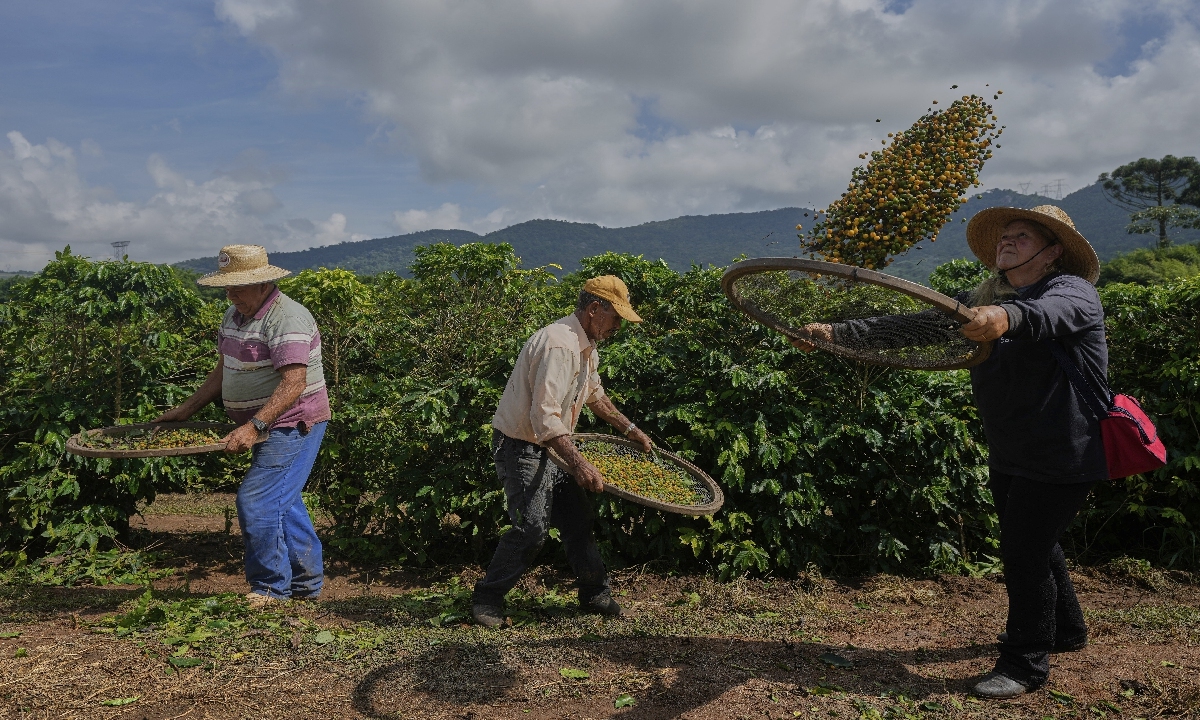
Farm employees work on a farm during the coffee harvest in Braganca Paulista, Brazil, April 4, 2025. Photo: VCG
Brazil and China are entering a new stage of robust economic cooperation, fueled by deeper ties, expanding trade, and rising investment opportunities, said a Brazilian trade official at the ongoing 25th China International Fair for Investment and Trade (CIFIT) held in Xiamen, East China's Fujian Province.In an interview with the Global Times on Wednesday, Inty Mendoza, chief representative officer at Invest SP, Investment Promotion Agency of Sao Paulo State, Brazil, highlighted Brazil's ongoing efforts to diversify its exports to China, its largest trading partner since 2009, the enduring appeal of the Chinese market to Brazilian businesses, and huge opportunities for further collaboration in fields such as artificial intelligence (AI), new infrastructure, biotech and pharmaceuticals.
Amid rising global protectionism, "there's a growing need for closer ties between Brazil and China," said the Brazilian official, noting that Brazil is the largest market in the South American continent, while China, as the world's second-largest economy, boasts the world's largest industrial hub, with a domestic market that continues to grow each year and more and more consumers gaining growing purchasing power.
"Meanwhile, China's market remains a magnet — vast, vibrant and red-hot for Brazilian enterprises," he said, pointing to the growth of sectors such as animal protein, sugar, cellulose and coffee, alongside traditional exports such as soybeans, oil and iron ore. This diversification highlights the increasing breadth of bilateral economic ties.
Mendoza also underscored the complementary nature of the two economies, with Brazil's rich natural resources, particularly in agricultural products, aligning well with China's growing demand. Notably, Brazil supplies approximately 70 percent of China's imported soybeans, along with significant quantities of beef, chicken, and corn. This established trade relationship has already yielded mature results, positioning Brazil as China's largest trading partner in those sectors, he said.
Mendoza expressed confidence in two-way investments between Brazil and China. Referring to a China-Brazil business matchmaking meeting held on the sidelines of the CIFIT on Tuesday, the Brazilian official said it sent a clear message that Brazil and China, two BRICS countries, are moving beyond soy-and-iron trade to co-author a new chapter in e-commerce, new-energy vehicles, pharmaceuticals and AI infrastructure.
More and more Chinese companies are showing great interest in exploring the Brazilian market, particularly in sectors such as cross-border e-commerce, logistics, and infrastructure. To attract more Chinese businesses, the Sao Paulo state's investment promotion agency has rolled out a package of services including site selection for factories and warehouses, tax consulting, and assistance with environmental licensing, said Mendoza.
The event on Tuesday brought together key representatives from both nations, including a governor from Brazil, and representatives of four Brazilian state investment promotion agencies, according to Mendoza.
The conference -- marked by strong optimism about the future of Brazil-China trade relations - provided a platform for dialogue and collaboration, showcasing the immense potential for trade and investment between the two countries, he said.
"As global trade faces challenges and uncertainties, Brazilian businesses are increasingly looking toward the Chinese market. The vast scale of the Chinese market presents an attractive alternative for Brazilian exporters, particularly in light of recent tariff pressures from the United States. The Brazilian government is actively seeking to diversify its export markets, with recent agreements allowing Brazilian beef to be exported to Vietnam and ongoing negotiations with Southeast Asian countries," Mendoza said.
In a keynote speech delivered at the matchmaking meeting on Tuesday, Vice Minister of Commerce Ling Ji noted that China-Brazil economic and trade cooperation has entered a period of rapid development in recent years. China has remained Brazil's largest trading partner for 16 consecutive years, and bilateral trade has exceeded $100 billion for seven consecutive years. Chinese companies have also invested over $50 billion in Brazil, demonstrating a high level of enthusiasm for cooperation, according to the china.com.cn reports.
Ling stated that China is committed to continuously consolidating its trade foundation with Brazil in areas such as agricultural products and minerals, further opening up markets to each other, expanding trade channels, and encouraging Chinese companies to actively explore investment cooperation in areas such as green sustainability, the digital economy, and energy transition, said the china.com.cn report.
Beyond traditional agricultural products like soybeans, coffee, and beef, the pharmaceutical industry has emerged as a key area for future collaboration. "Brazil's large population is creating significant demand for innovative drugs. Chinese pharmaceutical companies are encouraged to explore investment opportunities in Brazil, where many medicines are imported," he noted.
According to the Brazilian official, these investments provide Brazilian firms with a platform to combine technology, capital and market access. China's push to develop new quality productive forces offers a timely window for Brazilian investors to join the next wave of industrial upgrading and share in the dividends, Mendoza said.
As both countries continue to explore new opportunities, the potential for mutual growth and prosperity remains significant, he said, adding that China remains a massive market and a key global source of investment amid global economic uncertainties, and its sustained growth is creating development opportunities for Brazil and beyond.
The conference on Tuesday has witnessed the cooperation intentions being reached between Brazilian economic delegates and 30 Chinese companies in areas such as new energy, agriculture, infrastructure, and manufacturing.
RELATED ARTICLES