Nearly half of US firms urge Washington to lift tariffs; more companies express confidence in China: AmCham Shanghai
More companies express confidence in China: AmCham Shanghai
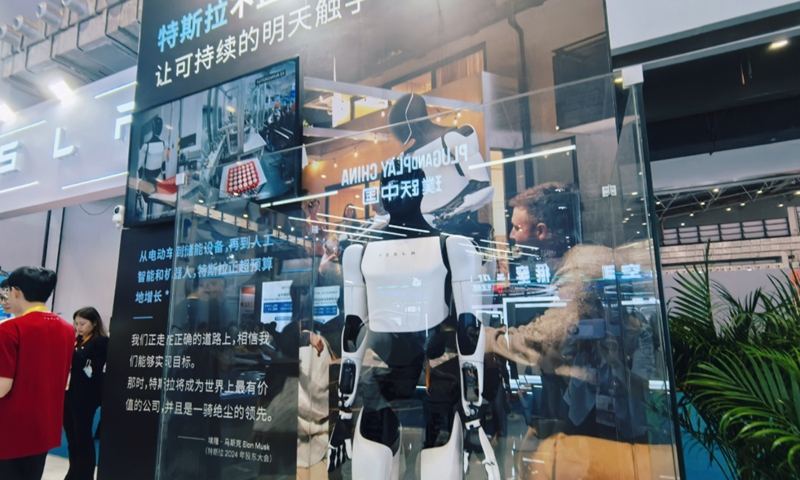
Tesla's humanoid robot is on display at the 2025 China International Consumer Products Expo in Haikou, Hainan Provine on April 13, 2025. Photo: Zhang Yiyi/GT
A business climate report by AmCham Shanghai said that China's continued efforts to remain open to global business have significantly improved its regulatory-related metrics, with a notable rise in companies expressing confidence in the country's further opening-up, according to a news release on the chamber's official website on Wednesday.
The survey also found that the US-China trade relationship has dampened optimism in the business environment, with nearly half of the respondents, 48 percent, urging the US government to completely remove all tariffs and non-tariff barriers on Chinese goods, the release said.
The 2025 China Business Report, based on a comprehensive survey of AmCham Shanghai's member companies, showed that US companies' profitability in China rebounded last year despite strained trade relations.
In 2024, 71 percent of respondents reported being profitable, an improvement from 2023's record low of 66 percent, with manufacturers (80 percent) and retailers (69 percent) performing better than the services (55 percent), according to the survey.
However, volatility in the US-China trade relationship has dragged down optimism in the business environment, headquarters' prioritization of the China market, and future revenue expectations to record lows, the release said.
The survey found that 64 percent of surveyed companies expect new US-China tariffs to drag on their 2025 revenue performance, with only 45 percent anticipating revenue growth — which would be a record low if realized.
Despite these headwinds, the report noted that China's regulatory environment is improving in ways that foreign companies increasingly recognize. Nearly half (48 percent) of respondents said that the regulatory environment was transparent, up 13 percentage points from last year, the release said.
More than one-third of respondents said that Chinese government policies and regulations toward foreign companies have improved in the past few years, 4 points higher than in 2024, with 41 percent now confident that China will open up further, up from 22 percent last year, the report said.
The rising confidence among US companies is a direct result of China's continuous opening-up measures, which contrast sharply with US protectionism, Gao Lingyun, a research fellow at the Institute of World Economics and Politics of the Chinese Academy of Social Sciences, told the Global Times on Wednesday.
"China's opening-up is reflected in concrete, practical measures, and foreign businesses in the country are the direct witnesses and beneficiaries," Gao said. "Their voices serve as strong evidence that China's commitment is not just rhetoric, but a reality delivering tangible results."
Jeff Yuan, head of tax at PwC China, stressed that foreign companies continue to value the Chinese market for scale and dynamism. He said that "while some firms are exploring alternative supply chains for enhanced diversification and resilience, China remains a critical part of their global strategy," according to the release.
Jeffrey Lehman, chair of AmCham Shanghai, said that Chinese "government efforts to improve the regulatory environment have been noticed by members, but they are overshadowed by US-China trade tensions." He urged both governments to create a stable and transparent framework that is conducive to cross-border trade and investment.
Chamber members continued to rank the US-China relationship or geopolitical tensions more broadly as the biggest challenge to their China operations and to China's economic growth, while nearly half (48 percent) of respondents urged the US government to completely remove all tariffs and non-tariff barriers on Chinese goods, according to AmCham Shanghai.
Gao stressed that bilateral trade tensions are largely a result of the persistent US protectionist policies, which have heightened economic uncertainties and complicated investment planning for US firms. He cautioned that "many US companies still rely heavily on China's manufacturing quality, scale and efficiency. Forcing shifts to alternative sources will not only increase operating costs but also reduce competitiveness in the long run."
Gao further urged the US administration to align with China's open and cooperative direction and work toward the same goal of stabilizing global supply chains and fostering mutual growth.
Chinese officials have pledged to advance higher-level opening-up. Vice Minister of Commerce Ling Ji told a press briefing on August 26 that China will actively and steadily expand pilot opening-up initiatives and continue to promote openness in key sectors.
Ling emphasized that the country will ensure national treatment for foreign-funded enterprises and focus on addressing specific market access issues, enabling them to "not only to enter the market but to also operate smoothly."
RELATED ARTICLES