ARTS / CULTURE & LEISURE
New speed skating school in NE China pioneers integrated sports-education model
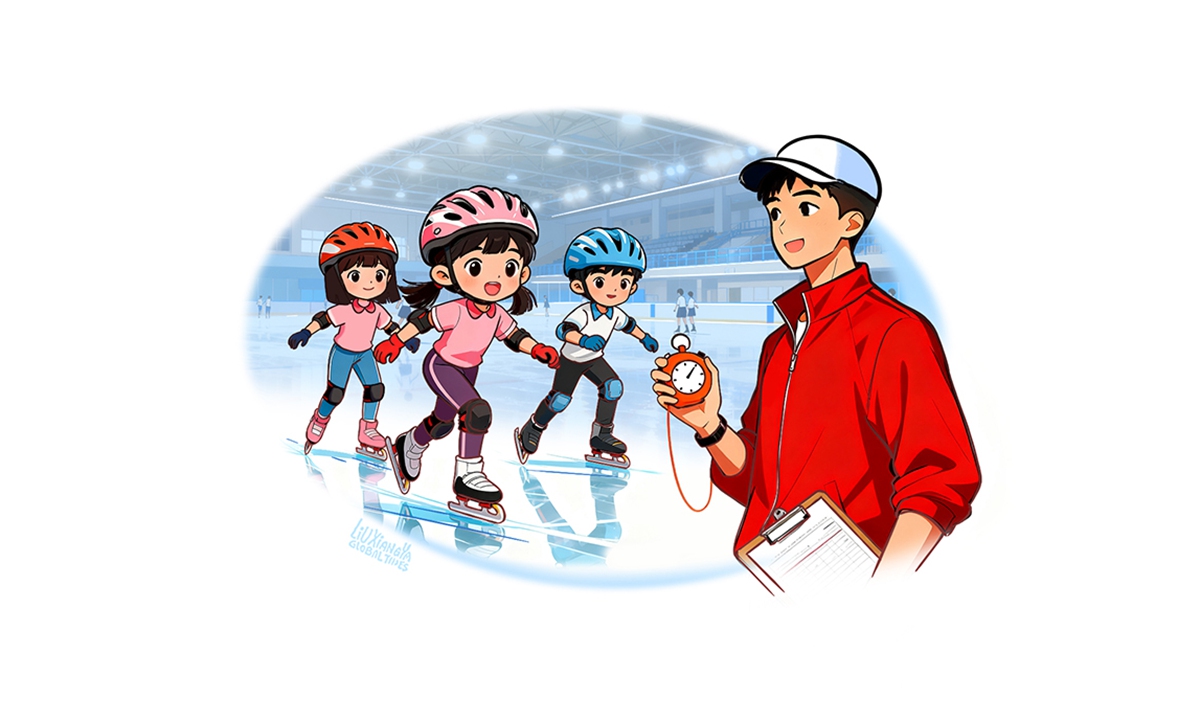
Illustration: Liu Xiangya/GT
Qitaihe, a city known as the "City of Olympic Champions" in Northeast China's Heilongjiang Province, welcomed more than 200 new students from across the country to China's first 12-year short track speed skating sports school. The establishment of the school offers a new model for the sustainable integration of sports and education, an analyst told the Global Times on Wednesday.
Four-time Olympic short track speed skating champion Wang Meng, who is from Qitaihe, attended the opening ceremony on Monday. She said she hoped the students would cherish this opportunity and carry forward Qitaihe's fine short track speed skating tradition of fearlessness and perseverance.
"We look forward to seeing you take the baton from our hands and skate out an even brighter future for this proud city," Wang said.
The school has built an integrated curriculum that combines academic learning, specialized training, and overall personal development. It has also pioneered a "step-by-step" training mechanism: for students aged 6 to 8, the focus is on developing a feel for the ice and stimulating interest; from 8 to 12, the emphasis shifts to strengthening physical fitness and standardized technical training; after 12, outstanding students are selected and sent to provincial and even national teams.
The new school represents an innovative attempt at integrating sports and education in China's ice and snow disciplines, while Qitaihe provides an exceptionally fitting context given its natural climatic conditions and long-standing tradition of cultivating winter sports talent, Luo Le, a sports scholar at Beijing University of Chemical Technology, told the Global Times on Tuesday.
Its significance lies not only in producing more champion athletes, but more importantly in constructing a sustainable system for nurturing sports talent, Luo said.
Since the 1970s, Qitaihe has cultivated 14 Olympic and world champions including Yang Yang, Wang Meng, Fan Kexin and Yang Jingru. Athletes from the city have won seven gold medals at the Winter Olympic Games, 186 golds at world-level competitions, and 601 golds at national-level competitions, according to a press conference for the school in July.
Hou Quanguang, a teacher with the elementary division of the school, told the Global Times on Tuesday that the school incorporates over 50 years of accumulated coaching expertise, training methodologies, and a culture of championship into a standardized educational framework, thereby rendering talent cultivation more systematic and scientific.
At present, specialized training is centered on short track speed skating, while in the future it will be expanded to other disciplines such as curling, roller skating, speed skating, and cycling, Hou noted.
Traditional sports schools generally face an imbalance between academic learning and specialized training, making it difficult for children who do not become elite athletes to acquire the competencies necessary to develop into talent in other sectors of society, Luo said.
The core advantage of the 12-year integrated sports school lies in broadening athletes' developmental pathways through the deep integration of education and training. Students may pursue professional competition, leverage their athletic strengths to advance into higher education, or transition into roles such as coaches, referees, and other reserve forces for ice and snow sports, thereby achieving diversified development, said head of the school Zheng Haiyu.
Instruction is tailored to students' individual abilities and learning pace. Outstanding students may be selected for provincial or national teams, others might leverage their athletic strengths to gain admission to other high schools or universities, or obtain professional sports certification to broaden their career pathways, Hou said.
As the ice-and-snow economy is projected to surpass 1 trillion yuan ($140 billion) in 2025, China's winter sports industry is rapidly growing in southern cities - where sustained snowfall is a rarity - signaling vast market potential and cultural integration opportunities, the Xinhua News Agency has reported.
Since 2024, the demand for ice and snow sports talent has increased by 16 percent year-on-year. Coaching positions account for the largest share, with a year-on-year growth of 198 percent; among these, ski coaches have seen a 356 percent increase. These positions are distributed across multiple regions, including Northeast China, Northwest China, the Yangtze River Delta, and the Pearl River Delta, with Jinan and Harbin leading the nation in recruitment growth, according to data from China's online recruitment service provider zhilian.com in December 2024.
Based on years of practical experience, children who have undergone specialized skating training tend to develop stronger willpower and resilience compared with their peers, which gives them an edge in pursuing other careers, Hou added.
The 12-year integrated sports school represents a significant upgrade and systematic exploration based on the amateur sports school system. It alleviates the long-standing tension between athletes' academic learning and specialized training, establishing a sustainable system for cultivating sports talent and serves as a reference for the development of talent in other specialized sports disciplines.
The author is a reporter with the Global Times. life@globaltimes.com.cn
RELATED ARTICLES