ARTS / MUSIC
New form of busking blends grassroots music with tradition, sports
Wild Concerts’ wave
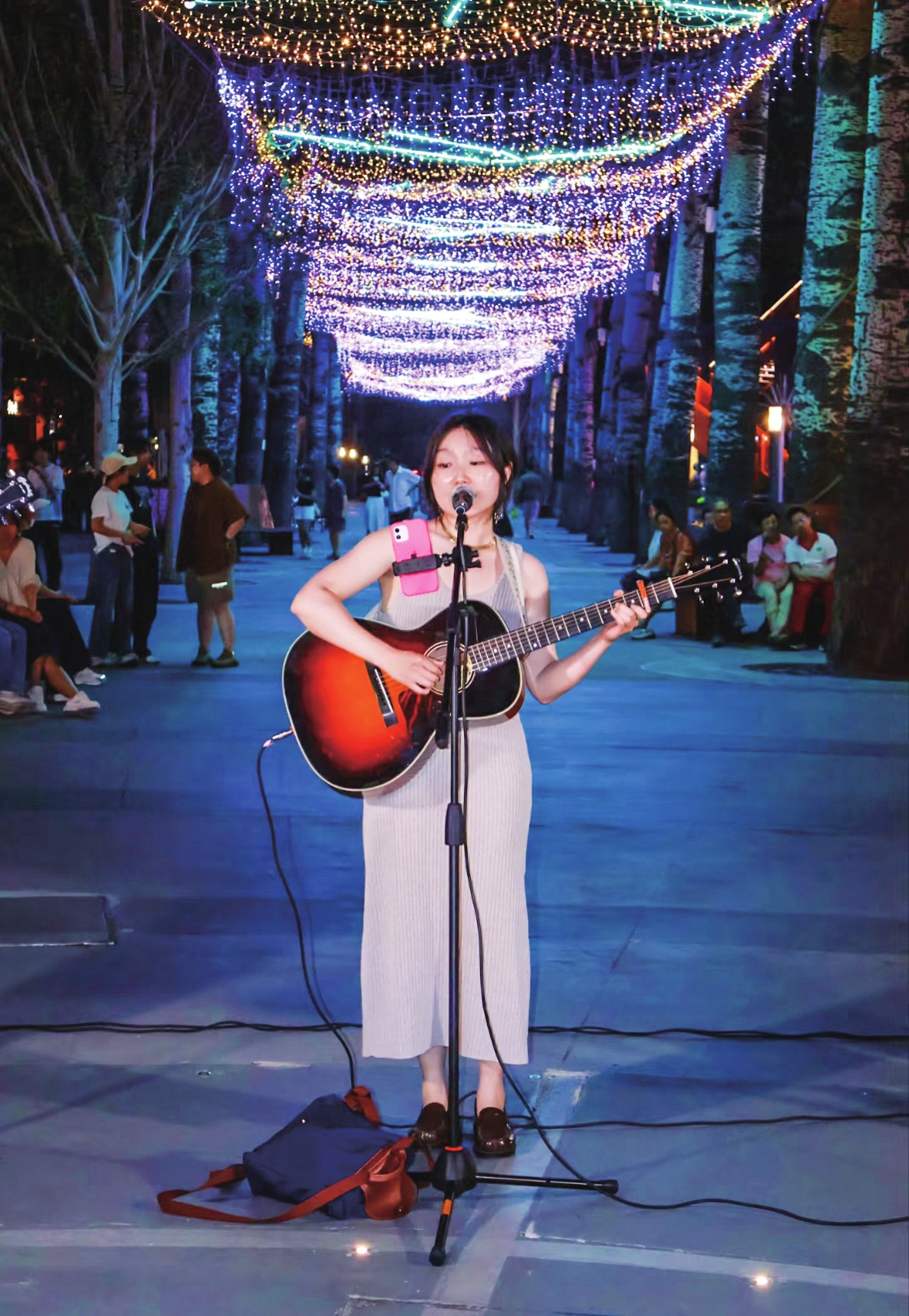
An amateur singer gives a street performance. Photos: Courtesy of the Beijing Street Performance Project
On the expansive lawns of Beijing's Sun Park in Chaoyang District, several microphones stood in place as 26-year-old Xiao Qin addressed the gathered crowd: "Autumn has arrived, and here's a new song to welcome it."As soon as his voice trailed off, lead vocalist Tan Wu and keyboardist Liang Zai picked up the cue, their guitar and keyboard filling the air with melodies.
Some in the audience sang softly along, others closed their eyes to absorb the sound, while many swayed gently to the rhythm. A relaxed and care-free atmosphere gradually settled over the park.
"In videos on social media, you often see street musicians performing in New York's Central Park or in front of Florence's cathedrals. At first, I envied that kind of vibe. But later I realized we actually have it here too," said Liu Mengtong, a resident who stumbled upon Chaoyang Park's "wild concert" by chance while out walking with her family.
Recently, this grassroots music phenomenon, known as "wild concerts," a special name for busking in parks, has emerged across China. From under the bridges along Chongqing's Jialing River to the plaza screens in Changzhou, East China's Jiangsu Province, people are gathering in spaces without stages, tickets, or formalities, joining together in spontaneous, free-flowing performances.
Audience members raise their phone lights to brighten the night sky, strangers interact through shared melodies, and an organic cultural landscape of the city begins to take shape.
Resonance of live music
At the beginning, Xiao didn't expect so many people would come, or that they could do so many shows. "But thinking about it, street performances aren't unusual. People's leisure time is fragmented, and chances to meet strangers without a specific purpose are rare. Wild concerts, or street performances, naturally close that distance between people," the 26-year-old told Global Times.
These concerts, without stages or tickets, remove burdens and lower barriers. "When my family and I first arrived, the performers were singing an English song, Bad Guy. I worried that my family might not accept that style, but the energy and atmosphere quickly won us over. Soon after, they played a Stefanie Sun's song, and we sat down on the spot, enjoying both the music and the cool evening breeze," Liu said.
So moved was she that she later searched on social media for one of the female singers from that night, hoping to connect. "The popularity of wild concerts reflects a broader shift in social psychology: the decentralization and lowering of thresholds allow music to move away from professional stages back to ordinary street corners, creating genuine connections among strangers through song," Zhang Ya, associate professor at the School of Psychology and Cognitive Science at East China Normal University, told Global Times.
This is echoed by a report released by Fudan University's Development Research Institute, which in 2024 introduced the concept of "emotional value consumption," which suggests that young people weigh not only cost-performance when making choices but also the emotional resonance those choices bring. "A nearly zero-cost, low-pressure public space where people can open up naturally attracts participation and sparks shared feelings," Zhang said.
Today, a team with the Beijing's street performance project has performed in 77 urban corners, drawing celebrities such as actor Pan Changjiang and singer Li Wenliang, as well as countless ordinary people who might otherwise never have dared to stand before a crowd.
"Sure, professional artists attract some attention, but that doesn't mean everyday people's singing goes unnoticed. We alternate between professionals and ordinary citizens, but what really matters is the shared atmosphere created through music," Xiao said. "Here at the performances, people can shed their social labels and return to their authentic selves."
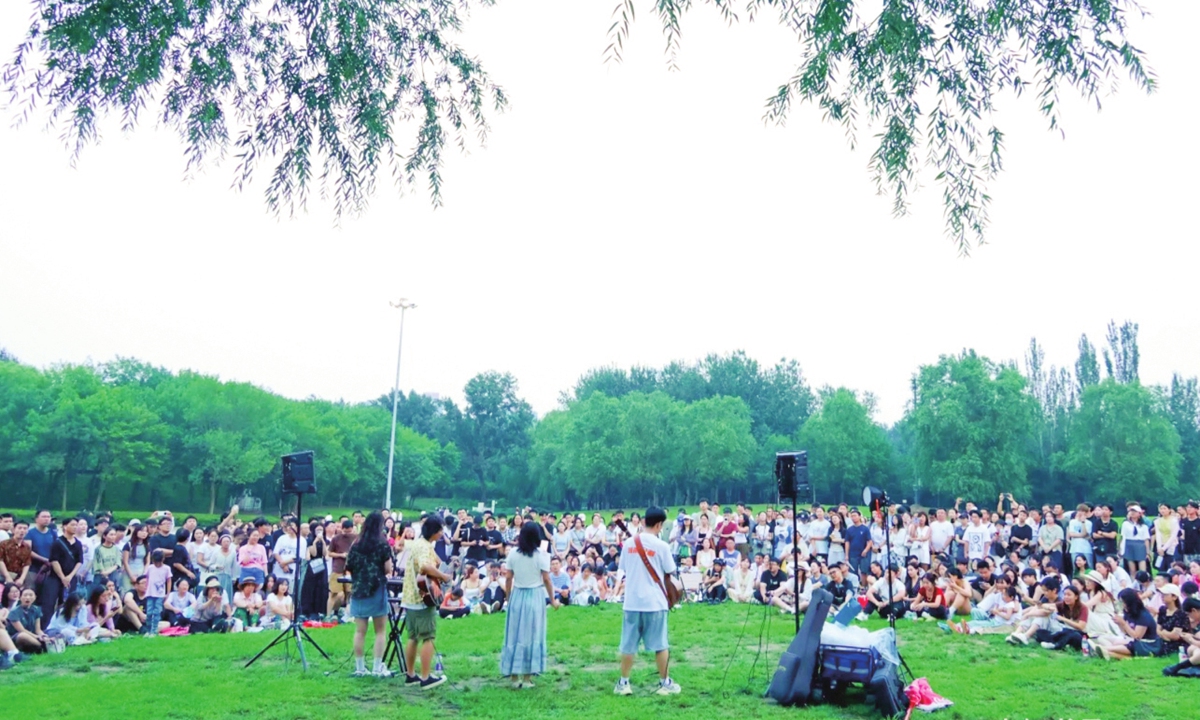
Audience members relax on the grass of Sun Park in Beijing, waiting for a new round of "wild concert" performances on August 24, 2025.
Tradition and sports mixWhat started in Beijing is now spreading nationwide. Wild concerts are being held in many cities, each creating its own version of the leisure-filled cultural spaces. For example, in Guian New Area, Southwest China's Guizhou Province, an evening wild concert was organized in collaboration with alike intangible cultural heritage event, bringing together residents and visitors alike.
From renditions of classics from the Bouyei ethnic group to lively bamboo pole dances, the performances, part of a wild concert series, offered the audience a dazzling showcase of ethnic culture through songs and dances, and the night unfolded as a cultural feast.
Tourists enjoyed dressing in Bouyei attire, joining in the singing, clapping, or simply admiring the show with delight.
Tan Hua, a local cultural official, told Global Times that more such events will be organized in the future, drawing on regional heritage to invite visitors to experience village life first-hand.
Meanwhile, wild concerts are also merging with sports in innovative ways. For example, the Changzhou Cultural Plaza hosted a crossover event combining the Chinese Super League (CSL) with live music. During the event, part of the audienceswayed to the music, while others roared at each goal, and the two rhythms of song and sport blended together. Meanwhile, in Chongqing, residents and visitors gather by the bridges of the Jialing River for memorable evenings that support both the nearby tourist attractions and the affiliated economy of online live broadcast.
Statistics show that each concert draws an average of more than 2,000 people on-site, while live streams reach millions of netizens.
Notably, policy support also poured in. Recognizing its value, Chongqing's cultural authorities have extended support, offering venues from historic bridge underpasses to iconic cultural landmarks such as the Hongya Cave, and even repurposed wartime air-raid shelters for wild concerts. "The future will likely see more local governments embracing these low-cost, high-impact gatherings as part of their cultural and tourism strategies. With each region adding its own local flavor, wild concerts are set to diversify further, attracting larger audiences and enriching the cultural lives of cities across China," Zhang said.
RELATED ARTICLES