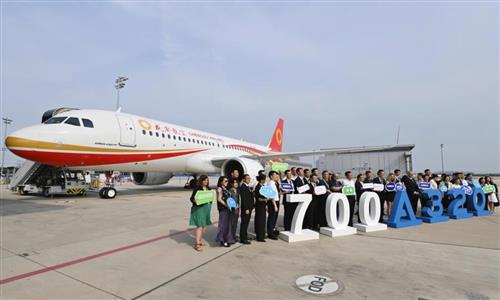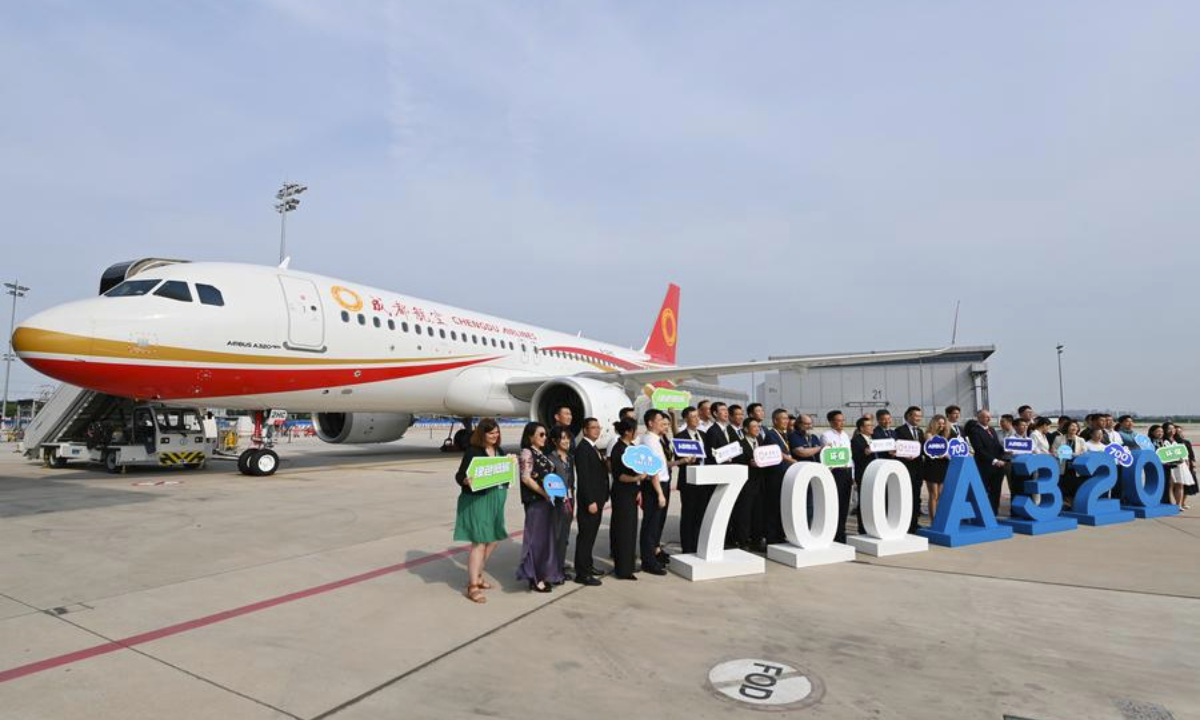
Guests attending the delivery ceremony of the 700th A320 family aircraft assembled by Airbus Tianjin to Chengdu Airlines pose for a group photo in front of the A320neo aircraft in Tianjin, north China, July 8, 2024. (Xinhua/Li Ran)
Airbus China's main task in the coming years will be to double its A320 family production capacity in North China's Tianjin to not only support Chinese airlines but also overseas markets, Airbus China told the Global Times on Thursday, reaffirming its commitment to the Chinese market.
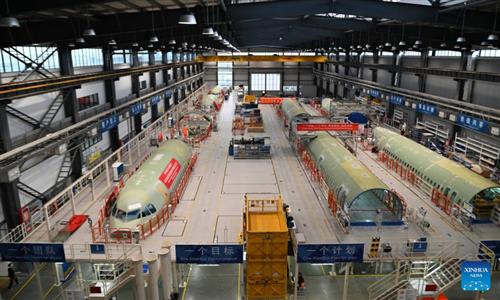
The remarks came as nearly 800 A320 aircraft have been assembled in Tianjin and delivered to the world, thanks to efficient loading and unloading at Tianjin Port, policy dividends of the free trade zone, and complete local industrial chain collaboration, China Central Television reported on Thursday.
And the European plane maker is continuing to expand its China operations. "Building the second A320 family final assembly line in Tianjin is a top priority for our industrial production, as it concerns both meeting market demand and fulfilling Airbus' commitment to China," the company said in a statement sent to the Global Times.
Once the second line is completed, Airbus will have 10 single-aisle aircraft final assembly lines worldwide, including two in Tianjin, said the company, noting that in the coming years, the main task will be to double the A320 family production capacity in China, since these aircraft are destined not only for Chinese airlines but also for overseas carriers.
In recent years, China has continued to advance high-level opening-up and stepped up efforts to attract foreign investment. As a leading enterprise in the supply chain, Airbus has played a pivotal and demonstration role, encouraging international suppliers to cooperate with China and driving many foreign-invested companies in the aviation sector to establish a presence in the country, the company said in a post on its official WeChat account.
The European company has consistently pursued a localization strategy and continuously carried out vertical integration of its supply chain in China. Now, about 200 Chinese suppliers support the production of Airbus commercial aircraft, covering the entire industrial chain from upstream raw materials to downstream system assembly, ensuring that every Airbus commercial aircraft model contains components manufactured in China. The annual value of Airbus' industrial cooperation with China has risen to more than $1 billion, according to the company.
The expansion of Airbus in China epitomizes the wider push by European businesses into the Chinese market.
"I think European companies are still very much committed to maintaining their global sourcing in China, given that the capability of Chinese manufacturing remains one of the main areas where European companies will look for manufacturing," Jens Eskelund, president of the EU Chamber of Commerce in China, in a previous interview with the Global Times.
China and the EU are closely connected through supply and industrial chains, forming an economic interdependence that is not easily disrupted by external pressures, Cui Hongjian, director and professor of the Center for European Union and Regional Development Studies at Beijing Foreign Studies University, told the Global Times.
Both sides have significant opportunities for collaboration in new areas such as the green and digital economies, which provide broad prospects for growth, Cui said, adding that the China-EU relationship should not be viewed as a zero-sum competition but rather as one built on complementary strengths that can generate shared benefits.
Global Times
RELATED ARTICLES