Photo: VCG
When it comes to artificial intelligence (AI), the transition from "making AI talk" to "making AI work" represents not merely a technological leap but the next frontier of commercialization. With the industry at a crossroads, could China, with its advantages in AI application, technology and policy support, be a global testing ground for such a transition?Current language models excel remarkably in the information domain, outperforming 99.99 percent of humans. However, when it comes to the real-world realm of "making AI work," the entire field remains largely a "desert," with large-scale explosive growth still on the horizon, Wang Xingxing, chief executive and chief technology officer and founder of Chinese robot start-up Unitree, said during the 2025 Inclusion Conference on the Bund in Shanghai on Thursday.
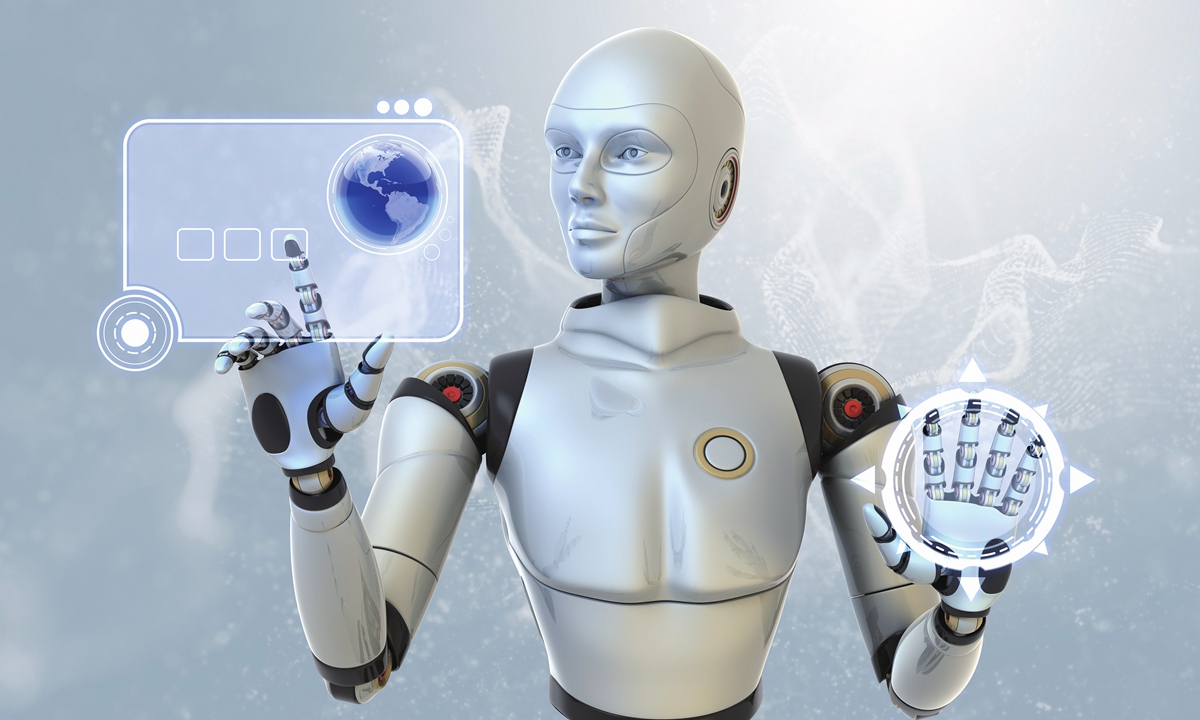
What exactly does "making AI work" mean? It refers to AI moving beyond the virtual realm of information into the physical world, participating in practical operations across production and daily life.
For years, progress in AI has been epitomized by breakthroughs in large-language models. Models like ChatGPT and Deepseek have achieved breakthroughs in content generation, information retrieval, and interactive dialogue. Whether businesses use AI to draft reports and generate marketing copy, or ordinary users rely on it to access personalized information, these developments all signify AI's maturity in the information domain.
Yet, as the industry evolves, it stands at a crossroads, transitioning from the information sphere to empowering physical realms. "Making AI work" has become the critical next step. This transformation is vital because it opens new frontiers for AI commercialization. While conversational AI demonstrates impressive capabilities, the outlook for sustainable business models remains uncertain.
In contrast, AI that "works" is directly tied to enhanced production efficiency, optimized labor costs, and the creation of new business formats, offering far clearer commercial value. Tech giants and start-ups worldwide have recognized that whoever achieves breakthroughs in this area will gain the initiative in the next phase of AI development.
In this global race to "make AI work," China undoubtedly possesses unique potential to become a core testing ground.
First, the heart of this potential lies in China's vast array of scenarios for AI application. No other country boasts such a large-scale, multi-tiered application market.
Second, China's massive domestic market creates possibilities for large-scale implementation of AI applications; this scale effect is unmatched by other regions globally.
Third, policy support provides a strong foundation; national strategies promoting smart manufacturing, digital transformation, and the development of new quality productive forces offer robust policy guarantees for integrating AI technology with the real economy.
Together, these advantages lay a solid foundation for China to serve as a testing ground for "making AI work."
However, potential alone is not enough. For China to truly become a global testing ground for "making AI work," it needs to overcome several key challenges. Technologically, China still faces gaps in basic algorithms, core chips, and high-end sensors. Without addressing these "chokepoint" issues, it could be difficult for China's AI applications to establish long-term competitive advantages.
On the data front, balancing utilization with privacy protection, breaking down data silos, and ensuring security and compliance present complex governance issues. Talent is another problem. China needs more breakthrough scientists in foundational theories as well as interdisciplinary experts who understand both AI technology and industrial applications. Such talent cannot be trained overnight.
Additionally, external factors like global tech competition and export controls add difficulties to this AI path.
In conclusion, the transition from AI that "talks" to AI that "works" has already begun. This shift is not merely about changes in technological paths; it will redefine the structure of global AI competition. With its market advantages, industrial foundation, and policy support, China has secured a position in this race. Whether it can truly become a global core testing ground depends on China's ability to convert its advantages into technological strengths and a vibrant innovation ecosystem.
RELATED ARTICLES