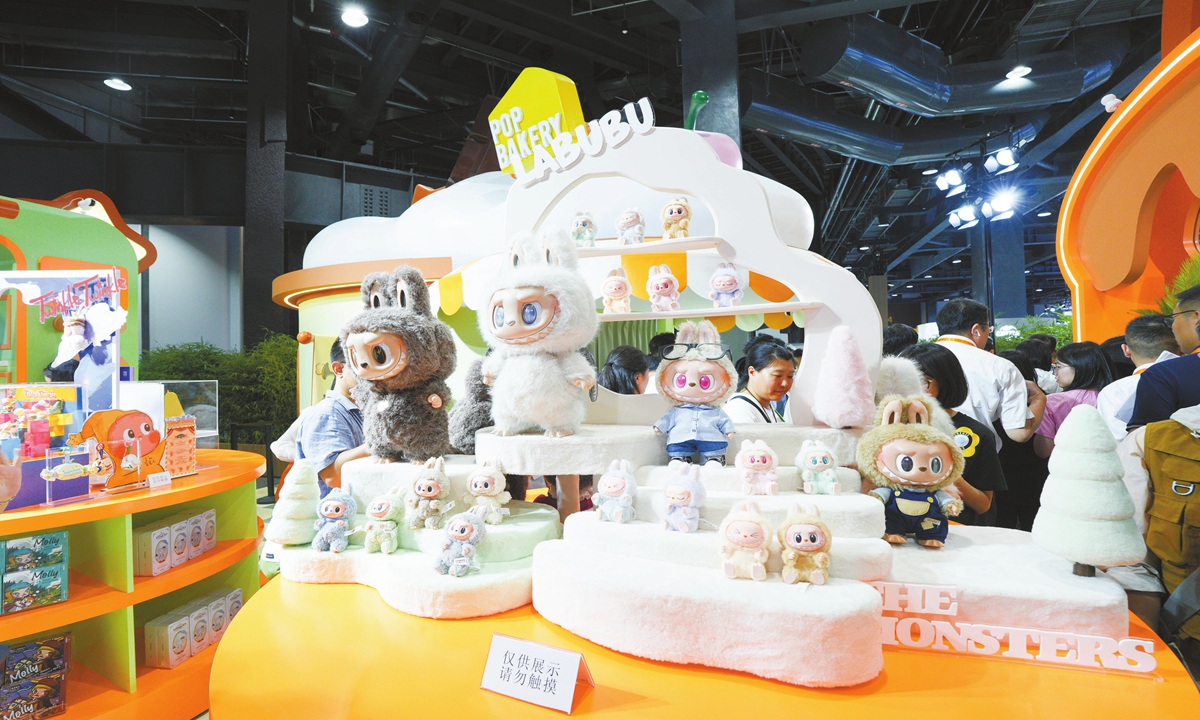
LABUBU dolls are displayed at the 2025 China International Fair for Trade in Services(CIFTIS) in Beijing's Shougang Park on September 10, 2025. Photo: VCG
On a bustling afternoon in Zhejiang Province, one of China's manufacturing hubs, the hum of production lines and the flow of goods reflected the country's global supply role. Amid this wave, an unexpected niche has emerged — micro-sized haute couture for dolls.
Unlike conventional toys, these garments — no longer than five centimeters — are designed with the same precision as adult fashion. From knitted sweaters to embroidered silk qipao, and from Han-style skirts to modern chic, they are made for collectible dolls, including the wildly popular Labubu figure that has taken global pop toy markets by storm.
Often crafted with Chinese traditional fabrics such as Song brocade or Xiangyun silk, or embellished with ruoyi fasteners and kesi weaving, the doll clothes have become miniature carriers of Chinese aesthetics. As one trader has put it: "When people dress their dolls, they are also dressing them in stories of Chinese culture."
Flexibility in transformation
Among the pioneers leading this trend is Gu Huijie, a former garment designer at a well-known brand. She now sells her craftsmanship overseas through her own company, turning doll clothes into a global hit.
"Recently, we designed several new Chinese-style products, especially doll clothes with Song brocade, Xiangyun silk, and hand embroidery. Orders from Southeast Asia and Brazil have multiplied," Gu told the Global Times on Tuesday. Her factory now employs hundreds of workers, with a design team producing more than 30 new doll clothes styles each month — the Chinese-style line remains the bestseller.
"To embody Oriental aesthetics, we carefully choose fabrics and integrate details like ruyi fasteners, pearl embellishments, and kesi weaving. Even though the clothes are just five centimeters long, every step, from fabric selection to tailoring, must be refined," Gu explained. A lover of traditional culture herself, she often wears qipao, which has become a constant source of inspiration.
Starting with just a few home sewing machines in March this year, Gu rapidly turned her passion into a thriving business. "I began by making a few doll qipao from leftover fabric, and to my surprise, they sold out instantly online," she recalled. Today, her factory is equipped with hundreds of machines, operates four stores, and produces up to 20,000 to 30,000 pieces daily, making her one of the hottest names in Zhejiang's doll-wear market within just months.
The appeal of doll-sized haute couture goes beyond craftsmanship. For post-1990s inheritors of traditional techniques, doll clothes have become a creative medium for cultural export. A young embroiderer recognized as a bearer of Wuxiu (Wu embroidery) surnamed Wu, designed a qipao doll dress using Song brocade.
"Originally, it was just a gift for a friend's child, but it turned out to be loved by many young people," she said. "This generation has stronger cultural confidence, and they enjoy expressing aesthetics and identity through dolls."
"China's private enterprises have long operated in a competitive environment where survival depends on flexibility," said Zhang Yi, CEO of iiMedia Research Institute. "Their smaller scale, combined with market pressures, has honed agility, innovation, insight, and strong execution. These strengths are crucial in domestic competition, and equally valuable in global markets."
Strong industrial foundation
Corporate responsiveness alone is not enough. Industry experts says the boom of doll-sized haute couture is underpinned by the resilience and adaptability of China's private sector.
An industry report by Chinese consultation firm ASKCI Consulting Co showed that in 2024, annual retail sales of licensed products in the domestic market reached 155.1 billion yuan, up 10.7 percent year-on-year. Analysts at the China Business Industry Research Institute forecast the figure will rise to 167.5 billion yuan in 2025, according to a report by thepaper.cn.
To keep pace with such growth, the completeness of the industrial chain is crucial.
From 2020 to 2024, China's total industrial added value rose from 31.3 trillion yuan to 40.5 trillion yuan, while manufacturing added value increased from 26.6 trillion yuan to 33.6 trillion yuan, data from the Ministry of Industry and Information Technology (MIIT) showed at a press conference on Tuesday.
During the 14th Five-Year Plan period (2021-2025), the increment of China's manufacturing added value is expected to reach 8 trillion yuan, contributing more than 30 percent to global manufacturing growth, MIIT showed, noting that China's manufacturing sector has ranked first in the world in overall scale for 15 consecutive years.
Experts pointed out that China's industrial ecosystem — from heavy to light industries — offers unmatched supply chain completeness. "In doll clothing, every component can be sourced domestically, from buttons and threads to dyes and fabrics. Designers can freely create, knowing suppliers and logistics can deliver almost instantly. This comprehensive ecosystem, largely driven by private firms, gives Chinese products a decisive edge."
Execution speed is another advantage. "For private firms, ideas can turn into reality almost overnight. What customers see today is often what they get tomorrow. This responsiveness has fueled Chinese companies' competitiveness in both domestic and international markets," Zhang said.
Cultural foundation underlies innovation, Zhang noted. "China's 5,000 years of continuous civilization provide a wellspring of inspiration. Culture not only enriches product designing, but also transforms into creative IP, enabling private firms to keep innovating and expanding globally."
From Zhejiang's workshops to global toy markets, the rise of doll-sized haute couture shows how private firms are seizing opportunities, drawing on cultural heritage, and leveraging complete industrial chains to meet new consumer demand.
As Gu had put it: "The best designers are our customers. We just turn their ideas into reality."