ARTS / FILM
Chinese movie on Japan’s notorious Unit 731 to screen in multiple countries
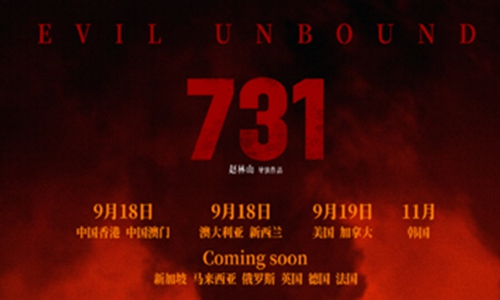
The poster of movie Evil Unbound Photo: Screenshot from Evil Unbound's official Sina Weibo account
According to the Weibo post, the movie will open in Australia and New Zealand on Thursday, coinciding with its release in the Chinese mainland, Hong Kong and Macao special administrative regions. The movie is also scheduled for release in the US and Canada on Friday, with screenings in South Korea in November. Additional releases in Singapore, Malaysia, Russia, Britain, Germany and France are also planned.
"The smoke of atrocities once sought to shroud and conceal everything, but the truth will pierce every disguise and be revealed to the world. This dark history is not only a wound for the Chinese people but also a scar on human civilization. On September 18, let evil find no refuge and let the truth spread worldwide," read the post.
"The film focuses on the wartime atrocities of Japan's Unit 731, exposing long-concealed truths in certain countries and serving as part of China's efforts to promote historical justice and strengthen its voice on the global stage," Zhang Peng, a cultural researcher and associate professor at Nanjing Normal University, told the Global Times on Sunday.
By releasing the film in multiple countries, producers aim to "place this chapter of history within the global anti-fascist memory and respond to the selective amnesia or avoidance of history in some nations," Zhang noted.
"The global release is also expected to prompt broad international discussion on war crimes, historical understanding and humanitarian issues. In countries and regions such as Japan, South Korea, Europe and the US, where narratives of the past diverge, it may also push the public to revisit questions of war-time responsibility," noted Zhang.
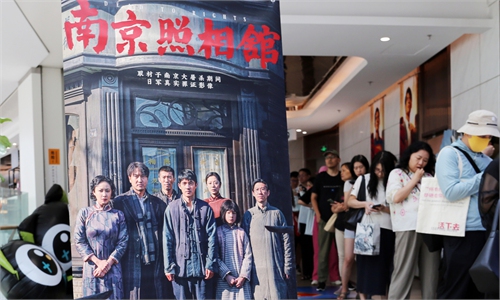
Given that the movie Dead To Rights has been screened in multiple countries and received positive reviews, expectations are high for Evil Unbound to follow in its footsteps and "strengthen global anti-fascist art and build broader cultural consensus," Sun Jiashan, a researcher at the Central Academy of Culture and Tourism Administration, told the Global Times on Sunday.
Across the world, anti-fascist art has shown remarkable resilience and profound depth. From literature and film to painting and music, classic works in every form continue to shine across different eras, added Sun.
2025 marks the 80th anniversary of the victory in the Chinese People's War of Resistance against Japanese Aggression (1931-45) and the World Anti-Fascist War. The release date of Evil Unbound coincides with the anniversary of the September 18 Incident in 1931, which marked the start of Japan's 14-year invasion of China.
According to the film's director, Zhao Linshan, it tells the story of Wang Yongzhang, a local vendor, and others who were imprisoned and lured by false promises of freedom in exchange for cooperation with health checks and disease prevention research, Xinhua News Agency reported.
Instead, they became victims of brutal medical experiments carried out by the occupying Japanese forces - including frostbite testing, gas exposure and vivisection.
Unit 731, a top-secret biological and chemical warfare research base, was established in Harbin, capital of Northeast China's Heilongjiang Province, and served as the nerve center for Japanese biological warfare in China and Southeast Asia during WWII, according to Xinhua.
RELATED ARTICLES