ARTS / CULTURE & LEISURE
The silent symphony of cross-cultural connection
By Published: Sep 15, 2025 11:30 PM

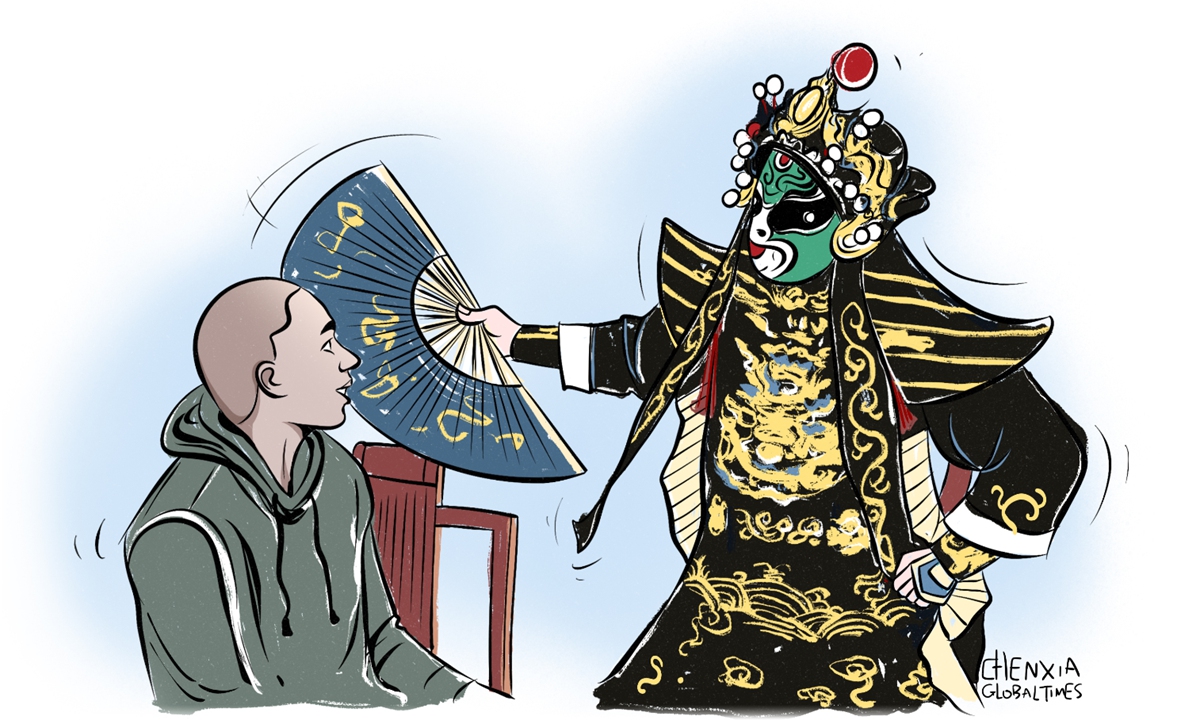
Illustration: Chen Xia/GT
In a world saturated with noise, where words often obscure as much as they reveal, silence can become a universal language. The saying "Silence speaks louder than words" finds a modern champion in Khaby Lame, the TikTok sensation whose wordless humor has captivated 260 million followers across platforms. Known as Wuyu Ge, or "Speechless Brother," to Chinese netizens, Lame recently kicked off a tour of China on September 9. The tour has been more than a viral moment; it's a cultural odyssey that harnesses silence, humor, and authenticity to bridge divides and reshape global perceptions of China. Lame has transformed China's vibrant diversity into a globally resonant narrative, proving that the most profound dialogues often unfold without words.Lame's journey has taken him from Beijing's majestic Forbidden City to Shanghai's tree-lined Wukang Road, from Tianjin's savory snack jianbing guozi to Chongqing's hotpot and Sichuan Opera's mesmerizing mask-changing performances. It has been a masterclass in cultural storytelling. With nothing but expressive gestures and a knack for comedic timing, he captures the pulse of China's urban charm and cultural depth.
His videos - free of narration yet brimming with meaning - translate the quotidian into the universal, turning local experiences into symbols that resonate worldwide. Whether he's exaggerating his awe at a Chongqing street performance or playfully attempting traditional tea-whisking, Lame's silent humor dissolves cultural barriers, inviting viewers to see China not as a distant "other" but as a vibrant tapestry of human connection.
Lame is not alone in this endeavor. He follows in the footsteps of creators like Darren Jason Watkins Jr., known as IShowSpeed or Jiakang Ge to Chinese fans, who has similarly used raw, unfiltered immersion to paint a dynamic portrait of China.
Together, they represent a new wave of foreign content creators exploring the country, leveraging digital platforms to foster people-to-people exchanges in an era defined by decentralized storytelling.
Their work signals a shift in global cultural discourse, where grassroots influencers wield power once reserved for traditional diplomats. By shedding the "tourist filter" and embracing local life with curiosity - sometimes stumbling, often laughing - they craft narratives that are persuasive precisely because they are imperfect.
China, in their eyes, is not a monolithic stereotype but a living, breathing mosaic of individuals, traditions, and modernity.
This phenomenon is particularly striking in the context of long-standing Western stereotypes that have mystified or exoticized the East. Lame's videos, with their focus on everyday moments such as having spicy dishes in Chongqing, or trying the TCM gua sha (scraping therapy) present China as approachable and relatable.
Similarly, IShowSpeed's clips of joining Shanghai's senior citizens in public square dances or tasting fermented soybean milk in Beijing's hutongs sparked cross-cultural resonance through their "culture shock" authenticity. These moments, unscripted and unguarded, dismantle the notion of China as an impenetrable enigma, replacing it with a vision of a nation alive with diversity and vitality.
The impact of these creators extends beyond their immediate audiences. Their content spawns memes, stickers, and viral trends that ripple across social media, creating a digital transmission chain of cultural resonance. Lame's exaggerated expressions in Chongqing or his playful stint as Sun Wukong from popular Chinese video game Black Myth: Wukong in Shanghai have inspired a flood of user-generated content, amplifying China's cultural reach. This viral loop underscores the transformative power of digital platforms, which have democratized global discourse and elevated influencers into "new cultural diplomats." With each post, Lame and his peers reach hundreds of millions, subtly reshaping perceptions of China as a place of warmth, creativity, and openness.
What makes this wave of storytelling particularly compelling is its alignment with the preferences of younger audiences, particularly Gen Z, who crave content that presents "non-instrumental exploration."
Unlike polished travelogues, Lame's and IShowSpeed's videos thrive on unscripted authenticity. When Lame walks a balloon dog through Chongqing's bustling streets or fumbles through a traditional performance, his comedic "failures" resonate because they feel real. This authenticity-driven approach mirrors a broader shift in how global audiences consume culture: They seek stories that are raw, relatable, and rooted in genuine human connection.
The cultural significance of these influencers' China tours transcends entertainment, emerging as a new paradigm for urban image construction. Cities like Chongqing, with its "magical realism" blend of tradition and modernity, or Shanghai, balancing cosmopolitan sophistication with historical depth, are redefined through these digital lenses.
Lame's silent videos capture the rhythm of Chongqing's old streets, where tea-whisking and fire-spitting coexist with the hum of daily life. In Shanghai, his interactions with locals - whether dressed as a mythical hero or simply marveling at the city's skyline - highlight a metropolis that is both global and deeply rooted in local culture. These portrayals collage a three-dimensional China, one that contrasts the charm of Tianjin's pancake stalls with the elegance of Chengdu's hotpot broths.
Lame's tour, in particular, feels like a meticulously crafted "cultural field experiment." Script-free and unpolished, it relies solely on facial expressions and physical gestures to convey the inclusivity and dynamism of Chinese culture. This wordless approach is not a limitation but a strength, allowing Lame to connect with audiences across linguistic and cultural divides. His silence speaks to the universality of human experience, proving that laughter, awe, and curiosity need no translation. In doing so, he unveils a China that is not confined to museum displays or textbook pages but thrums through its streets, markets, and communities.
The author is a reporter with the Global Times. life@globaltimes.com.cn
RELATED ARTICLES