China's per capita grain holdings reach 500 kilograms, food security strengthened during 14th Five-Year Plan period: ministry
Production keeps growing, food security strengthened during 14th Five-Year Plan period
By Published: Sep 16, 2025 01:30 PM

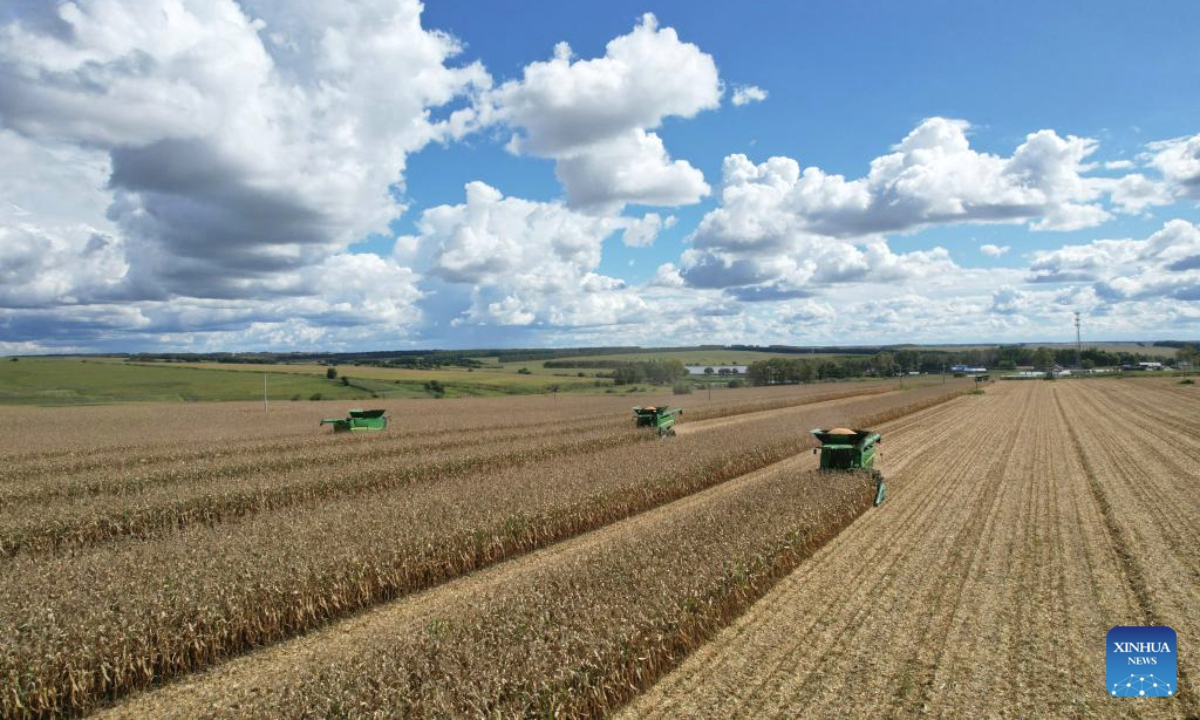
A drone photo shows harvesters working in a farm under Beidahuang Group in northeast China's Heilongjiang Province, Sept. 10, 2025. (Photo by Xu Yingxian/Xinhua)
China's per capita grain holdings have reached 500 kilograms as grain output continues to ramp up to new heights during the 14th Five-Year Plan (2021-25) period, according to the Ministry of Agriculture and Rural Affairs on Tuesday.
China's grain production for the first time exceeded 1.4 trillion jin (700 million tons) in 2024, an increase of 74 billion jin compared with 2020, Chinese agricultural officials said at a State Council press conference on achievements in the agricultural sector during the past five years.
The achievement demonstrates the country's ability to meet its own grain needs, a result of years of improvements in agricultural infrastructure and maintaining farmland area above a critical level, Chinese analysts said.
The improvement in volume was accompanied by the improved structure of agricultural produce, with a rise in domestic production for items largely reliant on imports. China's soybean production reached 20.65 million tons in 2024, with the self-sufficiency rate increasing by 4.0 percentage points compared with 2020, Minister of Agriculture and Rural Affairs Han Jun said at the press conference. The self-sufficiency rate of edible oil was raised by nearly 5.0 percentage points.
"With basic self-sufficiency in grain and absolute food security achieved, national food security is fully guaranteed. Furthermore, cotton, oil, and sugar production capacity continues to increase, and the supply of fruits, vegetables, tea, meat, eggs, milk, and aquatic products is sufficient and diverse. It can be said that the food on our people's tables is becoming increasingly abundant," Han said.
In recent years, China has enhanced efforts in protecting and developing arable land, as well as stabilizing sowing land. The country also spent more efforts in tapping science and technology to support modernization in the agricultural sector.
China developed more than 1 billion mu (about 66.7 million hectares) of high-standard farmland during the period, while the contribution rate of China's agricultural science and technology progress has reached 63.2 percent, Han said.
During the period, China's overall level of agricultural science and technology innovation has now reached globally leading status, said Zhang Xingwang, vice-minister of agriculture and rural affairs.
A number of key plant and animal varieties urgently needed for production have been developed, including high-quality, high-yield rice, water-saving and disease-resistant wheat, corn that can be harvested by machines, and high-oil, high-yield soybeans, Zhang said.
Domestically bred varieties now account for more than 95 percent of crop area, ensuring that "Chinese grain" is primarily produced with "Chinese seeds." Domestically bred varieties such as white-feathered broilers, Huaxi cattle, and whiteleg shrimp have broken foreign monopolies and continued to increase their market share, noted Zhang.
Apart from safeguarding national food security, the country also keeps working to consolidate and expand its achievements in poverty alleviation, prevent people from falling back into poverty and ensure that no large-scale return to poverty occurs.
According to minister Han, since 2021, cumulative funding for rural revitalization has reached 850.5 billion yuan, further uplifting infrastructure and public services in areas like transportation, water conservancy, telecommunications, education, health, and culture and assisting high-quality economic and social development in key areas of rural revitalization.
Zhou Li, a professor at the School of Agriculture Economics and Rural Development at Renmin University of China in Beijing, told the Global Times on Tuesday that from alleviating poverty to advancing all-around rural revitalization, the Chinese agricultural landscape has seen vast institutional changes and improvements during the past five years.
"Meanwhile, the achievement in grain production and the utilization of science and technologies continue to build on previous successes and scale up to new heights," Zhou said.
China secured a steady summer grain harvest in 2025, with various types of grain operators across the country procuring more than 100 million tons of wheat, CCTV News reported on Sunday, citing official data.
China secured a steady summer grain harvest in 2025, with a total output reaching about 149.74 million tons, official data showed.
RELATED ARTICLES