ARTS / CULTURE & LEISURE
What 2025 taught Chinese football so far
Illustration: Chen Xia/GT
The Chinese Football Association (CFA) set out ambitious goals at the beginning of 2025 for the Chinese men's national football teams, placing hopes on four targets to demonstrate progress. However, as of September only one of those targets has been achieved: The U22 team succeeded in qualifying for the U23 Asian Cup.As to the remaining goals - the senior team's qualification for the World Cup Asian qualifying fourth-round stage, U20's dream of reaching the U20 World Cup, U17's aim of making the U17 World Cup - the failures were stark. This mixed outcome offers both warning signs and cautious hope for China's football future.
On the one hand, the failure of the senior team to advance from the Asian qualifying fourth round after finishing in fifth place in the six-team group, underlines how far Chinese football still has to go at the top level. The elimination was sealed after a 1-0 away game defeat to Indonesia in June, which left their final home match meaningless. Even with 18-year-old prodigy Wang Yudong converting a stoppage-time penalty to net his first goal for the senior national team, the result was largely symbolic given the team's elimination.
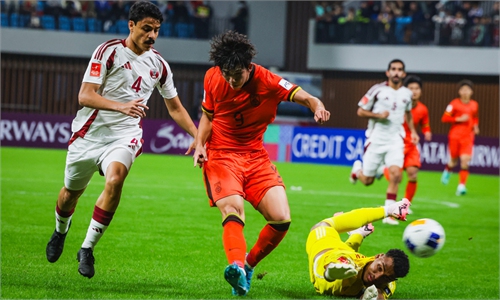
The U20 side, despite the home advantage for the U20 Asian Cup, was eliminated in the quarterfinals after first dominating in the match against Saudi Arabia but succumbing eventually in injury time to a goal. That loss denied the team's opportunity of reaching the U20 World Cup.
The U17 team fared worse. At the U17 Asian Cup group stage, they suffered straight defeats in the first two matches to hosts Saudi Arabia, then Uzbekistan. That meant no advance beyond the group stage, and no qualification for the U17 World Cup. Yet the U22 team at least offered a platform to build on by qualifying for the U23 Asian Cup, modest progress, but progress nonetheless.
So what lessons emerge from this mixed bag?
First, the senior team still lacks consistency, mental toughness in "big" moments, and perhaps the depth of talent to compete across Asia at a high level. The failures of the U20 and U17 teams also suggest that sheer numbers or domestic training do not equate to readiness for knockout matches, especially when physical and mental demands increase in the later stages of tournaments. The reversal losses, especially those conceding late goals, underscore the need for better game management, fitness and exposure to high-pressure environments. Fans and media have repeatedly pointed out that the team's intensity faded after the 60th minute, with lapses in defensive concentration proving costly.
Second, the fact that the U22 goal is the only target met should not lead to complacency. Qualifying is not the same as competing at the final tournament level. The successful qualification shows the structure, coaching, and individual development at the U22 level is beginning to yield returns. However, the gap between qualifying and succeeding at the senior level remains wide. Even among the youth, the difference between being good and being able to win in tight knockout or final-group matches has not yet been bridged.
Third, the emergence of specific players who have moved up through youth ranks into the senior set-up suggests that the youth pipeline is working - at least partially. Players like 18-year-old winger Wang, who is also the domestic top scorer in the Chinese Super League, 22-year-old forward Baihelamu Abuduwaili, and defender Hu Hetao have proven in matches that they can bear the responsibility that lies on their shoulders. What matters going forward is ensuring that those players continue to develop, that they play regularly, whether in the domestic league or abroad, that they get match time in high-stakes games, and that their progress is not arrested by lack of opportunities or by poor management of their potential.
Fourth, international exposure matters more than ever. The U20 and U17 teams clearly suffered in matches with higher pressure or adversity. Their domestic tournaments, friendly games, training camps may be plenty, but they are not always enough. When they face sudden adversity, conceding late, defending leads, handling unfamiliar playing conditions, adjusting to pace, altitude, or very different tactical styles, the gaps reveal themselves. Thankfully, this week several young Chinese players are going to experience the intensity of the Asian Champions League matches, which will ultimately help their development.
Finally, for young players, the importance of choosing whether to stay in the domestic league or move abroad is still paramount. What matters more than where the player plays is how often he plays, in what conditions, and with what support. One early senior goal or call-up is good, but unless it brings exposure to tougher challenges, there is a risk of stagnation. Similarly, competitions like the National Games, youth leagues, while useful, need to be complemented by more international exposure.
For Chinese football, the 2025 season will be remembered less as a year of success than as a year of painful lessons. If the setbacks of the youth teams spark reform and if the next generation is nurtured with patience and international exposure, the gap with Asia's elite can still be narrowed. The road is long, but not hopeless.
The author is a reporter with the Global Times. life@globaltimes.com.cn
RELATED ARTICLES