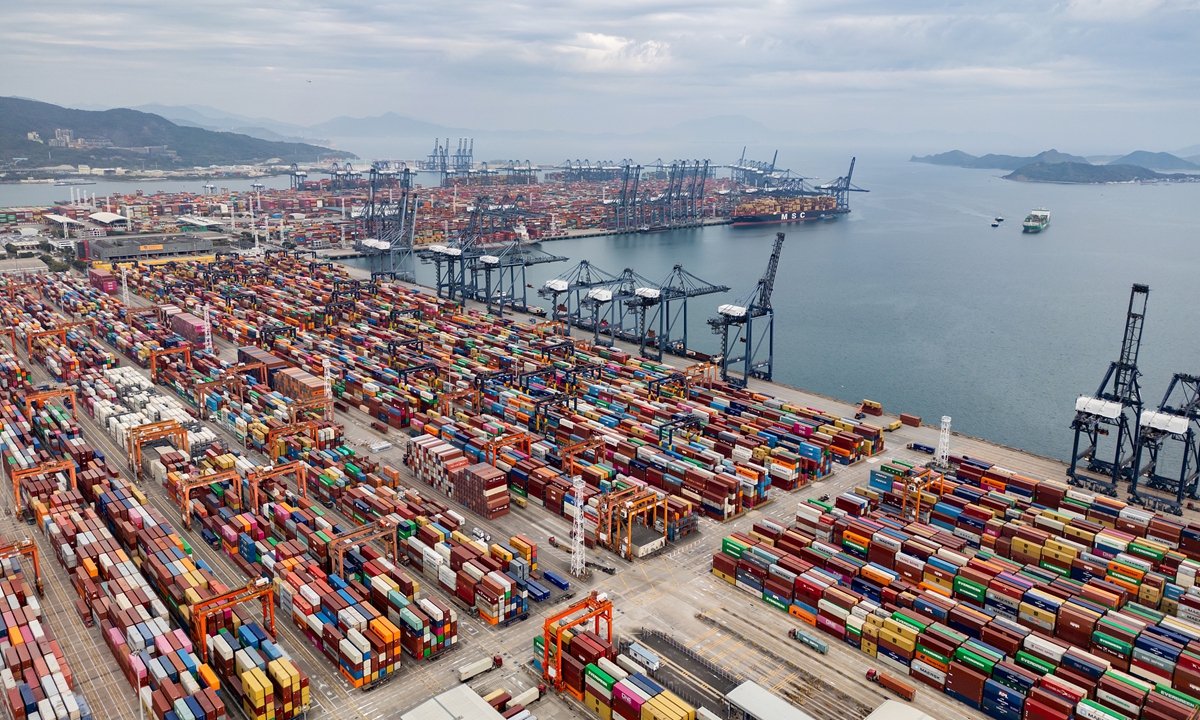
File photo: VCG
The US has increasingly viewed China's growing influence in the global maritime sector as a challenge, yet its focus on geopolitical rivalry and pursuit of control through the lens of containment lays bare the limitations and backwardness of its strategy and underscores a stark disconnect between its zero-sum mindset and the needs of maritime trade.The US government is on a mission to weaken China's global network of ports and bring more strategic terminals under Western control, Reuters reported on Tuesday, citing three sources familiar with the plan. Options the White House is considering include supporting private US or Western firms to buy Chinese stakes in ports, the three people said.
The news emerged at a time when the US has been hyping China's influence in global ports, a trend that seemingly reflects its anxiety. Yet, what Washington has consistently failed to recognize is that China's port development aims to serve economic and trade activities, functioning as an engine that drives growth for local economies and global trade at large. This is the fundamental difference from Washington's focus on geopolitical influence.
China's global port layout has evolved into a network system deeply integrated with global trade and centered on win-win cooperation. Geographically, Chinese investments have covered ports along major trade routes and critical nodes. In Asia, ports such as Hambantota in Sri Lanka and Gwadar in Pakistan have enhanced regional connectivity. In Europe, the Port of Piraeus in Greece has become one of the busiest ports in the Mediterranean. In Latin America, China's port cooperation with countries like Peru continues to deepen regional trade ties. These ports form a closely knit network that boosts global economic integration, fostering a virtuous cycle where port operations stimulate trade, and trade fuels economic growth.
At the heart of China's port strategy lies a focus on enabling trade and promoting regional development. These ports are not merely physical transportation nodes but also core parts sustaining the stable development of global trade and supply chains.
When operating overseas ports, Chinese enterprises often invest heavily in upgrading infrastructure and improving throughput efficiency while also prioritizing the development of local economies.
In contrast, the US approach to global ports remains centered on capital acquisition. Backed by the US government, a number of US capital groups are accelerating their global port acquisition plans. For instance, in 2024, BlackRock acquired Global Infrastructure Partners (GIP) for $12.5 billion. Given that GIP held equity stakes in multiple port terminals, this acquisition enabled BlackRock to indirectly hold shares in more than 70 ports worldwide, according to the Xinhua News Agency.
Yet, all these efforts serve the US geopolitical goal of suppressing its competitors. As the US vies for control of ports, it also steps up efforts to crack down on China's maritime industries, including by attempts to erode China's technological edge in the field of port machinery manufacturing and to charge Chinese-built or Chinese-flagged vessels with fees for calling at US ports. Such moves further reveal that US actions in the global port sector are never purely economic, but are driven by narrow geopolitical calculations to maintain its hegemony.
If the US attempts to use these port investments to "politicize" or even split the global trade chain, it will ultimately undermine the operational logic of trade. Imposing unilateral rules in its port networks solely to contain China will only raise trade barriers and costs, harming all parties involved, including the US itself. This reflects a fundamental flaw in Washington's China strategy: its pursuit of a "win-lose" outcome will only lead to a lose-lose situation. The ultimate goal of US capital investment in ports is profitability, but within the framework of a zero-sum game, the space for profit will only continue to shrink.
For China, the key next step is to further unlock the value of existing ports and trade networks, enhance economic synergy with countries along these networks, and enable more nations and regions to benefit from this interconnected structure. This requires not only advancing the construction of physical facilities but also making sustained efforts in areas of soft connectivity such as trade facilitation, coordination of rules and standards, and digital customs clearance, so that the dividends of cooperation can benefit a wider range of participants.
The vitality of international port operations and maritime trade stems from efficiency improvements and shared development opportunities, not from any country's strategic rivalry. This is why China's port strategy has gained broad recognition and why America's tactics against China's maritime sector are doomed to fail.
RELATED ARTICLES