ARTS / ART
New finds made at Hualongdong in Anhui, key site for E.Asia’s human evolution
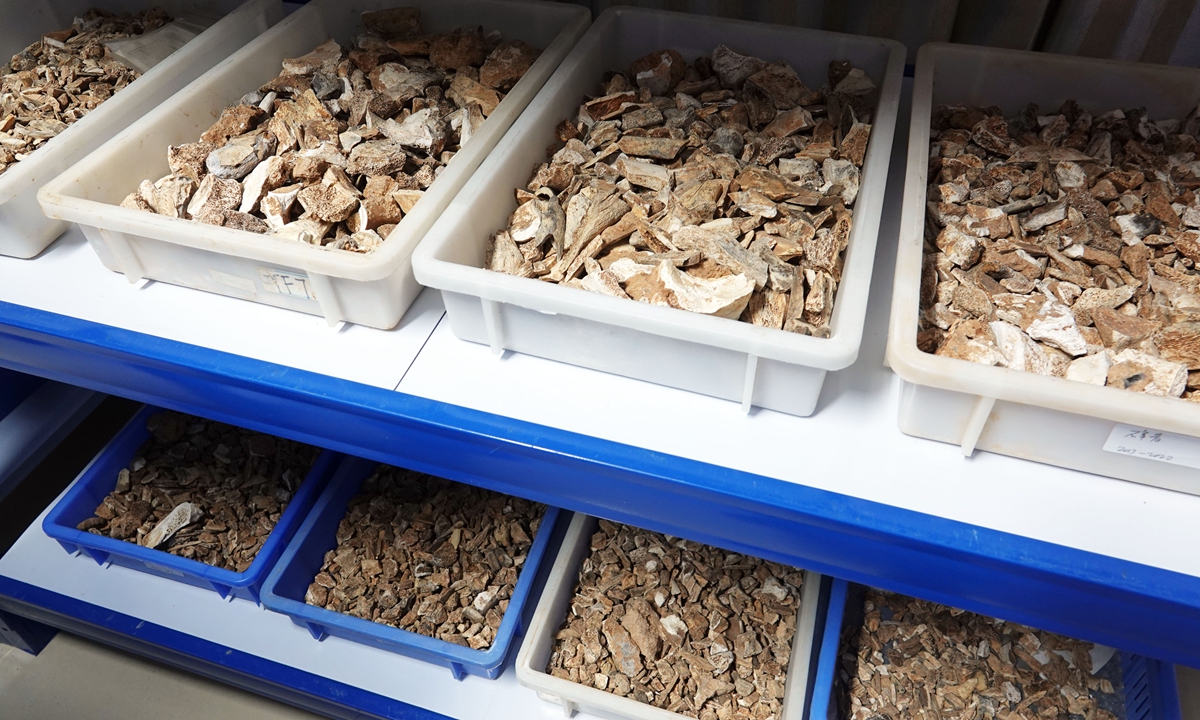
Fragments of fossils unearthed from the Hualongdong ruin, a key site to showcase East Asia's human evolution in China's Anhui Province. Photo: IC
Located in East China's Anhui Province, the Hualongdong site, a key archaeological site for exploring the human evolution in the East Asia, recently started a new phase of excavations.The new round of excavation covers 85 square meters. Although the project has just begun, new discoveries have already been made at the site. These findings include fossils of small mammals. By studying the extracted cemented sediments, archaeologists have uncovered a relatively complete skull of an axis deer, also known as spotted deer. The jawbone of a wild boar and the skull of a large porcupine have also been unearthed from the site.
Wu Xiujie, an expert paleontologist involved in the excavations, said that given the animal remains, the site is also rich with fragments of stone tools and the remains associated with the "Dongzhi people."
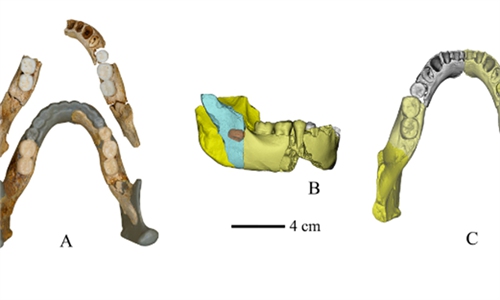
The "Dongzhi people" refers to a type of late Middle Pleistocene human who inhabited and thrived around the Hualongdong site approximately 300,000 years ago. Their physical characteristics exhibit features intermediate between Homo erectus and modern humans, making them a transitional hominin group from archaic to modern humans. They were named "Dongzhi people" due to the Hualongdong site being located in Dongzhi county, Anhui Province.
"As a transitional hominin species, the Dongzhi people had already begun to develop physical features that carry similarities to modern humans, such as a flatter facial profile," paleontologist Zou Hesi told the Global Times.
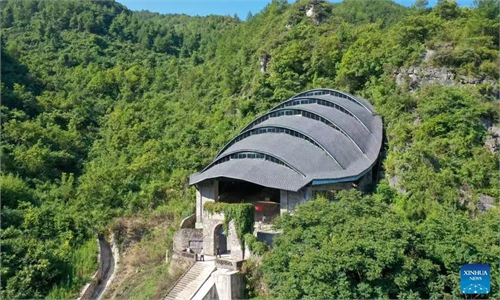
This round of archaeological excavation is scheduled to run from September to the end of November. At the eastern part of the site, a fossil cleaning area has been established. This was used by on-site experts to carry out tasks such as the washing, examining and recording of relics. Large cemented sediment blocks extracted from the site, along with other unearthed fossils, have also been transferred to a nearby museum for cleaning and further research.
To better support on-site archaeological works, a mobile fossil restoration lab has also been set up. The lab is equipped with specialized devices such as high-precision microscopes, enabling delicate restoration and reinforcement of tiny fossil fragments.
"We refer to such facilities as 'mobile archaeological modules.' The greatest advantage of these devices is that they minimize the exposure of precious cultural relics to the external environment, allowing for immediate protection and treatment at the excavation site," archaeologist Chen Hurong told the Global Times. He also adds that for sites containing ancient human remains, such devices assist experts "in organizing and labeling fragmented bone fossils," helping later research and reconstruction.
Prior to the 2025 excavation, the Hualongdong site had undergone several excavations since its initial discovery in 1988. The first formal excavation took place in 2006. Since 2014, remains of approximately 20 ancient human individuals, over 400 stone tools, and more than 80 species of vertebrate fossils have been unearthed at the site.
A milestone for the site's excavation was in 2015, when a relatively complete human skull fossil was unearthed. The skull was later found to belong to a 13-year-old female, and was named "Dongzhi girl." Using digital 3D facial reconstruction technology, researchers discovered that this female had higher eye sockets and a more delicate skull structure, and a chin-like formation appeared on her face. These features significantly differed from those of archaic humans.
"A hominin fossil exhibiting such a multitude of modern human facial features has never been found before in the fossil records of the same period in China, or even in East Asia," Wu noted.
Archaeological wonders at the site continue to emerge. In 2024, 11 ancient human fossils — including one well-preserved complete metatarsal bone — over 40 stone artifacts, a large number of mammalian fossils, and three types of reptile fossils were unearthed.
Such discoveries have made the Hualongdong site the most significant Middle-to-Late Pleistocene hominin site discovered in China following the discovery of Peking Man at the Zhoukoudian site.
Noting that the site provides tangible evidence of human evolution in China and the East Asia, paleoanthropologist Liu Wu said that the Hualongdong site demonstrates that the evolution of Homo sapiens in East Asia was the result of "continuous genetic exchange and integration," rather than stemming from a single African population.
To better promote the Hualongdong archaeological heritage, the site was designated as a provincial-level archaeological park in 2025. The park encompasses not only the excavation area, but also exhibition and public education facilities.
The new archaeological park also engages in cross-sector collaboration with tourism and cultural creative industries to transform resources under the ground into new intellectual properties (IPs). For example, the image of the unearthed "Dongzhi Girl" fossil has already been developed into a creative IP, inspiring products such as refrigerator magnets and keychains.
RELATED ARTICLES