ARTS / CULTURE & LEISURE
Seeds of progress planted for football clubs despite sobering results in AFC Champions League
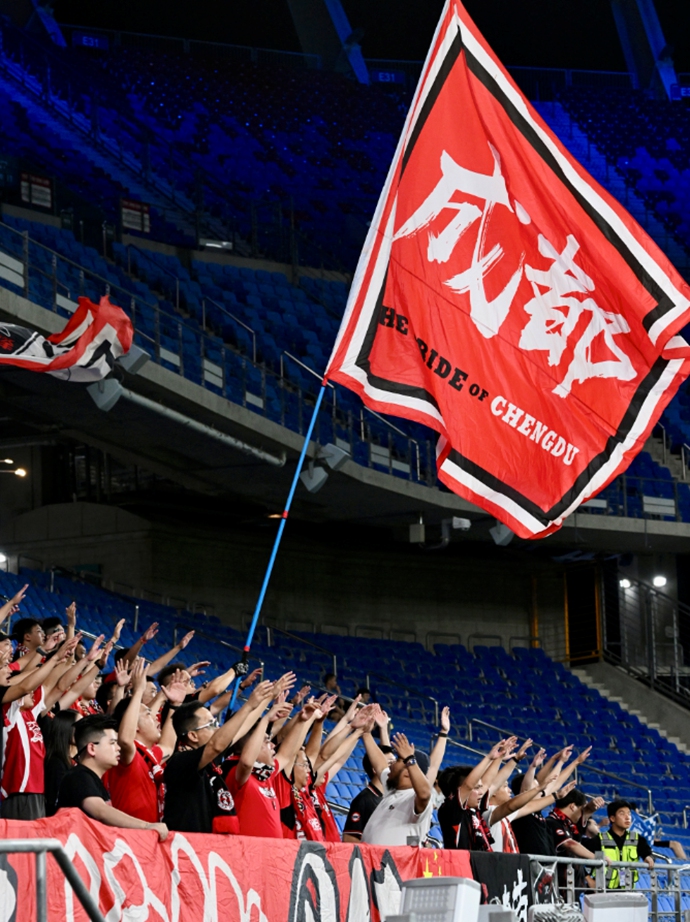
Supporters of Chengdu Rongcheng cheer for the team during the AFC Champions League Elite match against Ulsan HD in Ulsan, South Korea on September 17, 2025. Photo: VCG
All three Chinese Super League (CSL) sides suffered setbacks during the opening round of the AFC (Asian Football Confederation) Champions League Elite. While the results are sobering, they highlight the long-term challenges and opportunities that come with balancing domestic league title races and international competition.Champions League debutants Chengdu Rongcheng fell 1-2 to Ulsan HD of South Korea due to a last-minute goal on Wednesday night while Shanghai Port were downed 0-3 by Vissel Kobe of Japan. Earlier, Shanghai Shenhua were handed a 1-2 away defeat to Gangwon FC of South Korea.
In the AFC Champions League Two match at home in Beijing, CSL team Beijing Guoan were held to a 2-2 draw by Vietnam's Cong An Hanoi FC on Thursday night.
Although both Shanghai sides opted for squad rotations in light of the intensified title race for CSL, the opening round still laid bare the gap between Chinese clubs and their South Korean and Japanese counterparts, especially the performances of domestic players, Liu Yu, a Beijing-based sports commentator, told the Global Times.
In international matches defined by higher intensity, physical confrontation, and tactical discipline than the domestic league, Chinese players often find it difficult to match the consistency, pace, and decision-making of their South Korean and Japanese peers. The squad rotation offered young Chinese players a golden opportunity to gain valuable experience, which is beneficial for the youth development of Chinese football over the long run, Liu noted.
Over this upcoming weekend, two blockbuster clashes could largely shape the trajectory of the 2025 CSL championship race. Third-placed Shanghai Shenhua will host current leaders Chengdu, while Beijing Guoan is to face off against second-placed Shanghai Port at home. Fourth-placed Beijing sits just five points behind the leaders Chengdu.
Saving energy for the crucial clash, Shanghai Shenhua made sweeping changes to their starting lineup against Gangwon. Compared with the previous CSL round, the team replaced as many as eight starters, with only one foreign player, striker Joao Teixeira, going to South Korea with the team. But 18-year-old defender Wu Qipeng made his first appearance for the club, while young players such as Liu Chengyu, Jin Shunkai, and Wang Shilong were handed starting opportunities.
With the away match against Beijing looming on Sunday, domestic defending champions Shanghai Port opted for the same rotation strategy against Vissel Kobe by resting some key players.
Defeats in Asia's top club competition are a costly but necessary part of development. For CSL teams, the short-term sting of losses must be weighed against the long-term gains: the growth of young players, the delicate act of rotating squads amid intense league title races, and the chance to test tactical adaptability against higher-caliber opponents.
These matches provide vital lessons that cannot be replicated during training. If Chinese football is serious about building a sustainable future, clubs must continue to expose young players to these challenges, even if it means paying "tuition fees" in the form of early setbacks.
The South Korean and Japanese sides are also fighting on two fronts of domestic and continental competitions, facing the same challenges of balancing squad options.
Despite being newcomers and playing on the road, Chengdu made a statement showing their commitment by fielding the best possible lineup against South Korea's Ulsan HD. De Erjiaduo's strike delivered the club's first-ever Champions League goal but he was sent off in the end of regular time. The opponents managed to steal a win in stoppage time.
Under the tutelage of South Korean coach Seo Jung-won, Chengdu was the better side right from the outset and fought toe-to-toe with one of South Korea's strong sides. More importantly, Rongcheng's attacking creativity and fighting spirit provided a refreshing blueprint for how CSL clubs might confront South Korean and Japanese opponents in future fixtures. For a debutant, this was less a failure than a statement of intent.
Chengdu's debut wasn't just a loss - it was a valuable first step. They proved they can compete at the Champions League level, but the match also underlined the importance of discipline, stamina, and experience if they want to grow into a serious continental contender.
These early tests in the AFC Champions League reveal both the scale of the challenge and the seeds of progress. The gap with regional heavyweights remains clear, but it will only be bridged through consistent exposure, steady squad building, and the courage to prioritize long-term growth over short-term glory. The CSL's pursuit of league titles must not blind clubs to the importance of international experience. If Chinese football aims for higher accomplishments, patience and persistence will be just as important as immediate results.
The author is a reporter with the Global Times. life@globaltimes.com.cn
RELATED ARTICLES