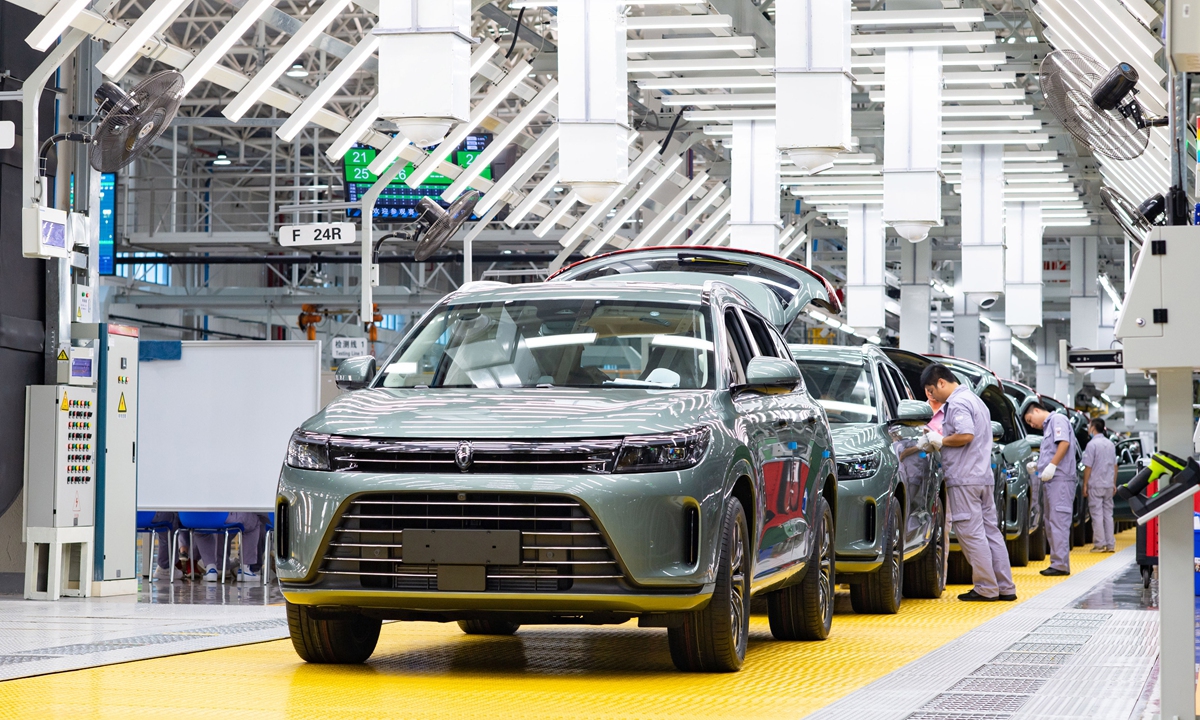
An NEV manufacturing line in Southwest China's Chongqing Municipality Photo: VCG
There have been reports and discussions about the preliminary talks between General Motors (GM) and China's SAIC Motor Corp over the renewal of their longtime joint venture. A Bloomberg report on Wednesday said that it signals the US automaker's budding optimism about its business in the Chinese market.While details of the situation remain undisclosed and unclear, the reported talks have again drawn public attention to GM's performance in the Chinese market. This automaker reported $116 million in profit as of Wednesday after suffering losses in China in 2024, according to Bloomberg. This positive shift has drawn market discussion.
Specifically, GM's China sales grew in the first half, including a 20 percent jump in the second quarter to 447,000 vehicles. Deliveries of brands such as Buick and Cadillac in China grew nearly 30 percent in the first eight months of this year, while its lower-priced Wuling joint venture saw sales surge 37 percent in the same period, according to the report.
While the rapid rise of local Chinese automakers has intensified competition, the vast scale and continuously upgrading appetite of the Chinese vehicle market still provide a broad stage for all participants willing to adapt and innovate. By actively integrating into the development trend of China's car industry, foreign automakers can still unlock enormous potential for growth.
China's car market has entered a new phase centered on green development, with energy-efficient and new-energy vehicle (NEV) models becoming the mainstream. This transformation is a structural reshaping driven by both consumption upgrading and industrial policies, and it harbors unprecedented new opportunities. The Chinese government has vigorously promoted green and low-carbon development, establishing clear strategic guidance and a comprehensive policy support system for the NEV industry. This stable and proactive policy environment has created broad development prospects for all companies, including foreign automakers.
It is precisely because of the dividends brought by China's green transformation that more and more international automakers have accelerated the adjustment of their layouts in China, demonstrating their emphasis on the Chinese market through concrete actions. For instance, Volkswagen built and expanded a research and development (R&D) center in Hefei, capital of East China's Anhui Province, that will facilitate R&D work on NEV platforms, complete vehicles, parts and components, as well as hardware and software integration and testing, the Xinhua News Agency reported in May 2024.
At a time when the global vehicle market is experiencing slowing growth and manufacturers are under pressure, foreign automakers wishing to achieve sustained success in the Chinese market require the ability to truly adapt by implementing localized innovation. The days are over when foreign automakers could easily dominate the market and reap profits relying on brand reputation and technological advantages. Now Chinese consumers have increasingly diverse and personalized requirements for their cars.
They not only pay attention to performance and quality but also value intelligent connectivity features, localized services, and adaptability to usage scenarios. This requires foreign automakers to establish R&D systems that are more closely connected to the Chinese market, and launch products and services that better align with local demand and meet intelligent needs.
From a broader perspective, the appeal of the Chinese auto market lies in its unique ecology and unparalleled development opportunities. China's support policies for NEVs are characterized by continuity and stability, alleviating concerns for long-term planning by foreign companies. Chinese consumers are at the global forefront in their expectations for intelligent vehicles, prompting automakers to accelerate technological innovation.
The development potential for foreign automakers in China will not diminish due to market competition. The opportunity has already been deeply embedded within China's high-quality development process, closely linked to industrial upgrading, green transformation, and consumption upgrading.
Whether this potential can be unleashed lies in the hands of the carmakers themselves. Can they advance deeper localization? Can they respond swiftly to the evolving demands of Chinese consumers? More importantly, do they have an open mindset to engage in technological innovation and collaboration with Chinese industrial chain partners? For those foreign automakers willing to actively integrate and embrace change, the Chinese market will always be full of opportunities.
RELATED ARTICLES