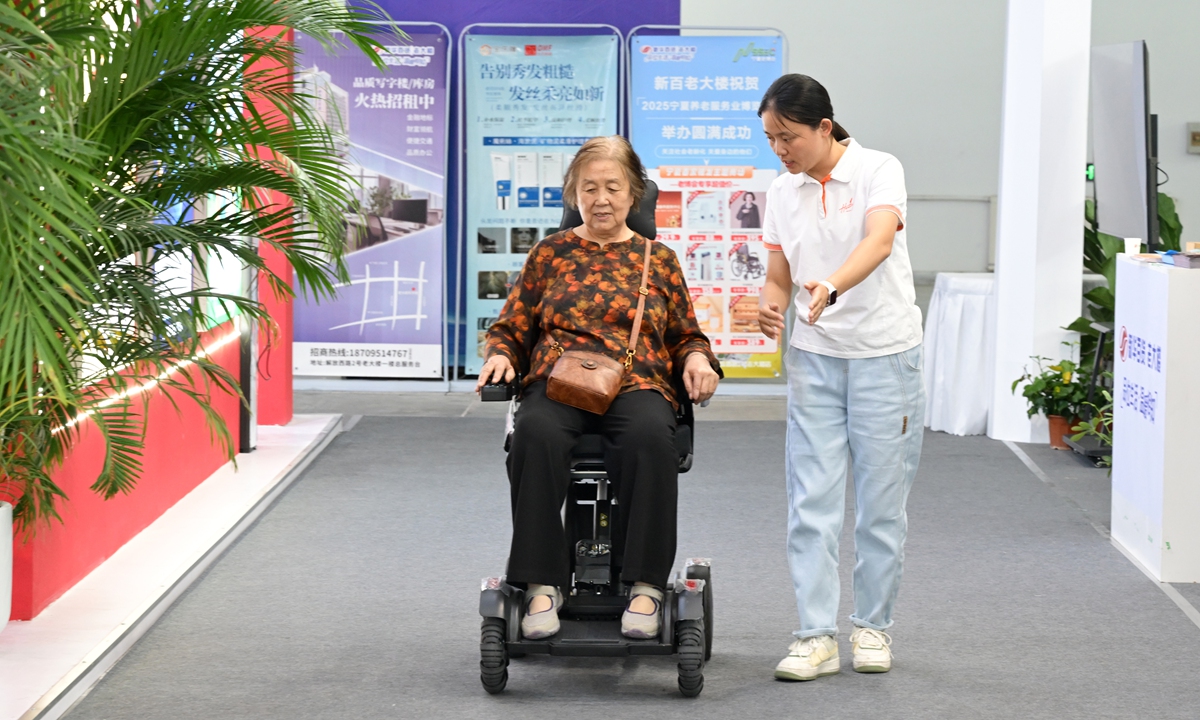
An elder tries out a assistive devices at the 2025 Ningxia Senior Service Expo & Conference on September 14, 2025. Photo: VCG
In recent years, the elderly services sector has increasingly become an important part of the silver economy. In the first half of this year, revenue from elderly tourist services grew by 26.2 percent year-on-year, signaling a shift in the silver population from simply "aging well" to actively "enjoying aging." And, the rapid rise of educational tourism for the elderly is emerging as a new blue ocean.
This new retirement lifestyle, centered on "learning while traveling," has become an example of how Chinese elderly people are enriching their lives in retirement. To put it in perspective, elderly tourism is undergoing a profound transformation - from traditional sightseeing to in-depth experiences.
Educational tourism refers to a specialized form of travel designed to broaden travelers' horizons, enrich their life experiences, and enhance their knowledge and skills. For the elderly, this model breaks the limitations of traditional sightseeing.
On the one hand, it allows senior tourism to go beyond sightseeing and leisure vacationing, enabling travelers to gain new knowledge and skills during the journey - such as intangible cultural heritage crafts, calligraphy and painting and more. On the other hand, elderly educational tourism helps participants alleviate feelings of loneliness and isolation through social interactions with fellow travelers.
For the tourism industry, the rise of elderly educational tourism places higher demands on the sector, pushing market players to accelerate their transformation and focus more on quality, customization, and refinement of their products.
For example, some travel agencies have designed "traditional Chinese medicine wellness routes" that not only include professional physicians to explain health knowledge, but also tailor activity intensity to participants' health conditions.
And, the higher demands of elderly educational tourism for safety and service standards have, indirectly, promoted improvements in the public tourism service system, accelerating the standardization of safety and service protocols.
Many local cultural and tourism authorities, responding to market changes, have begun establishing service standards for elderly educational tourism, specifying instructor qualifications and emergency response procedures, and even integrating health assessments into their registration procedures.
Objectively, beneath the booming market of elderly educational tourism, some issues still exist. To further elevate elderly educational tourism toward the high-end segment, coordinated efforts are needed on improving the policy guidelines and for tourism enterprises to address market bottlenecks.
Regarding the policies, it is essential to accelerate the development of specialized industry standards and regulations. It is necessary to specify core requirements such as curriculum design, instructor qualifications, and medical safeguards for the elderly.
At the same time, market supervision measures should be strengthened, resolutely cracking down on "fake educational tours" and "low-price traps," and using mechanisms like credit ratings and product registration to protect the consumption rights of elderly people.
As to tourism enterprises, the focus should be on their services innovation and upgrading to reach the high-end segment. Since elderly educational tourism combines unique travel experiences with educational functions, efforts should be made to meet elderly people's pursuit of knowledge and good quality of life.
Moreover, teaching methods should be diverse, emphasizing hands-on experience and interaction, with elderly service providers earning certificates for managing some challenging tasks.
The author is a professor and director of the Tourism Research Center, Capital University of Economics and Business. bizopinion@globaltimes.com.cn
RELATED ARTICLES