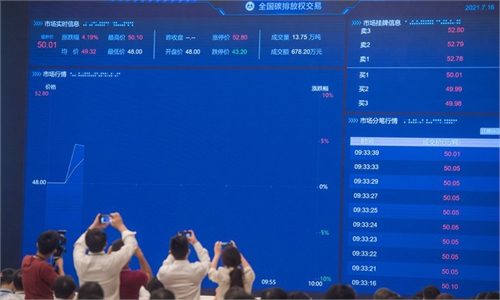
China’s carbon emission trading market world’s largest: minister
Nation plays a key role in global climate governance
By Published: Sep 19, 2025 10:42 PM

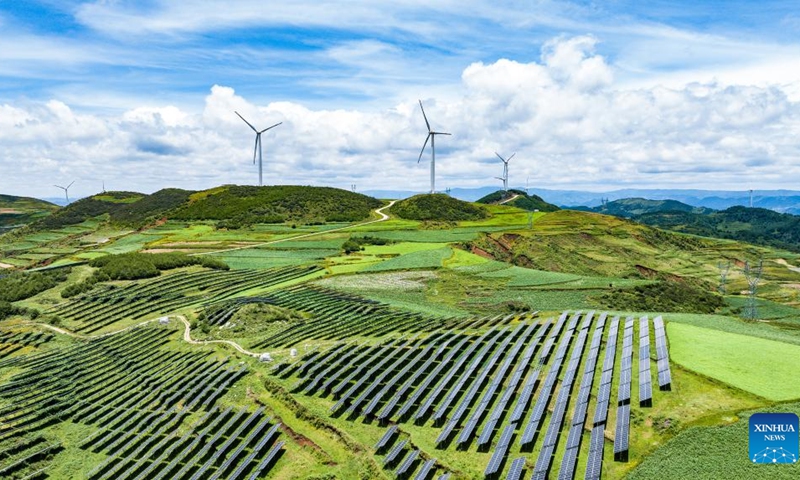
An aerial drone photo taken on July 3, 2025 shows a solar power station for agricultural use in the Yi-Hui-Miao Autonomous County of Weining, southwest China's Guizhou Province. (Photo: Xinhua)
Chinese officials highlighted the government's efforts to address climate change on Friday, saying that China has always played a key role in global climate governance.
China has built the world's largest carbon emission trading market during the 14th Five-Year Plan period (2021-25), which is now operating stably, said Huang Runqiu, minister of ecology and environment, highlighting that the endogenous driving force and innovative vitality of green development have been improved.
Huang made the remarks at a press conference to reveal the ecological environment achievements during the period, and he noted that the market covers over 60 percent of China's carbon emissions.
As of Thursday, the cumulative trading volume of the national carbon emissions trading market has reached 714 million tons, Huang said, adding that the cumulative trading volume has reached 48.961 billion yuan ($6.88 billion). The standardization, accuracy and timeliness of carbon emission data statistics and accounting have been greatly improved, he added.
"The national carbon market has achieved a steady start and stable operation, and has become a powerful measure to achieve peak carbon and carbon neutrality. It's a beautiful business card for China's active response to climate change," Huang said.
The Chinese government is taking concrete measures to promote the all-round construction of a low-carbon development framework, including the establishment of the carbon emission trading market, Lin Boqiang, Dean of China Institute for Studies in Energy Policy at Xiamen University, told the Global Times on Friday.
China has the world's largest energy production and consumption system, and the rising proportion of clean energy such as wind power has played an important part in China's green energy progress, Lin added.
According to Huang, China led the development of a product carbon footprint management system. This included the release of over 100 carbon footprint accounting standards, and the launch of the national greenhouse gas emission factor database, which filled a domestic data gap.
China regularly publishes national electricity carbon footprint data and has promoted the international integration and mutual recognition of carbon footprint rules and standards, Huang added. It also helps businesses to proactively address international carbon-related trade barriers.
Guo Fang, vice minister of ecology and environment, also highlighted the efforts made by the Chinese government in global climate governance.
The nation is committed to being a provider of green technology and has achieved numerous innovative results in its green transformation, Guo said. China has also shared these achievements globally, she noted, injecting strong momentum into the world's green development.
Over the past decade, China has provided ultra-low emission steel transformation technologies and standards to numerous countries, helping them achieve clean, low-carbon transformation.
In the UAE desert, Chinese companies have installed zero-energy cooling systems, reducing building energy consumption by 70 percent. In South Africa, a tower-type lava solar thermal power station built by Chinese companies is the largest renewable energy project in the region, generating approximately 480 gWh style of clean electricity annually, Guo added.
China has always played a key role as a stabilizer and promoter of global climate governance, Guo added.
The Xinhua News Agency reported on Friday that since China launched its national carbon emission trading market in July 2021, the platform has evolved into the world's largest, based on the amount of greenhouse gas emissions traded.
Carbon emissions trading, which allows the buying and selling of permits to emit carbon dioxide or other greenhouse gases, is regarded as one of the critical tools to help reduce carbon footprints and meet emissions targets.
In August of this year, China released a guideline to accelerate the country's green, low-carbon transition and strengthen the national carbon trading market.
The guideline outlines a clear roadmap, saying that by 2027, the carbon trading market will expand to cover all major industrial sectors, and the national voluntary greenhouse gas emission reduction trading market will expand to include all key fields.
By 2030, China will have essentially established a national carbon trading market based on a cap-and-trade system with both free and paid allocations. The year will also see the completed construction of a national voluntary greenhouse gas emission reduction trading market that is credible, transparent, standardized, broadly participatory, and aligned with international standards.
RELATED ARTICLES