New $100,000 fee for H-1B visas in US goes into effect, raises widespread concerns
By and Zhang Han Published: Sep 21, 2025 09:27 AM Updated: Sep 21, 2025 12:59 PM

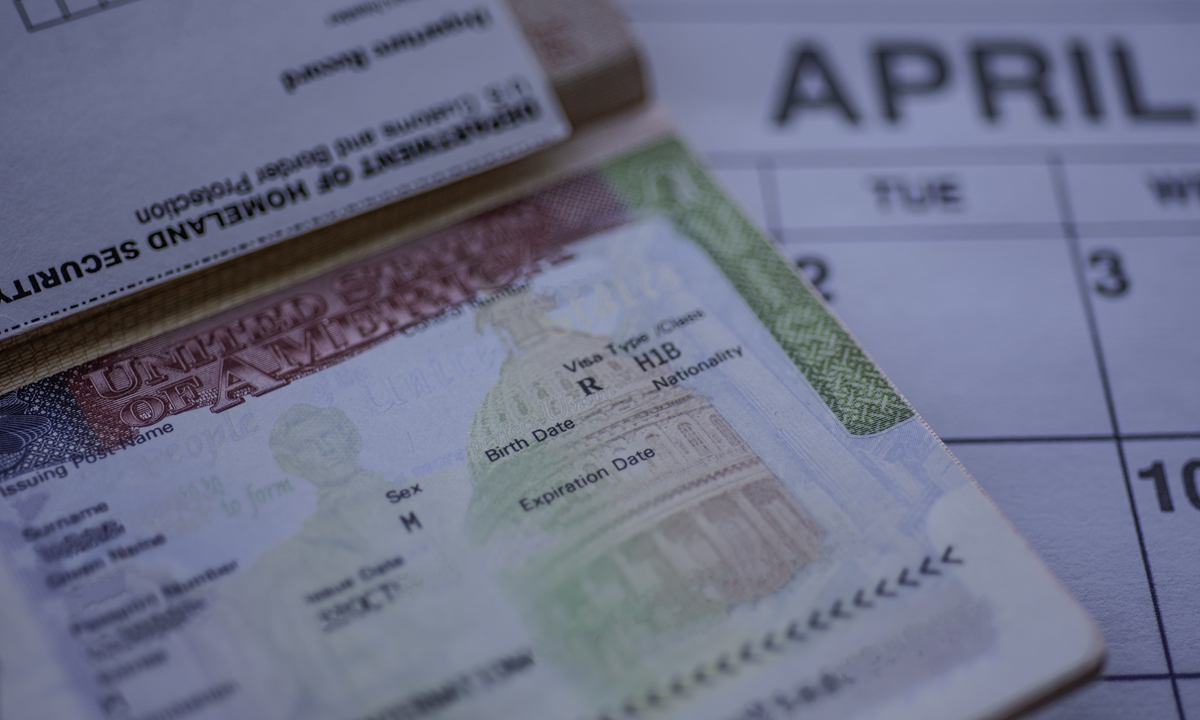
H-1B visa Photo: VCG
The White House stunned skilled foreign workers and US tech companies with a new policy that will impose a $100,000 fee on H-1B visas, effective this Sunday, according to media reports. The news has sent particular shockwaves through applicants from India, with the Indian government warning of "humanitarian consequences," according to Indian media outlets.
The fee policy that goes into effect on Sunday will be levied per petition and will not be applied to existing holders of valid visas re-entering the country, the White House said on Saturday, Reuters reported Sunday.
"This is not an annual fee. It's a one-time fee that applies only to the petition," White House spokesperson Karoline Leavitt said in a post on X on Sunday.
Leavitt also said that current H-1B visa holders who are currently outside of the country right now will not be charged $100,000 to re-enter the US.
Leavitt's latest clarification came after the H-1B announcement, which was issued by the White House on Friday, immediately spurred chaos, with companies and immigration lawyers warning travelers to return to the US before 12:01 am, when the new policy is scheduled to kick in, according to Politico, which published an article titled "White House tries to tamp down corporate panic for high-skill visa holders after last-minute overhaul."
Some companies including Microsoft, JPMorgan and Amazon had responded to the Friday announcement by advising employees holding H-1B visas to remain in the US, according to internal emails reviewed by Reuters. A Goldman Sachs internal memo seen by Reuters on Saturday urged employees with such visas to exercise caution on international travel, Reuters reported.
Politico reported that the White House said Saturday that corporate lawyers and "others with agendas are creating a lot of FAKE NEWS" around the proclamation, and said it does not apply to anyone with a current visa, and only affects future applicants in the February lottery who are outside of the US.
Indian applicants likely to be hit most
According to BBC on Saturday, the Indian government has said a new $100,000 fee for applicants seeking US skilled worker visas will have "humanitarian consequences".
India was the largest beneficiary of H-1B visas last year, accounting for 71 percent of approved beneficiaries, while China was a distant second at 11.7 percent, according to government data, Reuters reported Sunday.
The report said that a statement from the Indian Ministry of External Affairs on Saturday stated that the fee would have humanitarian consequences "by way of the disruption caused for families," and the Indian government "hopes that these disruptions can be addressed suitably by the US authorities."
The India Today reported Sunday that many Indians in the US on H-1B visas scrapped travel plans to India within hours of the White House order.
According to the India media outlet, some canceled flights at the last minute, even while waiting at departure gates, while others already in India are rushing to return amid confusion, just weeks before Indian professionals and their families typically travel home for Diwali and year-end holidays.
H-1B holders and their families described the mood as one of "a crazy sense of panic" and "worry", as several told Indian news agency PTI on condition of anonymity.
Also, a Chinese national who works in Seattle on H-1B status told the Global Times on Sunday that the policy raised concerns that H-1B approval and renewal would be more difficult.
"I am also worried about my status although it is not an immediate problem; I am not sure whether my employer would help with that and how much it can help, but a lot of my colleagues are working here on H-1B status," she said.
Commenting on the new visa fee, Lü Xiang, a research fellow at the Chinese Academy of Social Sciences, told the Global Times on Sunday that the policy may deal a heavy blow to the American technology industry which relies heavily on foreign talent.
The policy will undoubtedly affect a significant portion of Indian people working and intending to work in the US, Lü said. The expert also noted that the policy would affect some H-1B visa Chinese applicants. More talented Chinese individuals may choose to return home after graduation in the US, where there is strong demand for their skills, Lü said.
The expert believes that the new visa fee policy serves several intended purposes.
First, there is a fiscal objective. "The US government is seeking every possible avenue to increase government revenue and address budget shortfalls," Lü said.
Recently, the US government has rolled out a series of moves to raise revenue for the Treasury in "new and often unprecedented" ways, Politico reported Friday.
On Friday, the White House also issued a version of the current administration's long-promised gold card, a $1 million fast-track for wealthy foreigners to live and work in the US.
Another purpose, according to Lü, is that the US government intends to reserve these jobs for American workers. "The main group affected by the H-1B restrictions are employees in high technology companies. The hope is to increase the share of Americans in these roles—or at least reduce the use of foreign workers—especially in high-paying positions," Lü said.
"The company needs to decide … is the person valuable enough to have a $100,000-a-year payment to the government, or they should head home and go hire an American?" US Commerce Secretary Howard Lutnick said at the signing of the policy. "That's the point of immigration: Hire Americans and make sure the people coming in are the top, top people," Lutnick claimed, CNN reported Sunday.
Blow to US tech companies
The expert believes that the policy could be a blow to US companies that currently hold a strong global competitive edge.
"Even if the US government gains fiscally and creates more job opportunities for some Americans—assuming those goals are partly achieved—the damage to American businesses would far outweigh any benefits," Lü said.
The real loss will be for US tech companies—both giants and startups—which rely heavily on foreign talent, especially in their early stages when they can't afford higher-cost domestic hires, the expert said.
Senator Mark Warner told Bloomberg on Friday after initial reports of the administration's move that while it's likely that "many companies will pay" to secure employees' visas, the decision would further limit the US' ability to attract foreign skilled students and workers. "We still need to attract world-class talent in America," the senator emphasized. Citing a series of the US government's policies, he told Bloomberg that "we are not getting the same caliber of folks coming to our graduate programs, universities, and frankly even in trying to come and work in America." "And that's long-term going to hurt our economy," the senator said.
Senator Chuck Grassley, also the chair of the Judiciary Committee, acknowledged on X on Saturday that the policy announcement would likely rile "tech [companies] & biz groups."
Reuters on Sunday, citing some analysts, suggested the fee may force companies to move some high-value work overseas, hampering America's position in the high-stakes artificial intelligence race with China.
"In the short term, Washington may collect a windfall; in the long term, the US risks taxing away its innovation edge, trading dynamism for short-sighted protectionism," eMarketer analyst Jeremy Goldman was quoted by Reuters.
RELATED ARTICLES