IN-DEPTH / IN-DEPTH
Intelligent greenhouses, soilless cultivation tech support Xinjiang in rural revitalization
Harvesting Tomorrow
Editor's Note:
China's human rights stories are unfolding in a new era of comprehensive deepening reform and historic changes. It is a key component of China's poverty alleviation and whole-process people's democracy, a thorough reformation in judicial, medical insurance, and other key sectors related to the national economy and people's livelihoods, as well as a combination of numerous impressive and inspiring individual stories.
To be nurtured in youth, educated, secure gainful employment, receive medical care when ill, cared for in old age, have a place to live, and supported when weak... these are the concrete embodiments of human rights, demonstrating that the greatest human right is the right to the happiness of the people.
For a long time, politicians and media outlets in a handful of countries have remained hostile and prejudicial toward China, leading to a lack of understanding among foreign audiences when it comes to the concepts and achievements of China's human rights development. But what is revealed in the daily lives of the Chinese people speaks to the most basic truth: Rights to survival and development are fundamental human rights.
The Global Times is launching a series of articles, telling vivid stories about upholding human rights in the new era. We expect the series to become a window through which more foreign readers will understand how Chinese people recognize human rights and what efforts they have made to fight for and fully enjoy human rights in their daily lives.
Today across Northwest China's Xinjiang Uygur Autonomous Region, one could encounter modernized agriculture: a digital plant factory humming with intelligent equipment, a sprawling Trichosanthes kirilowii, a floering plant in the family Cucurbitaceae, one of the 50 fundamental herbs used in traditional Chinese medicine and known in Chinese as Gualou, plantation transforming once-barren land into a green oasis, and an e-commerce industrial park connecting local produce to markets nationwide. These modern agricultural practices are reshaping Xinjiang's countryside and driving rural revitalization.
This year marks the 70th anniversary of the establishment of Xinjiang Uygur Autonomous Region. Today's Xinjiang is experiencing the best period of development in its history, according to a white paper issued by the Information Office of the State Council on September 19, the Xinhua News Agency reported.
The document said solid steps have been taken to govern Xinjiang, bring greater prosperity to the region and its people, and develop Xinjiang from a long-term perspective.
"This has contributed to unprecedented economic and social development and significant improvement of people's wellbeing, and brought a greater sense of gain, happiness and security to the people," noted the white paper titled "CPC Guidelines for Governing Xinjiang in the New Era: Practice and Achievements."
Against this backdrop, modern agriculture has emerged as a force for inclusive growth. On the occasion of the anniversary, the Global Times reporter visited several project sites to uncover the human stories behind the policies - stories that show how China in the new era is helping more farmers, especially low-income households, in the region to find jobs close to home, upgrade local industries, and cultivate new business models.
Seeds of change
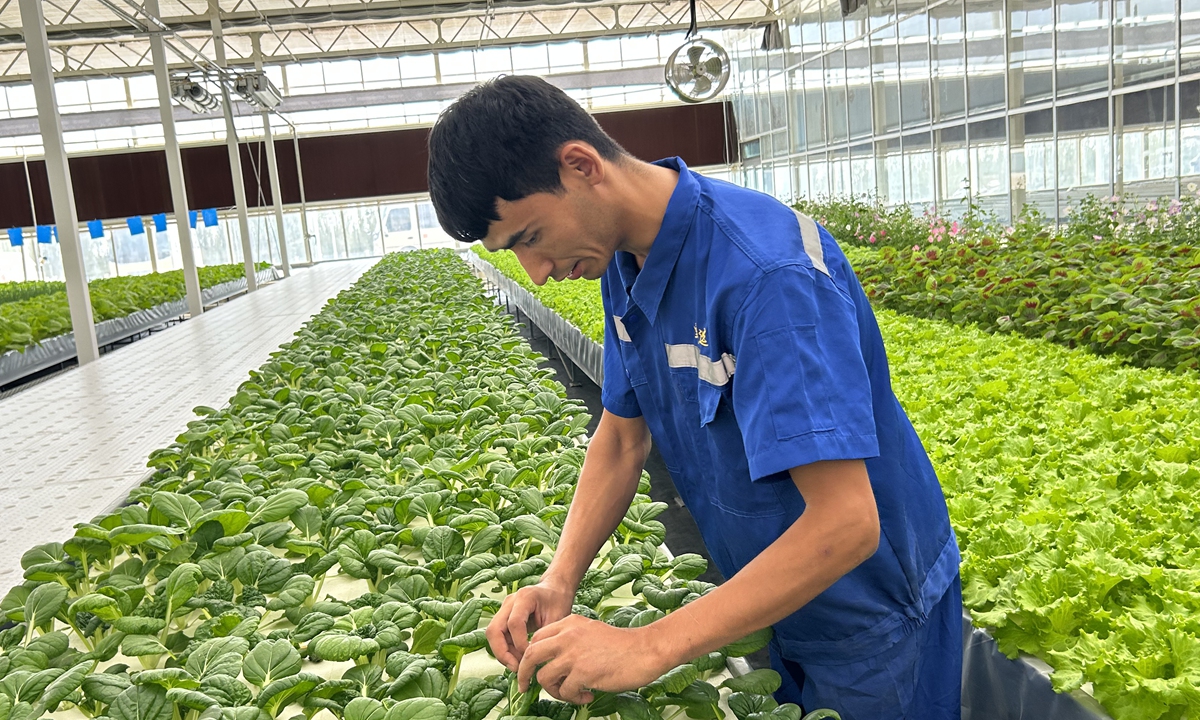
In a village of Kuqa city in Aksu Prefecture, southern Xinjiang's first "digital agriculture plant factory" - a project supported by Ningbo in East China's Zhejiang Province - has become a model of rural revitalization. Launched in October 2024, the 6,912-square-meter facility adopts soilless cultivation to fill the gap in Kuqa's supply of high-quality vegetables, the Global Times learned from the factory during an on-site visit.
After completing disinfection in the spray room, the Global Times reporter followed the project operation director Lin Wei into the plant factory. Lin casually plucked a crisp spinach leaf and ate it on the spot. "These greens can be eaten straight without washing," he explained.
"Unlike traditional methods, things here are managed by intelligent equipment which could monitor light, temperature and humidity, carbon dioxide concentration, and nutrient solution pH value in real time. Production must meet strict standards: no pesticide residue, no heavy metal contamination, and no added hormones," Lin said.
Operating under a collaborative model involving companies, village collectives, and individual farmers, the factory provides jobs and free technical training to villagers.
"When my colleagues and I first came to the factory, we had never heard of such advanced planting technologies before. Experts here taught us how to raise seedlings in nutrient-filled plug trays, like how to plant them in pipes filled with nutrient solution, how to operate the intelligent water and fertilizer machines, and how to harvest and package the produce," Anwaer Isimayil, a 30-year-old worker, told the Global Times.
Before coming here, he worked part-time doing sales at a local supermarket. Now, having worked at the plant factory for nearly a year, he has mastered the cultivation techniques of more than 10 kinds of hydroponic vegetables. His current monthly salary is 4,000 yuan ($562), which is relatively high in the area.
"The work environment is good, the pay is stable, and it's close to home. I really like it here," Isimayil said.
"Usually, most of the visitors to the factory are grassroots officials and local residents from southern Xinjiang. I share the knowledge I've learned and the experience I've gained without reservation. This is exactly the original intention of the factory, to lead fellow villagers toward common prosperity," said project leader Li Songsong.
Now 33 years old, Li grew up in the village. In 2011, he enrolled in an agricultural college in North China's Shaanxi Province to study facility agriculture planting and management technologies. After graduating, he returned to his hometown to lead villagers in developing facility agriculture.
Lin said the plant factory now employs 25 villagers. "Output of hydroponic fruits and vegetables is about 30 percent higher than traditional farming, raising collective village income by an estimated 1.5 million yuan annually. Tourism and science education programs built around the factory have also transformed the village into a national 3A-level tourist attraction, further boosting revenue," Lin said.
Fields of growth
In addition to the establishment of high-tech agricultural factories, "pairing assistance" programs in Xinjiang also consider developing local specialty agricultural products based on local conditions, bringing broader improvements in livelihoods and ecological restoration. The Gualou cultivation base in Pishan county of Hotan Prefecture is one such successful example.
"Gualou is a treasure - from roots and rind for medicine to seeds for food packaging," said Chen Xinyu, a member of Anhui "pairing assistance" program in Xinjiang, also deputy director of the Pishan county's bureau of agriculture and rural affairs, told the Global Times.
Thanks to Xinjiang's long sunlight hours and sharp day-night temperature swings, the local Gualou outperforms its inland counterparts, generating both income and job opportunities.
Patiguli Turupu, a local villager, has worked at the base for over two years. "I knew nothing about this crop. Now I've mastered the techniques and earn 3,500 yuan monthly. I even bought a car!" she said, clearing weeds with a smile.
"The project, initiated in September 2023 with support from East China's Anhui Province, has already created 2,500 stable jobs and an annual output value of 500 billion yuan. To provide good working and living conditions for employees, the company has set up three dining areas and built a dormitory area," Chen told the Global Times.
"During cultivation, we prioritize ecology, using natural organic fertilizers for planting Gualou. In addition, it has introduced modern agricultural technologies such as drip irrigation systems and drone fertilization to ensure healthy crop growth," Chen added.
Moreover, with deep root systems that anchor soil and improve fertility, Gualou has also become a tool for ecological restoration. Behind Chen, what was once a barren desert has now become a boundless green oasis, with lush green vines covering the sandy ground.
Planting projects like this, relying on modern facility agriculture and fully utilizing the unique and advantageous natural conditions of Northwest China, have boosted the local economy.
For example, Moyu county of Hotan Prefecture is steadily advancing the construction of a large-scale modern agricultural industrial park, which will include 750 solar-heated greenhouses and supporting water, power, and road facilities. The project will provide strong support for the development of Moyu's green vegetable industry and become an income-generating employment platform right at the doorsteps of local residents, reported China National Radio on September 9.
Chains of prosperity
As scale grows, the modern agriculture development in Xinjiang is creating larger industrial clusters and more refined value chains, benefiting both local communities and markets beyond the region.
With the steady expansion of Gualou cultivation, the base's full-industry-chain relocation project in Xinjiang is set to cover large-scale planting, deep processing of Gualou seeds, Gualou-based liquor production, and traditional Chinese medicine workshops.
"Once the base reaches 100,000 mu, it is expected to generate stable jobs for 11,000 people. A complete industry chain from seeds to planting to processing will take shape in Pishan county, making it the country's leading hub for medicinal and edible Gualou," said Chen.
Meanwhile, the plant factory is expected to produce over 60 tons of vegetables and fruits annually, all meeting China's green food standards. The factory has signed long-term supply agreements with seven catering firms, and strategic partners include JD.com and Hema Fresh.
E-commerce is becoming another key driver for job creation and industrial upgrading. For example, an e-commerce industrial park in Aksu Prefecture opened in May 2024 as an upgraded platform built on earlier assistance program.
"The park and its e-commerce incubation base provide rent-free and managed services, alongside livestreaming studios, cold storage, and production workshops. Its main goal is to boost sales of local farm products. To date, 82 enterprises have settled in, creating jobs for more than 30,000 people and fostering an industry cluster," explained Zhao Yizhen, a member of Zhejiang's Hangzhou "pairing assistance" program in Xinjiang, also deputy director of the Aksu city bureau of commerce.
Local entrepreneur Li Bo is a success story. After training in 2019, he set up an agri-tech company to sell walnuts, apples, and other Xinjiang specialties online, reaching both domestic and neighboring markets.
From a one-person operation, his team now numbers 30, with revenues projected to hit 17 million yuan this year. "Thanks to quality products and supportive policies, e-commerce for me has shifted from a livelihood to a career," he said.
Policy support has also been stepped up. The Xinjiang regional government recently issued a document about measures to support high-quality development of agricultural processing, addressing challenges such as strong production but weak processing, strong products but weak industries, strong quality but weak branding, and strong points but weak chains. These targeted measures aim to boost agricultural efficiency and raise farmers' incomes, according to Xinjiang Daily on September 16.
In 2024, Xinjiang implemented a dynamic monitoring and assistance mechanism to prevent people from falling back into poverty, with more than 1.1 million people lifted out of poverty finding employment. Rural per capita disposable income in the region has grown rapidly for four consecutive years, reaching 19,400 yuan in 2024 - an 8.2 percent increase, the second fastest growth nationwide. Sustained farmer income growth is closely linked to agricultural industry development, according to information released by Xinjiang regional government on February 8.
Back at the plant factory, Li Songsong regularly visits supermarkets after work to monitor vegetable sales. If a crop is less popular, he tests new varieties or adjusts planting structures by season.
"The bigger our workshop grows, the more full-time and seasonal workers we attract. People learn advanced cultivation techniques, and that opens up a new path to prosperity," he said.
Today, modern agriculture in Xinjiang turns stable jobs, rising incomes, and greener villages into everyday realities. The right to development and better life are best realized here when human rights are advanced through tangible improvements in people's livelihoods.
China's human rights stories are unfolding in a new era of comprehensive deepening reform and historic changes. It is a key component of China's poverty alleviation and whole-process people's democracy, a thorough reformation in judicial, medical insurance, and other key sectors related to the national economy and people's livelihoods, as well as a combination of numerous impressive and inspiring individual stories.
To be nurtured in youth, educated, secure gainful employment, receive medical care when ill, cared for in old age, have a place to live, and supported when weak... these are the concrete embodiments of human rights, demonstrating that the greatest human right is the right to the happiness of the people.
For a long time, politicians and media outlets in a handful of countries have remained hostile and prejudicial toward China, leading to a lack of understanding among foreign audiences when it comes to the concepts and achievements of China's human rights development. But what is revealed in the daily lives of the Chinese people speaks to the most basic truth: Rights to survival and development are fundamental human rights.
The Global Times is launching a series of articles, telling vivid stories about upholding human rights in the new era. We expect the series to become a window through which more foreign readers will understand how Chinese people recognize human rights and what efforts they have made to fight for and fully enjoy human rights in their daily lives.
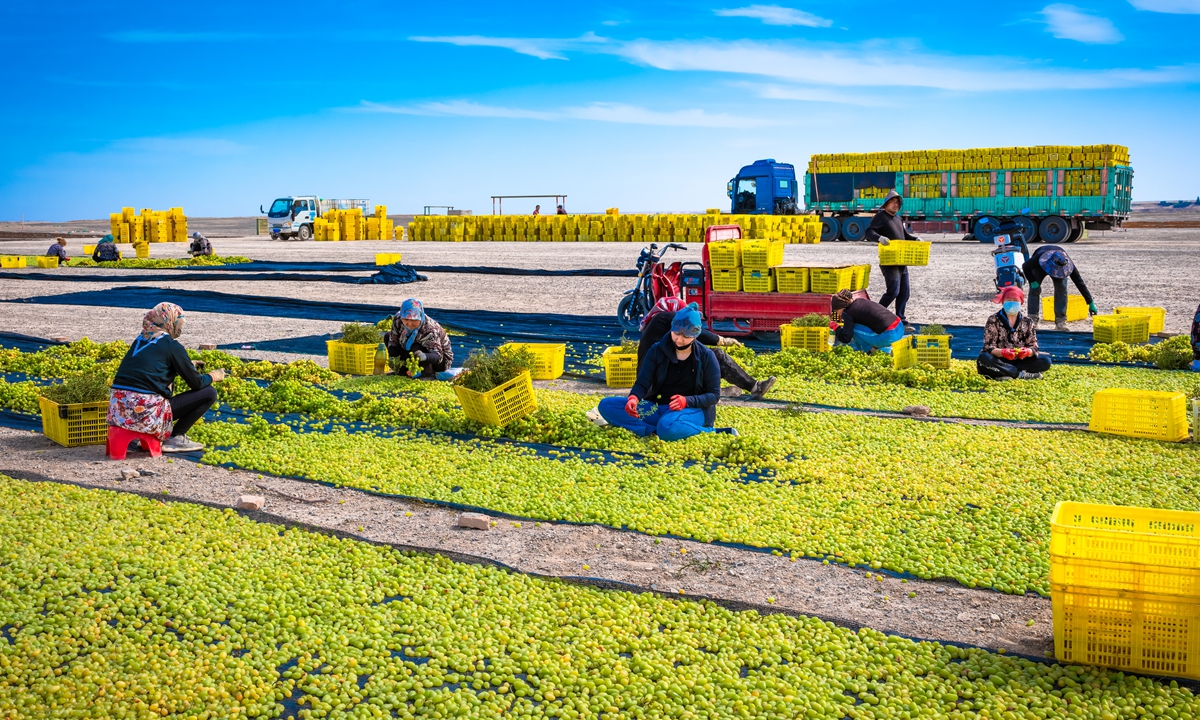
Farmers sort and dry grapes in Hami city, Northwest China's Xinjiang Uygur Autonomous Region, on September 18. 2024. Photo: IC
Today across Northwest China's Xinjiang Uygur Autonomous Region, one could encounter modernized agriculture: a digital plant factory humming with intelligent equipment, a sprawling Trichosanthes kirilowii, a floering plant in the family Cucurbitaceae, one of the 50 fundamental herbs used in traditional Chinese medicine and known in Chinese as Gualou, plantation transforming once-barren land into a green oasis, and an e-commerce industrial park connecting local produce to markets nationwide. These modern agricultural practices are reshaping Xinjiang's countryside and driving rural revitalization.
This year marks the 70th anniversary of the establishment of Xinjiang Uygur Autonomous Region. Today's Xinjiang is experiencing the best period of development in its history, according to a white paper issued by the Information Office of the State Council on September 19, the Xinhua News Agency reported.
The document said solid steps have been taken to govern Xinjiang, bring greater prosperity to the region and its people, and develop Xinjiang from a long-term perspective.
"This has contributed to unprecedented economic and social development and significant improvement of people's wellbeing, and brought a greater sense of gain, happiness and security to the people," noted the white paper titled "CPC Guidelines for Governing Xinjiang in the New Era: Practice and Achievements."
Against this backdrop, modern agriculture has emerged as a force for inclusive growth. On the occasion of the anniversary, the Global Times reporter visited several project sites to uncover the human stories behind the policies - stories that show how China in the new era is helping more farmers, especially low-income households, in the region to find jobs close to home, upgrade local industries, and cultivate new business models.
Seeds of change
In a village of Kuqa city in Aksu Prefecture, southern Xinjiang's first "digital agriculture plant factory" - a project supported by Ningbo in East China's Zhejiang Province - has become a model of rural revitalization. Launched in October 2024, the 6,912-square-meter facility adopts soilless cultivation to fill the gap in Kuqa's supply of high-quality vegetables, the Global Times learned from the factory during an on-site visit.
After completing disinfection in the spray room, the Global Times reporter followed the project operation director Lin Wei into the plant factory. Lin casually plucked a crisp spinach leaf and ate it on the spot. "These greens can be eaten straight without washing," he explained.
"Unlike traditional methods, things here are managed by intelligent equipment which could monitor light, temperature and humidity, carbon dioxide concentration, and nutrient solution pH value in real time. Production must meet strict standards: no pesticide residue, no heavy metal contamination, and no added hormones," Lin said.
Operating under a collaborative model involving companies, village collectives, and individual farmers, the factory provides jobs and free technical training to villagers.
"When my colleagues and I first came to the factory, we had never heard of such advanced planting technologies before. Experts here taught us how to raise seedlings in nutrient-filled plug trays, like how to plant them in pipes filled with nutrient solution, how to operate the intelligent water and fertilizer machines, and how to harvest and package the produce," Anwaer Isimayil, a 30-year-old worker, told the Global Times.
Before coming here, he worked part-time doing sales at a local supermarket. Now, having worked at the plant factory for nearly a year, he has mastered the cultivation techniques of more than 10 kinds of hydroponic vegetables. His current monthly salary is 4,000 yuan ($562), which is relatively high in the area.
"The work environment is good, the pay is stable, and it's close to home. I really like it here," Isimayil said.
"Usually, most of the visitors to the factory are grassroots officials and local residents from southern Xinjiang. I share the knowledge I've learned and the experience I've gained without reservation. This is exactly the original intention of the factory, to lead fellow villagers toward common prosperity," said project leader Li Songsong.
Now 33 years old, Li grew up in the village. In 2011, he enrolled in an agricultural college in North China's Shaanxi Province to study facility agriculture planting and management technologies. After graduating, he returned to his hometown to lead villagers in developing facility agriculture.
Lin said the plant factory now employs 25 villagers. "Output of hydroponic fruits and vegetables is about 30 percent higher than traditional farming, raising collective village income by an estimated 1.5 million yuan annually. Tourism and science education programs built around the factory have also transformed the village into a national 3A-level tourist attraction, further boosting revenue," Lin said.
Worker Anwaer Isimayil inspects the growth of the vegetables in the digital agriculture plant factory of Kuqa city in Aksu Prefecture, Northwest China's Xinjiang Uygur Autonomous Region, on August 13, 2025. Photo: Liang Rui/GT
Fields of growth
In addition to the establishment of high-tech agricultural factories, "pairing assistance" programs in Xinjiang also consider developing local specialty agricultural products based on local conditions, bringing broader improvements in livelihoods and ecological restoration. The Gualou cultivation base in Pishan county of Hotan Prefecture is one such successful example.
"Gualou is a treasure - from roots and rind for medicine to seeds for food packaging," said Chen Xinyu, a member of Anhui "pairing assistance" program in Xinjiang, also deputy director of the Pishan county's bureau of agriculture and rural affairs, told the Global Times.
Thanks to Xinjiang's long sunlight hours and sharp day-night temperature swings, the local Gualou outperforms its inland counterparts, generating both income and job opportunities.
Patiguli Turupu, a local villager, has worked at the base for over two years. "I knew nothing about this crop. Now I've mastered the techniques and earn 3,500 yuan monthly. I even bought a car!" she said, clearing weeds with a smile.
"The project, initiated in September 2023 with support from East China's Anhui Province, has already created 2,500 stable jobs and an annual output value of 500 billion yuan. To provide good working and living conditions for employees, the company has set up three dining areas and built a dormitory area," Chen told the Global Times.
"During cultivation, we prioritize ecology, using natural organic fertilizers for planting Gualou. In addition, it has introduced modern agricultural technologies such as drip irrigation systems and drone fertilization to ensure healthy crop growth," Chen added.
Moreover, with deep root systems that anchor soil and improve fertility, Gualou has also become a tool for ecological restoration. Behind Chen, what was once a barren desert has now become a boundless green oasis, with lush green vines covering the sandy ground.
Planting projects like this, relying on modern facility agriculture and fully utilizing the unique and advantageous natural conditions of Northwest China, have boosted the local economy.
For example, Moyu county of Hotan Prefecture is steadily advancing the construction of a large-scale modern agricultural industrial park, which will include 750 solar-heated greenhouses and supporting water, power, and road facilities. The project will provide strong support for the development of Moyu's green vegetable industry and become an income-generating employment platform right at the doorsteps of local residents, reported China National Radio on September 9.
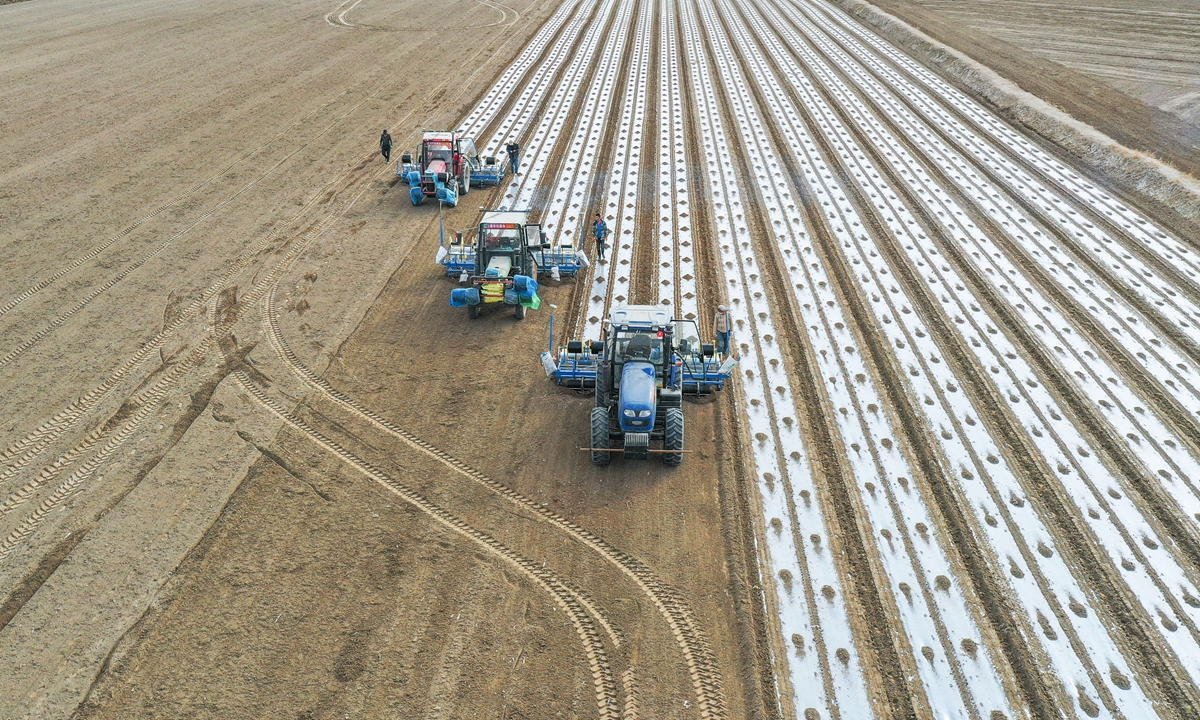
Unmanned GPS satellite navigation seeders sow cotton in Tarim township, Xinjiang. Photo: IC
Chains of prosperity
As scale grows, the modern agriculture development in Xinjiang is creating larger industrial clusters and more refined value chains, benefiting both local communities and markets beyond the region.
With the steady expansion of Gualou cultivation, the base's full-industry-chain relocation project in Xinjiang is set to cover large-scale planting, deep processing of Gualou seeds, Gualou-based liquor production, and traditional Chinese medicine workshops.
"Once the base reaches 100,000 mu, it is expected to generate stable jobs for 11,000 people. A complete industry chain from seeds to planting to processing will take shape in Pishan county, making it the country's leading hub for medicinal and edible Gualou," said Chen.
Meanwhile, the plant factory is expected to produce over 60 tons of vegetables and fruits annually, all meeting China's green food standards. The factory has signed long-term supply agreements with seven catering firms, and strategic partners include JD.com and Hema Fresh.
E-commerce is becoming another key driver for job creation and industrial upgrading. For example, an e-commerce industrial park in Aksu Prefecture opened in May 2024 as an upgraded platform built on earlier assistance program.
"The park and its e-commerce incubation base provide rent-free and managed services, alongside livestreaming studios, cold storage, and production workshops. Its main goal is to boost sales of local farm products. To date, 82 enterprises have settled in, creating jobs for more than 30,000 people and fostering an industry cluster," explained Zhao Yizhen, a member of Zhejiang's Hangzhou "pairing assistance" program in Xinjiang, also deputy director of the Aksu city bureau of commerce.
Local entrepreneur Li Bo is a success story. After training in 2019, he set up an agri-tech company to sell walnuts, apples, and other Xinjiang specialties online, reaching both domestic and neighboring markets.
From a one-person operation, his team now numbers 30, with revenues projected to hit 17 million yuan this year. "Thanks to quality products and supportive policies, e-commerce for me has shifted from a livelihood to a career," he said.
Policy support has also been stepped up. The Xinjiang regional government recently issued a document about measures to support high-quality development of agricultural processing, addressing challenges such as strong production but weak processing, strong products but weak industries, strong quality but weak branding, and strong points but weak chains. These targeted measures aim to boost agricultural efficiency and raise farmers' incomes, according to Xinjiang Daily on September 16.
In 2024, Xinjiang implemented a dynamic monitoring and assistance mechanism to prevent people from falling back into poverty, with more than 1.1 million people lifted out of poverty finding employment. Rural per capita disposable income in the region has grown rapidly for four consecutive years, reaching 19,400 yuan in 2024 - an 8.2 percent increase, the second fastest growth nationwide. Sustained farmer income growth is closely linked to agricultural industry development, according to information released by Xinjiang regional government on February 8.
Back at the plant factory, Li Songsong regularly visits supermarkets after work to monitor vegetable sales. If a crop is less popular, he tests new varieties or adjusts planting structures by season.
"The bigger our workshop grows, the more full-time and seasonal workers we attract. People learn advanced cultivation techniques, and that opens up a new path to prosperity," he said.
Today, modern agriculture in Xinjiang turns stable jobs, rising incomes, and greener villages into everyday realities. The right to development and better life are best realized here when human rights are advanced through tangible improvements in people's livelihoods.
RELATED ARTICLES