Beyond the fields: Innovation and technology propel China's agricultural products up the value chain
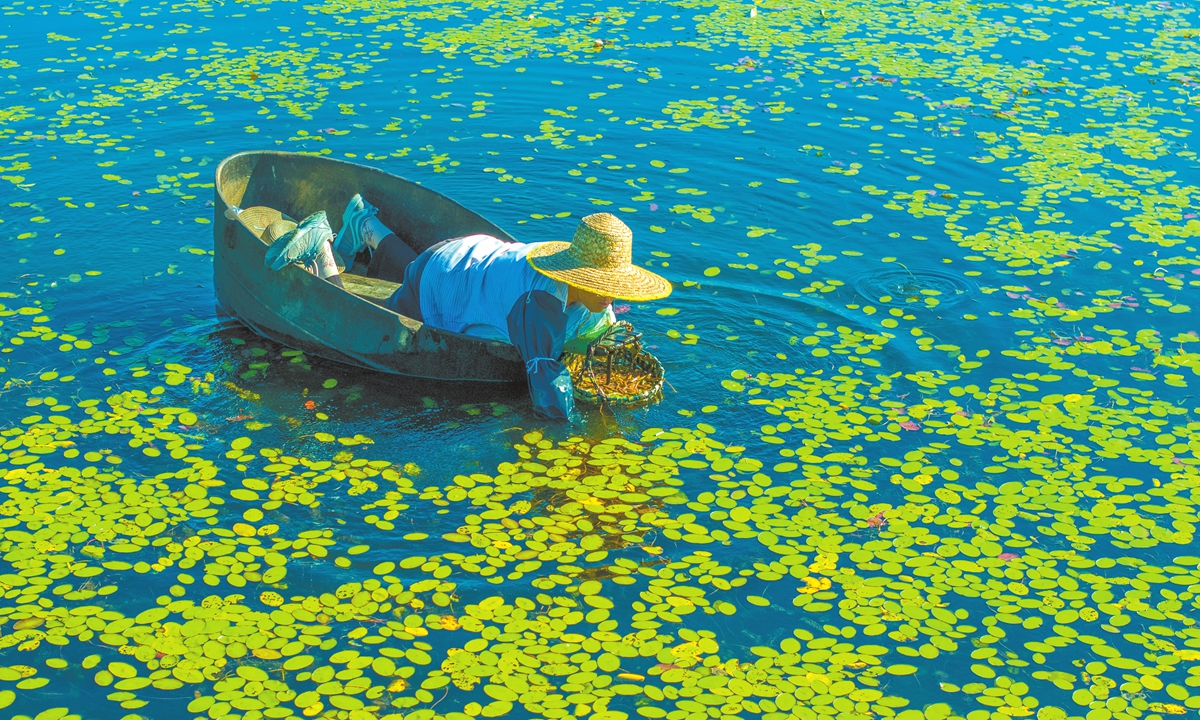
A farmer picks water shield in Suzhou, East China's Jiangsu Province. Photo: VCG
What comes to your mind when you think of coffee beans? A steaming cup of fragrant coffee? Or perhaps a decadent dessert laced with that rich, roasted flavor?
In Southwest China's Yunnan Province, however, coffee beans have undergone a remarkable makeover - They are now starring as key ingredients in skincare products.
This offers a vivid example of how Chinese enterprises are transforming agricultural raw materials into high-value products, blending ancient heritage with cutting-edge science. Increasingly, Chinese enterprises are joining this journey, where farms meet laboratories, and "made in China" becomes "innovated in China."
From raw roots to radiant results
Take the coffee bean planting base in Lancang, Yunnan, a major sourcing hub for domestic skincare brand HBN, for example. Currently, this site has long been at the forefront of R&D for coffee bean extracts and their applications in beauty products, according to a report by CCTV News.
"Quality control of raw coffee beans is paramount. To unlock peak efficacy, our team selects unroasted green coffee beans and employs bio-fermentation extraction techniques. In formula design, we tackle the challenge of oxidation-prone active compounds by meticulously engineering the entire system - ensuring high-potency additions while maintaining rock-solid stability and performance," Shu Peng, R&D director of HBN, was quoted by CCTV News as saying.
Not just coffee beans. A single berry of Prinsepia utilis Royle, plucked from the rugged slopes of snow mountain in Yunnan's Shangri-La, after undergoing dozens of cycles of "high-temperature rapid extraction, layered purification, low-temperature preservation" processes, is transformed into polysaccharide substances, which becomes the core ingredient in skincare products of domestic brand Winona.
Drawing on Yunnan's signature flora, such as Prinsepia utilis Royle, purslane and Yunnan camellia, Winona's parent company, Botanee Group, has independently developed over a dozen plant-based cosmetic raw materials. To date, the Botanee R&D team has successfully registered 16 novel plant ingredients, including lychee grass, and short-stemmed tumbleweed, topping national approval rankings, Botanee Group said in a statement.

A display wall for plant specimen at Botanee Group in Kunming, Southwest China's Yunnan Province Photo: Courtesy of Botanee Group
But the innovation doesn't stop at skincare. Chinese brands' tech wizardry is elevating agricultural staples across diverse realms.
In Chongqing's Shizhu county, the world's largest hydroponic water shield production base, a company has spun water shield into a whopping 28 products spanning food, beauty and skincare, and health supplements, according to the Ministry of Agriculture and Rural Affairs.
In Guyang county in North China's Inner Mongolia Autonomous Region, local ingenuity transforms raw astragalus into high-value gems.
Leveraging bio-extraction tech, Guyang launched 48 new items made from astragalus in 2024, from astragalus essence liquids and to polysaccharide lozenges. Five earned national health food certifications. In 2024, Guyang's astragalus output soared past 1 billion yuan ($140.5 million), sparking seasonal jobs for 8,000 people, according to local media reports.
Policy support
From a humble coffee seed to rows of skincare jars, more and more agricultural enterprises have transformed from pure processor of primary products to deep processor with technologies and patents.
Fueled by relentless R&D, they are making primary agricultural products more valuable. And none of this happens in a vacuum - Policies are the wind beneath these wings.
In 2020, the Regulations on the Supervision and Administration of Cosmetics urged "encouraging and supporting the use of modern science and technology, combined with China's traditional strengths and distinctive plant resources, to support the research and development of cosmetics."
Fast-forward to July 2023, when a joint guideline for light industries issued by three ministries spelled out "strengthening innovation in specialty plant raw materials, promoting scaled bio-manufacturing of active ingredients, and boosting their use in foods, cosmetics, and beyond."
China's botanical bounty, paired with policy support for raw material R&D and surging consumer love for natural, plant-powered efficacy, hands domestic firms a golden ticket to "overtake on the curve" to develop and go abroad, Wang Peng, an associate research fellow at the Beijing Academy of Social Sciences, told the Global Times on Thursday.
It's not just about ingredients. Chinese agribusinesses are also turbocharging digital production for efficiency.
For example, in Botanee's new central factory in Yunnan's Kunming, officially put into operation on March 13, 2025, fully-automated lines hum along without a human touch, slashing errors from mix-ups to masterpieces. The factory integrates plant extraction, formulation, filling, packaging, and warehousing into a streamlined process, the company told the Global Times.
These tales spotlight how Chinese primary products are breaking free through a "tech + brand + supply chain" approach, emerging as formidable players in premium global markets, said Wang.
In recent years, China has seen a wave of innovation where primary agricultural products are elevated into premium offerings. Chinese firms have emerged, turning Chinese products into globally celebrated brands.
Going abroad
"Serving our country is step one; serving the world is the shared aspiration. We're eager to export our 'Chinese blueprint' - rooted in local botanicals and dermatological insights - to the global stage," Zhong Wei, Botanee Group's PR director, said in a statement sent to the Global Times.
Currently, Botanee's factory and Yunnan Characteristic Plant Extraction Laboratory weave Yunnan's plant resources richness into an end-to-end pipeline: from sourcing to R&D to production. Botanee has begun exporting this model overseas, with its planting research flags in Tokyo and Paris, the company said.
A variety show "The Chinese Beauty Shop," a program themed around cross-border entrepreneurship, is being broadcast on television and online in China. The program aims to empower national cosmetic brands, including Winona, Chando and Shanghai Vive, to go global by operating pop-up stores on the streets of Paris.
"National brands are innovating at warp speed - ramping R&D, debuting proprietary core ingredients - to vault from pursuers to pioneers in select spheres," Li Jiaqi, product director in the program, said in a statement sent to the Global Times.
According to Li, fresh Chinese makeup marques are stealing the show on overseas platforms, winning hearts worldwide.
"This fully demonstrates the strength and potential of domestic products going global, which has given me great confidence in the ability of domestic products to reach the international market,"said Li. "We need to enhance our hard power and take the courage to act."
"From crafting for locals to captivating the globe, while shifting from mere production to genuine innovation, the evolution of Chinese enterprises is clear: from makers to creators, from followers to frontrunners, China's innovative trailblazers are scripting a new chapter," said Wang.
Customs data revealed that exports of beauty products from China hit 18.7 billion yuan in the first half of 2025, an increase of 12 percent year-on-year, with major markets spanning the US, UK, Indonesia, Netherlands, and Japan.
RELATED ARTICLES