ARTS / CULTURE & LEISURE
If done this way, Cai’s Himalayan fireworks show would have been true art
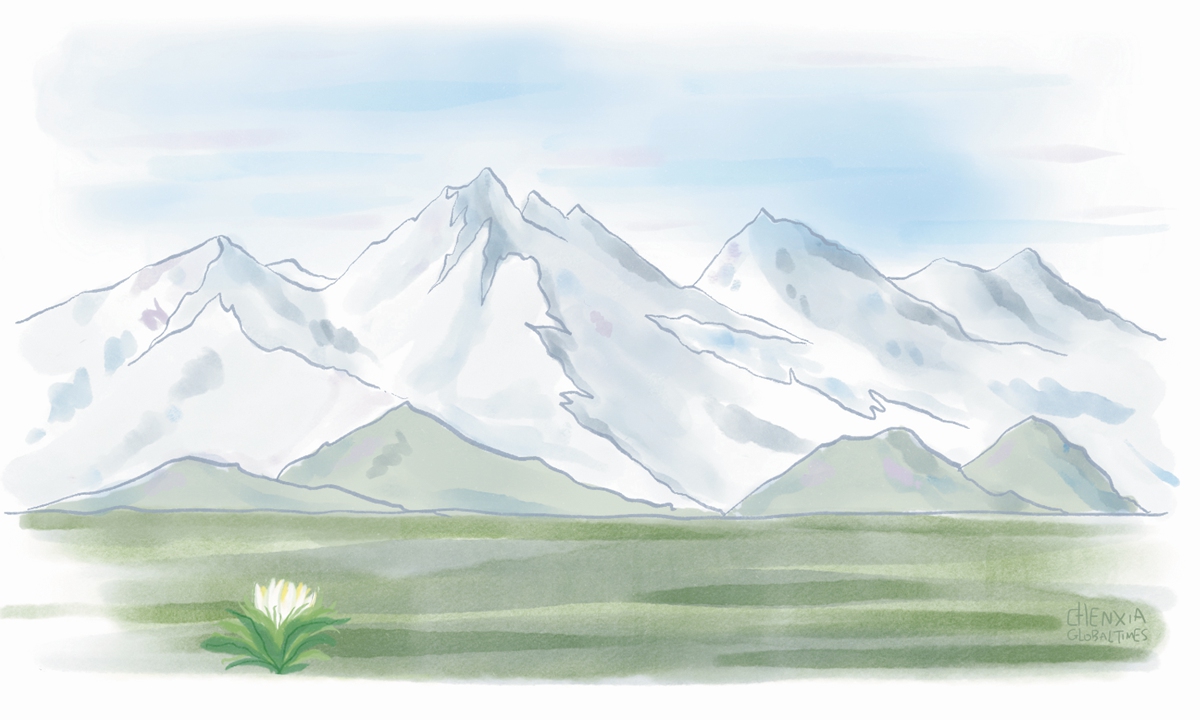
Illustration: Chen Xia/GT
Created by artist Cai Guoqiang, a pyrotechnic artwork titled Rising Dragon bloomed recently in the sky, leaving behind a multicolored haze over the Himalayas. But, with an apology letter issued by Cai on Sunday regarding this work, the piece seems to have also plummeted into the haze of public criticism. It made many people realize that creating art in natural environments is not entirely about doing as one pleases.The artwork was created by Cai in collaboration with outdoor sports brand Arc'teryx in Gyangze county, Southwest China's Xizang Autonomous Region.
How much harm Rising Dragon actually did to the environment has not yet been confirmed, but the public statements that were issued by both the artist and the brand reveal a frank truth: environmental risks were not fully avoided in the artwork's creation.
This is evident from the brand's apology, which promises a "rigorous and transparent evaluation" by environmental agencies. Similarly, Cai explicitly expressed his willingness to "dedicate every effort to repair and restore the environment" if any impact is confirmed.
"Fireworks could cause irreversible damage to the fragile environment. Under extreme cold, even degradable materials can break down very slowly," natural environment resource expert Li Junsheng told the Global Times. After the incident, the organizer of Cai's show had noted that the fireworks were "degradable."
Shouldn't "evaluation" and the need to carry out "restoration" be addressed prior to the project commencing? Although the project team's apology appears sincere, the truth is that the natural environment cannot withstand any hasty experiments. In other words, whether in the Himalayas or elsewhere, any art project that uses the natural environment as its "backdrop" must respect its surroundings first.
For Rising Dragon, nature itself was an integral part of the art project. For example, the upwardly winding ridges of the Himalayas served as the visual prototype for the "dragon" imagery in Cai's work. If genuine ecological damage occurs, it ultimately undermines the very purpose of art itself.
The Rising Dragon has also prompted profound contemplation on the relationship between art and the environment, particularly: What stance should a creative professional take when engaging with nature?
Since ancient times, many artworks like paintings and poetry by Chinese creators have drawn inspiration from nature or used natural imagery to convey emotion. Thus, art and nature have never been opposed to each one, but rather have a dynamic relationship.
Today, such art-to-nature interaction has gone beyond being a mere vehicle for ancient people's romantic expression to gain real-world significance through artist engagement.
Taking regional land art festivals across China - from Jiangxi to Guangdong and Zhejiang - as examples. More and more artists have started using mediums such as architectural installations, sculpture, and dance to express themselves. Such works are not merely artistic expressions, but also provide a natural environment with opportunities for rural revitalization, cultural tourism and more.
In other words, a contemporary artistic stance toward engaging with nature should no longer prioritize self-expression at the expense of nature, but should consider how to interpret nature through new means.
Imagine if Rising Dragon had not risked burdening the Himalayas with loud explosions and residual dust, but had instead explored digital fireworks technology, perhaps the public response might have been entirely different.
Perhaps venturing into digital pyrotechnics would have pushed the established firework artist beyond his comfort zone, yet it might also have opened a door for the public to recognize that artists, too, are evolving their creative methods.
In other words, respecting nature is no longer a constraint on creativity. On the contrary, it can inspire artists to develop distinctive forms of expression. And encouragingly, Cai has already taken steps in this direction by developing a multimodal AI model, thereby bringing digital fireworks to a broader audience.
The downfall of Rising Dragon matters not just to the art crew, but also shows that nature inspired art projects demand stricter management by regional authorities.
Although an investigation team has already been sent to the fireworks site for inspection, what matters more than the post-facto scrutiny is ensuring rigorous review procedures before an art project starts.
Establishing a pre-project assessment mechanism specifically designed for cultural and artistic initiatives carried out in fragile natural environments should be encouraged.
For example, in the future, any art project planned within ecologically protected zones must require organizers to commission a qualified independent third party to conduct an all-round environmental impact assessment.
The results of an assessment should be made available for public discussion or votes with professional environmental departments providing guidance.
After the artwork became a trending topic on multiple social media platforms, the public's focus on the incident actually reflects the social growth in China: Ecological conservation has evolved from policy into a public consensus among the masses.
This grassroots public voice is a driver of society's ecological progress, since it can push all artists, organizers, and managing bodies toward greater awareness when it comes to safeguarding nature.
The author is a reporter with the Global Times. life@globaltimes.com.cn
RELATED ARTICLES