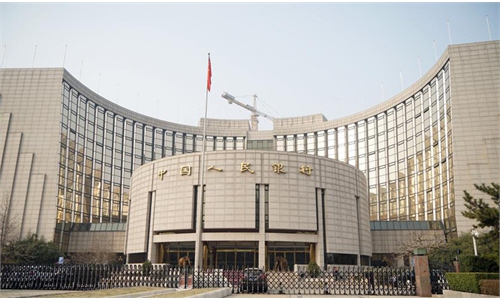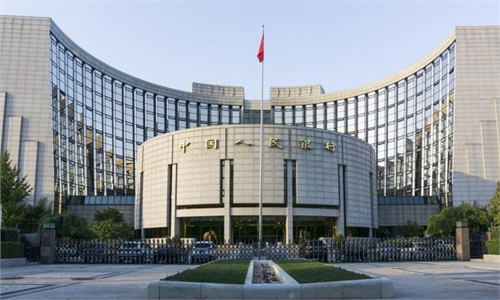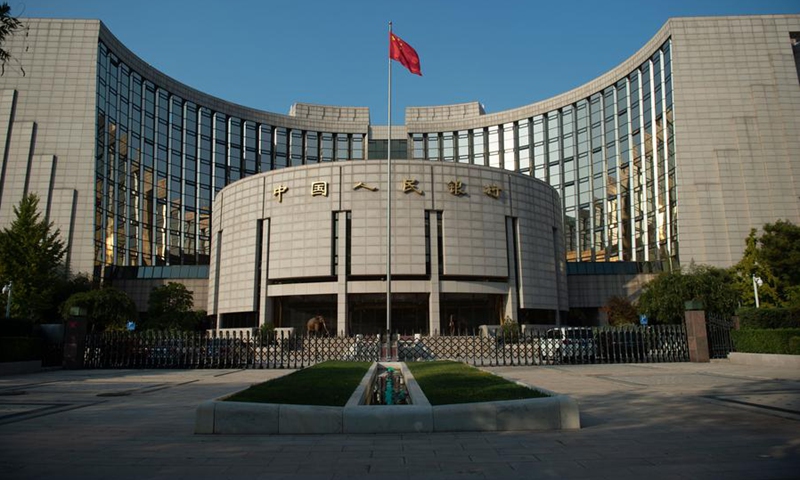
File photo shows an exterior view of the People's Bank of China in Beijing, capital of China. (Photo: Xinhua)
The People's Bank of China (PBC), the central bank, announced on Monday that it conducted 300 billion yuan ($42.17 billion) of 14-day reverse repos through interest rate bidding with a fixed quantity and multiple-price auctions.
It marked the first such operation since the central bank on September 19 announced that 14-day reverse repo operations in the open market will be adjusted to interest rate bidding with a fixed quantity and multiple-price auctions starting from the same day, in order to keep liquidity adequate in the banking system and better meet the differentiated funding needs of participating institutions. The timing and size of the operations will be determined based on liquidity management requirements, the central bank said.
A reverse repo is a process in which a central bank purchases securities from commercial banks through a bidding process, with an agreement to sell them back in the future, according to the Xinhua News Agency.
"With the National Day holidays approaching and rising cash withdrawal demands by consumers, these operations help curb the potential upward pressure on funding rates," Wang Qing, chief macroeconomic analyst at Golden Credit Rating International, said in a note sent to the Global Times on Monday.
Wang noted that the PBC is expected to continue to inject short-term liquidity into the market. After the holidays, it will utilize maturing funds for net withdrawals to smooth peaks and troughs, guiding short-end liquidity to remain stable and ample, according to the analyst.
According to stcn.com, following the adjustment to multiple-price auctions, the 14-day reverse repos no longer have a unified winning bid rate. Instead, participating institutions independently submit bids based on their funding needs and risk preferences, with the final results determined by market-oriented principles.
The adjustment also indicates that the transformation of China's monetary policy framework is ongoing, with an increasing emphasis on the role of price-based regulation. By continuously deepening interest rate marketization reforms and enhancing the independent pricing capabilities of financial institutions, the role of interest rates in regulating financial resource allocation can be fully leveraged, thereby more effectively supporting the real economy, according to the report.
Currently, the PBC's liquidity toolkit is well-stocked, with a more balanced distribution of tenors. Long-term tools include reserve requirement ratio cuts and government bond trading, while medium-term tools include the Medium-term Lending Facility, outright reverse repo operations, and various structural tools. Short-term tools include seven-day and 14-day reverse repos in open market operations, as well as temporary outright and reverse repos, stcn.com reported.
Under a moderately loose monetary policy stance, the central bank is likely to continue injecting liquidity of varying tenors based on the actual performance of the economy and markets, ensuring ample liquidity to meet phased market demands. At the same time, it will continue to refine and innovate structural monetary policy tools to better support the high-quality development of the real economy, the report said.
Global Times
RELATED ARTICLES