ARTS / CULTURE & LEISURE
Exhibition showcases literary achievements of Xizang
Works chronicle diverse facets of Snowy Plateau
By Published: Sep 22, 2025 10:32 PM
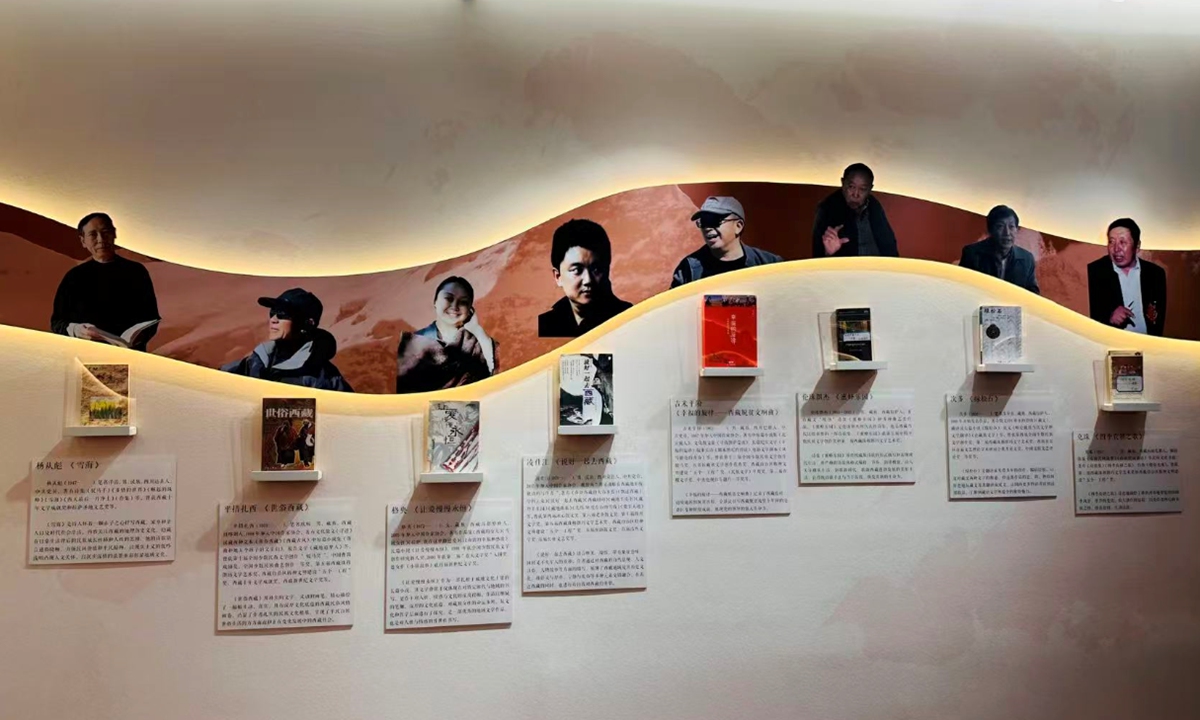
Exhibits at the new exhibition Photo: Ji Yuqiao/GT
A new exhibition that opened Monday in Beijing brings together outstanding literary works produced since the founding of Southwest China's Xizang Autonomous Region 60 years ago. These works chronicle diverse facets of the Snowy Plateau, from its unique ecology to its rich cultural exchanges and vibrant ethnic traditions. Organized in chronological order, the exhibition systematically traces the evolution of literature in the region.Ma Lihua, a famous writer and former vice president of the Federation of Literary and Art Circles of Xizang, told the Global Times on Monday that after six decades of exploration and development, the literature of Xizang, rooted in the region's distinguished cultural heritage, has developed its own distinctive character and diverse forms of expression, becoming an important part of contemporary Chinese literature.
The exhibition hall on the second floor of the National Museum of Modern Chinese Literature is divided into four sections, each assigned a unique theme that intertwines the march of the times with the charm of Tibetan ethnicity. Through manuscripts, books, periodicals, certificates, trophies and other artifacts, the exhibition presents a literary symphony that ranges from the deep emotional singing of the plateau to the harmonious interplay between literature of different ethnic groups.
The spatial design of the hall draws inspiration from Xizang's natural landscapes and regional culture, featuring elements such as mountains, rivers and khata (the traditional ceremonial scarf). A winding multicolored khata encircles the space, bearing the likeness of each featured author. Beneath the nameplate of Sonam Tsering, for example, lies the script of a 15-episode TV documentary series, each page handwritten by this Tibetan author, whose words vividly depict the natural beauty of Xizang. Another highlight is Wuxingbie de Shen (lit: The Genderless God) by Tibetan writer Yangzhen, the first long-form Chinese-language novel by a female author in the literary history of Xizang. Hailed as the Dream of the Red Chamber of the Tibetan ethnic group, the novel delves into every aspect of Tibetan daily life, including politics, religion, customs, dress and cuisine.
According to the introductions at the exhibition, over the past 60 years, writers from all ethnic backgrounds have contributed more than 500 works in both Chinese and Tibetan, some of which have received major accolades such as the Lu Xun Literature Prize. Poetry and non-fiction have become vital vehicles for the literature of Xizang, skillfully blending the spirit of the era with ethnic characteristics. The poem "Xueshan Fengbao" (lit: Snow Mountain Storm), for instance, highlights the awakening and struggle of serfs, using vivid characters and dramatic plotlines to portray the sweeping changes brought about by social reform, standing as a literary monument to the times. The narrative poem "A Mother's Daughter" sensitively portrays the deep bonds between peoples of different ethnicities, suffusing the plateau with the spirit of unity.
Since the turn of the 21st century, the literature of Xizang has shifted its focus to social transformation and individual spiritual worlds. Writers have depicted not only the changes modern technology has brought to Xizang but also delved into the core of traditional Tibetan culture, exploring how ancient beliefs are inherited and transformed in the present day, thus achieving a dialogue between tradition and modernity. These works, often grounded in realism, document the tides of social change and paint a panoramic picture of Xizang's achievements in economic development, education and livelihoods - a point that resonates deeply with Ma Lihua.
Ma said that she first arrived in Xizang in 1976. She began collecting many materials for her writing, beginning with poetry before turning to non-fiction. In recent years, her major documentary prose series, Zouguo Xizang (lit: Walking Through Tibet), has undergone numerous revisions and reprints.
"I keep adding new materials. Why? Because Xizang is changing so rapidly," Ma said. She recalled how, in the 1990s, she interviewed an impoverished local family who later prospered through the auto transport business after the opening of a highway. Other families who once struggled in the harsh conditions of northern Xizang have since relocated to more habitable areas, with their children now able to study in spacious, well-lit classrooms. Such real, striking stories have strengthened Ma's resolve to chronicle Xizang's transformation through literature.
The exhibition also features interactive displays inspired by traditional Tibetan horsemanship festivals. One installation presents two-dimensional animated figures of horseback riders and dancers; visitors can color these images, place them on a turntable, and watch as they transform into continuous, vibrant animations - adding an element of playful engagement.
Co-hosted by the National Museum of Modern Chinese Literature and the Federation of Literary and Art Circles of Xizang, and guided by the China Writers Association, the exhibition is set to run until December 22.
RELATED ARTICLES