ARTS / CULTURE & LEISURE
New discoveries on Sanxingdui civilization to be unveiled at upcoming forum
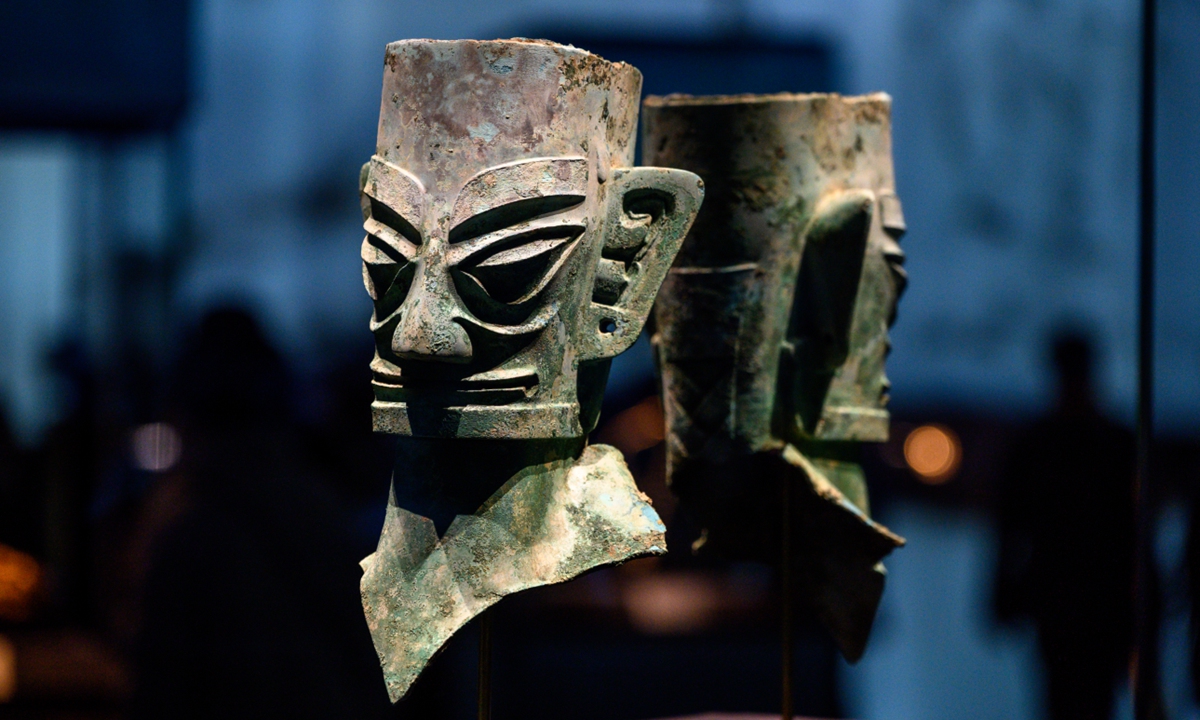
Bronze heads displayed at the Sanxingdui Museum in Guanghan, Southwest China's Sichuan Province Photo: VCG
New research findings concerning the ancient Sanxingdui civilization - ranging from bronze-casting techniques to gold craftsmanship and early rice cultivation - will be announced at the 2025 Sanxingdui Forum in Deyang, Southwest China's Sichuan Province, local officials announced at a press conference held on Monday.
Originally discovered in the late 1920s, the Sanxingdui Ruins have been dubbed as one of the world's greatest archaeological findings of the 20th century. Located in the city of Guanghan, around 60 kilometers from the provincial capital Chengdu, the ruins covering an area of 12 square kilometers are believed to be the remnants of the Shu Kingdom, dating back some 4,500 to 3,000 years.
The forum will present results from the past year of interdisciplinary research, covering dating methods, crafting technology, subsistence patterns and cultural preservation.
New research findings include the precise dating of sacrificial pits at the Sanxingdui Ruins and insights into innovative bronze-casting and painting techniques, gold craftsmanship, standardized pottery production, rice cultivation practices, and methods for preserving unearthed ivory.
In recent years, the Sichuan Provincial Institute of Cultural Relics and Archaeology, together with domestic and international research institutions, has made significant progress in areas such as the functional zoning of the Sanxingdui Ruins, dating of sacrificial pits, bronze-casting techniques, gold craftsmanship, sourcing and production of jade artifacts, silk archaeology, plant and environmental archaeology, analysis of organic residues and micro-traces, ivory preservation, and development of archaeological equipment, Ran Honglin, deputy director of the Sanxingdui Museum, said at the press conference.
These advances have provided crucial support for a more authentic, vivid, comprehensive, and systematic reconstruction of the ancient Shu civilization, once again demonstrating the profound antiquity and diversity-in-unity of Chinese civilization, Ran noted.
Looking ahead, working with leading research institutions and universities across China, archaeologists will continue excavation, preservation and multidisciplinary studies at the Sanxingdui Ruins, to explore the unknown, trace the civilization's origins and expand, organize and explain the discoveries made at the site, according to Ran.
Plans include expanding excavations at the rivers, roads, city walls, moats, water gates, workshops and other key areas at the Sanxingdui Ruins to clarify the site's water and land transport systems; determining the exact locations, chronological sequence and internal layout of key functional areas such as the palace district, workshop district and residential district; and investigating the ethnicity, social rank, status, gender and age of people who used to live at the site.
The next stage of research will aim to gain a preliminary understanding of burial customs, funerary systems, ritual activities, ceremonial frameworks, and spiritual beliefs at the site as well as roughly understand the settlement patterns, political geography, and resource supply and circulation systems in the area.
Multidisciplinary research will focus on settlement structure, artifact production techniques and raw material sources, resource control and utilization, ancient climate and environment, ritual scenarios and their meanings, the artistic and aesthetic value of excavated objects, the relationship between the Sanxingdui and Jinsha sites, and cultural exchanges between the ancient Shu civilization and other civilizations.
Under the theme "Civilizational Exchange from an Archaeological Perspective," the forum will feature an opening ceremony and main forum, as well as four sub-forums: "Decoding Civilization," "Global Dialogue," "Cultural Communication" and "Youth Innovation."
Under the theme "Civilizational Exchange from an Archaeological Perspective," the forum will feature an opening ceremony and main forum, as well as four sub-forums: "Decoding Civilization," "Global Dialogue," "Cultural Communication" and "Youth Innovation."
The sessions will explore the latest research on Sanxingdui archaeology, exchanges between Chinese and world civilizations, cultural heritage preservation and utilization, and public archaeology and cultural communication. The forum will also release the newest research findings and projects related to Sanxingdui, according to the press release.
RELATED ARTICLES