New vitality along ancient road
Exploring China's beautiful, harmonious countryside along Xi's footsteps
Editor's Note
China Rural Revitalization magazine has published a series of articles on the rapid development and transformation of rural China. The articles reflect the arduous efforts of rural revitalization across the country, which is an important and genuine solution to China's rural economic development. In the future, articles selected from this series will be published on Global Times.
Xi Jinping, general secretary of the Communist Party of China Central Committee, on January 26, 2022, visited a village in North China's Shanxi Province that was affected by severe floods in October 2021.
Braving the snow, Xi went to Fengnanyuan village of Huozhou city, where he visited the disaster-affected people and learned about local post-disaster reconstruction, the Xinhua News Agency reported.
In October 2021, heavy rains caused 19 houses in Fengnanyuan village to collapse and damaged 65 others across 42 households. Local authorities acted quickly, completing all necessary repairs and rebuilds by November 30 that year. Villager Shi Hongbing's four cave dwellings were destroyed, but he was already living in two newly built prefabricated homes in January 2022.
During his visit, Xi inspected Shi Hongbing's yard and house, chatted with the Shi family. Xi stressed the need to dovetail reconstruction with rural vitalization, improve integrated river basin management, and improve the capacity for disaster prevention, mitigation and relief.
Three years on, Fengnanyuan village has accelerated infrastructure construction and developed planting, animal husbandry, and rural tourism. At 68, Shi Hongbing spoke enthusiastically about the changes his home village had undergone: paved roads, water pipelines, heaters for daily life; greenhouses, sheep farms, and tourism becoming booming industries.
Along the ancient millennium trail, a vibrant rural revitalization unfolds amid lush trees and blooming flowers.
From valley floor to cliff crest
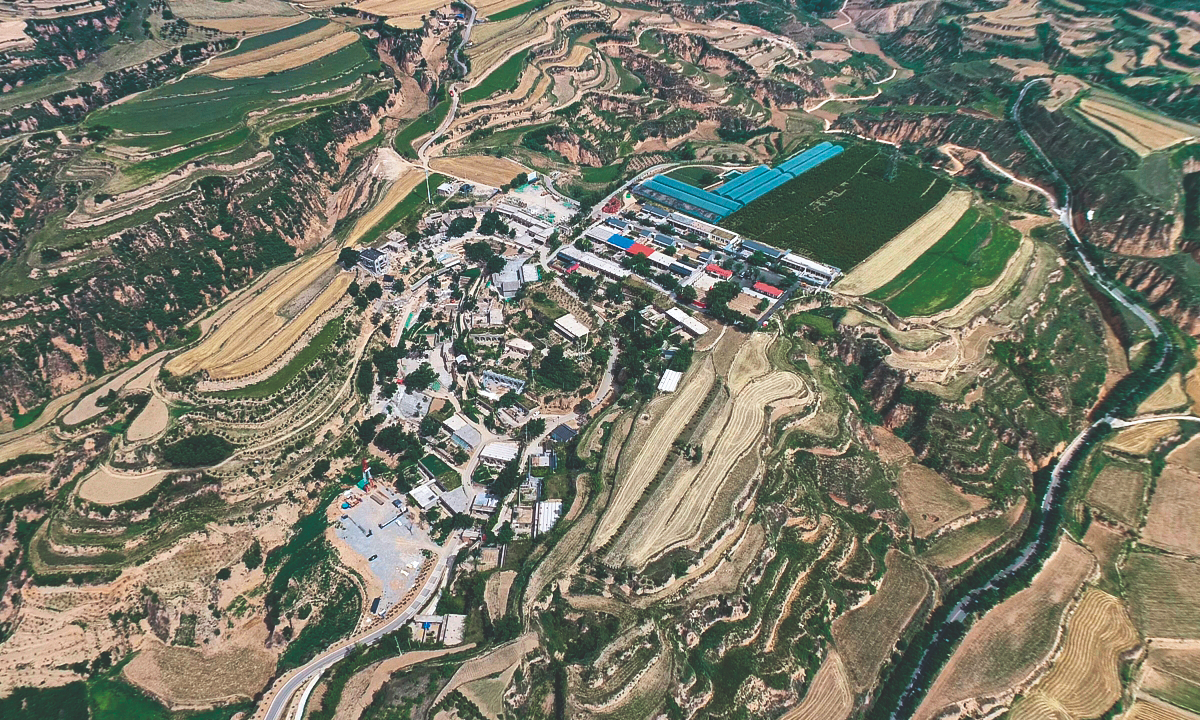
Rebuilt homes now sit atop a cliff with the wide, clean roads lined by hawthorn trees. Zhu Linmei, a villager, praised the spotless environment. Traveling to Huozhou city center - 13 kilometers away - became easier with a direct bus running daily.
"Everything is convenient now. Two years ago, seeing more tourists coming to our village, I planned to apply for a business license, which was handled online," villager Chen Xing'e said. Other villagers echoed, saying that nearly all daily affairs can now be managed within the village. Zhu Linmei also chimed in: "Pension verification too."
During the reconstruction and development of Fengnanyuan village, Huozhou established a Fengnanyuan zone, which included three neighboring villages - Zhoucun, Shizhuang and Laozhangwan - under Shizhuang township, and drafted a master plan for the zone's development. While building infrastructure, Fengnanyuan village and the zone prioritized convenient services.
According to Chen Lingzhen, director of Shizhuang township's integrated convenience service center, Shanxi's self-service kiosks now provide 115 government services, including elderly subsidy distribution, accessible via village terminals or mobile phones.
Village officials frequently assist elderly villagers in handling various affairs, earning their deep trust.
The Fengnanyuan village regards its senior residents as assets. People over 60-year-old can earn more than 50 yuan ($7.03) per day by helping with cleaning the village, while aid is promptly delivered to those in need.
Shi Hongbing is now the "publicity ambassador" for the village. Last year, the sightseeing helicopter service launched by Huozhou city opened a route to Fengnanyuan. On October 1, 2024, Shi Hongbing and his wife were invited to take the helicopter for a bird's-eye view of the entire village. From the old houses at the valley floor to the new homes atop the cliff, Shi Hongbing was deeply moved: "It was hard to imagine the happy life that we have now."
Booming industries
On January 26, 2022, during his visit to Fengnanyuan village, Xi observed Shi Hongbing's family making nianmo (traditional steamed flower buns) and joined in, shaping a jujube flower bun and topping it with a red date. To solve the problem of nianmo's short shelf life, Huozhou partnered with research institutes to refine production techniques, extending the shelf life to more than one month at room temperature. This enables year-round and nationwide sales, making nianmo a pillar industry in Huozhou.
The post-reconstruction of Fengnanyuan village also started with nianmo. In 2023, the village converted four idle cave dwellings into a processing workshop. By 2024, it was upgraded to a factory at the former grain depot of Shizhuang township, and is now split into a processing plant and an experience hall. At the hall, visitors can participate hands-on in tracing wheat grain to a finished bun.
Industrial growth is driving employment. Li Yunping, a villager of Fengnanyuan, worked 16 days last winter at the plant, earning 100 yuan daily. "It's idle time, but great income," she said. To counter seasonality and boost revenue, the factory is diversifying its operations. Yang Qin, an official at Shizhuang township, said that production lines will expand beyond nianmo to flower buns and macaron buns, plus a plan to add a tomato sauce production line.
The experience hall is also evolving, now becomes part of a "red agritourism + folk customs" study route. Several attractions along this route were converted from Fengnanyuan's cave dwellings.
Fengnanyuan village recently hosted its first cultural relics exchange fair, which ran for two days and attracted more than 30 businesspeople, said Yang.
"Developing agritourism and cultural tourism requires both facilities and carriers," Yang said. Fengnanyuan's key carrier is a Spring Festival fair, having been held three times since its debut in 2023, each attracting more than 200,000 visitors.
The village, after reconstruction, also expanded industries such as vegetables, livestock, and photovoltaic, boosting collective income from 81,000 yuan in 2021 to over 350,000 in 2024, with per capita income rising from about 17,000 in 2021 to 22,000 yuan in 2024.
According to the master plan for the Fengnanyuan zone, a cultural-tourism belt themed on ancient post roads will be built, while restoring historical sites. Villager Zhu Jianping converted his three shops into an ancient post road memorial hall, where he volunteered as tour guide. The admission was free. Zhu Jianping said he has hosted self-driving tourists from Shanghai, who were fascinated by Fengnanyuan's architecture, customs, and scenery. "With deep history, unique culture, and strong policies, our future looks bright."
Returning to hometown
"I returned to Fengnanyuan village in 2022," said villager Shi Xinping. "When I came back for the Spring Festival, I saw new industries emerging. I also needed to care for my elderly parents, so I decided to stay and work here."
Like many hardworking villagers in Fengnanyuan, Shi Xinping had long sought opportunities in cities. He first ran a crafts factory in Taiyuan, capital of Shanxi Province. Over a decade ago, he moved to Huozhou, bought a home for his two children's education, and worked as a carpenter, earning 8,000-9,000 yuan a month. Though income was lower than in cities, Shi Xinping said that the greenhouse at village brought him nearly 40,000 yuan yearly.
Industry growth depends on talent. In Fengnanyuan village and the broader region, the return of talent has been accelerating. Villager Chen Taohong, a breeding expert, managed farms for enterprises elsewhere with his family. When Fengnanyuan's modern sheep farm was completed in late 2023, Chen Taohong returned to village and contracted the sheep farm. Industrial development created more jobs and entrepreneurship, boosting the village's appeal.
Since the reconstruction of Fengnanyuan village, 13 households have returned home, with an increasing number of villagers visiting more frequently to evaluate opportunities for employment and entrepreneurship.
The trend of returning home has also spread to neighboring villages. Liu Shiqi from Shizhuang village, a former restaurant chef in Huozhou, returned home and opened a farm guesthouse in April 2023. Liu's neighbor Zhang Shuangfeng, in her 50s, works half-days there, earns 1,500 yuan a month. Chang Qing from Zhoucun village now runs an agritourism business at home, employing six full-time employees and some temporary workers, with monthly payroll reaching 40,000-50,000 yuan.
"I'm happy to support my neighbors," Chang said, "But above all, the development of Fengnanyuan zone has benefited everyone. I am just one of its many beneficiaries."
Li Lei is a reporter for China Rural Revitalization magazine.
China Rural Revitalization magazine has published a series of articles on the rapid development and transformation of rural China. The articles reflect the arduous efforts of rural revitalization across the country, which is an important and genuine solution to China's rural economic development. In the future, articles selected from this series will be published on Global Times.
An aerial view of Fengnanyuan village, Huozhou, in North China's Shanxi Province Photo: Courtesy of China Rural Revitalization magazine
Xi Jinping, general secretary of the Communist Party of China Central Committee, on January 26, 2022, visited a village in North China's Shanxi Province that was affected by severe floods in October 2021.
Braving the snow, Xi went to Fengnanyuan village of Huozhou city, where he visited the disaster-affected people and learned about local post-disaster reconstruction, the Xinhua News Agency reported.
In October 2021, heavy rains caused 19 houses in Fengnanyuan village to collapse and damaged 65 others across 42 households. Local authorities acted quickly, completing all necessary repairs and rebuilds by November 30 that year. Villager Shi Hongbing's four cave dwellings were destroyed, but he was already living in two newly built prefabricated homes in January 2022.
During his visit, Xi inspected Shi Hongbing's yard and house, chatted with the Shi family. Xi stressed the need to dovetail reconstruction with rural vitalization, improve integrated river basin management, and improve the capacity for disaster prevention, mitigation and relief.
Three years on, Fengnanyuan village has accelerated infrastructure construction and developed planting, animal husbandry, and rural tourism. At 68, Shi Hongbing spoke enthusiastically about the changes his home village had undergone: paved roads, water pipelines, heaters for daily life; greenhouses, sheep farms, and tourism becoming booming industries.
Along the ancient millennium trail, a vibrant rural revitalization unfolds amid lush trees and blooming flowers.
From valley floor to cliff crest
Rebuilt homes now sit atop a cliff with the wide, clean roads lined by hawthorn trees. Zhu Linmei, a villager, praised the spotless environment. Traveling to Huozhou city center - 13 kilometers away - became easier with a direct bus running daily.
"Everything is convenient now. Two years ago, seeing more tourists coming to our village, I planned to apply for a business license, which was handled online," villager Chen Xing'e said. Other villagers echoed, saying that nearly all daily affairs can now be managed within the village. Zhu Linmei also chimed in: "Pension verification too."
During the reconstruction and development of Fengnanyuan village, Huozhou established a Fengnanyuan zone, which included three neighboring villages - Zhoucun, Shizhuang and Laozhangwan - under Shizhuang township, and drafted a master plan for the zone's development. While building infrastructure, Fengnanyuan village and the zone prioritized convenient services.
According to Chen Lingzhen, director of Shizhuang township's integrated convenience service center, Shanxi's self-service kiosks now provide 115 government services, including elderly subsidy distribution, accessible via village terminals or mobile phones.
Village officials frequently assist elderly villagers in handling various affairs, earning their deep trust.
The Fengnanyuan village regards its senior residents as assets. People over 60-year-old can earn more than 50 yuan ($7.03) per day by helping with cleaning the village, while aid is promptly delivered to those in need.
Shi Hongbing is now the "publicity ambassador" for the village. Last year, the sightseeing helicopter service launched by Huozhou city opened a route to Fengnanyuan. On October 1, 2024, Shi Hongbing and his wife were invited to take the helicopter for a bird's-eye view of the entire village. From the old houses at the valley floor to the new homes atop the cliff, Shi Hongbing was deeply moved: "It was hard to imagine the happy life that we have now."
Booming industries
On January 26, 2022, during his visit to Fengnanyuan village, Xi observed Shi Hongbing's family making nianmo (traditional steamed flower buns) and joined in, shaping a jujube flower bun and topping it with a red date. To solve the problem of nianmo's short shelf life, Huozhou partnered with research institutes to refine production techniques, extending the shelf life to more than one month at room temperature. This enables year-round and nationwide sales, making nianmo a pillar industry in Huozhou.
The post-reconstruction of Fengnanyuan village also started with nianmo. In 2023, the village converted four idle cave dwellings into a processing workshop. By 2024, it was upgraded to a factory at the former grain depot of Shizhuang township, and is now split into a processing plant and an experience hall. At the hall, visitors can participate hands-on in tracing wheat grain to a finished bun.
Industrial growth is driving employment. Li Yunping, a villager of Fengnanyuan, worked 16 days last winter at the plant, earning 100 yuan daily. "It's idle time, but great income," she said. To counter seasonality and boost revenue, the factory is diversifying its operations. Yang Qin, an official at Shizhuang township, said that production lines will expand beyond nianmo to flower buns and macaron buns, plus a plan to add a tomato sauce production line.
The experience hall is also evolving, now becomes part of a "red agritourism + folk customs" study route. Several attractions along this route were converted from Fengnanyuan's cave dwellings.
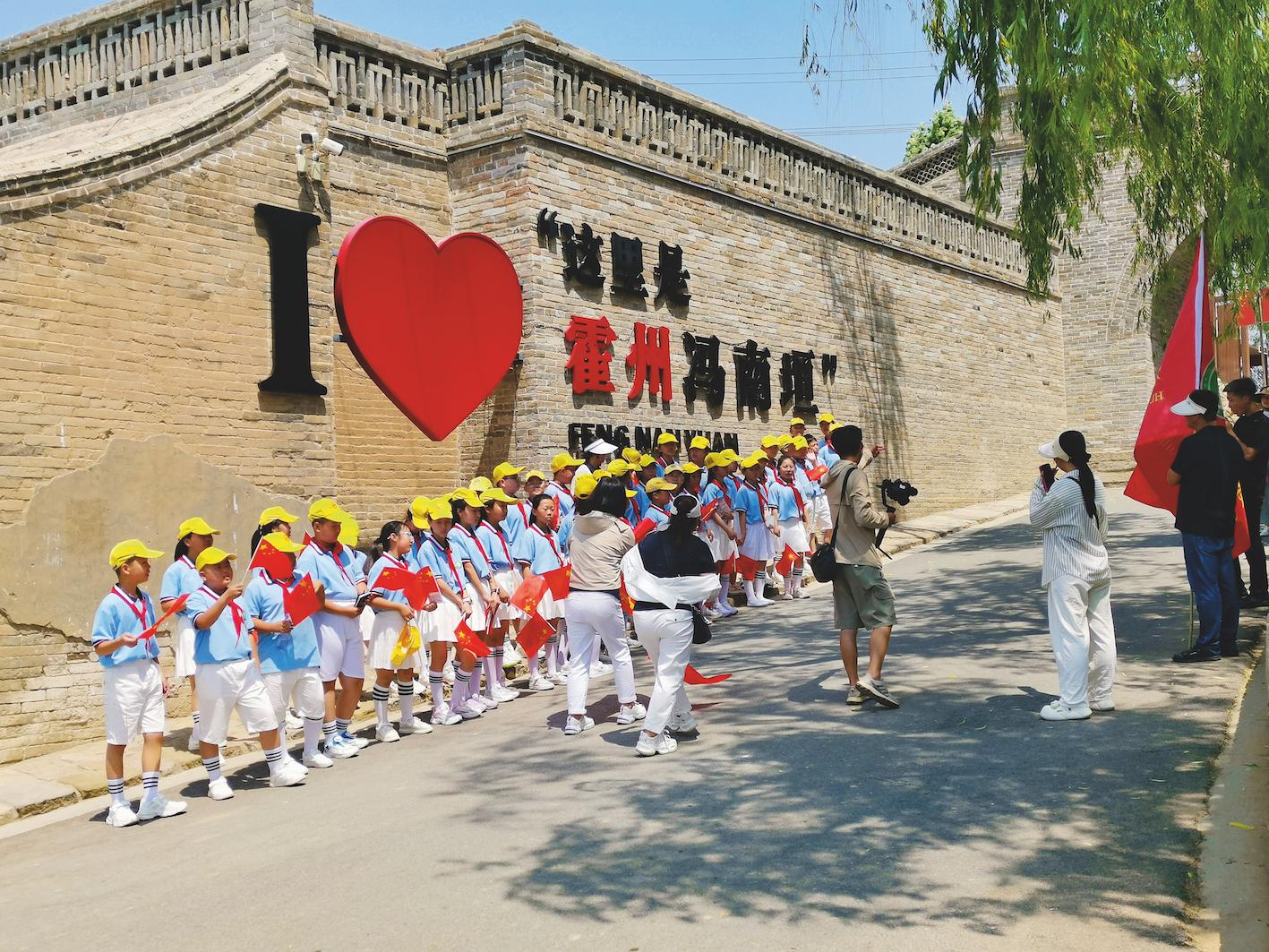
A study tour team of pupils from Huozhou take a group photo in Fengnanyuan village, North China's Shanxi Province. Photo: Courtesy of China Rural Revitalization magazine
Fengnanyuan village recently hosted its first cultural relics exchange fair, which ran for two days and attracted more than 30 businesspeople, said Yang.
"Developing agritourism and cultural tourism requires both facilities and carriers," Yang said. Fengnanyuan's key carrier is a Spring Festival fair, having been held three times since its debut in 2023, each attracting more than 200,000 visitors.
The village, after reconstruction, also expanded industries such as vegetables, livestock, and photovoltaic, boosting collective income from 81,000 yuan in 2021 to over 350,000 in 2024, with per capita income rising from about 17,000 in 2021 to 22,000 yuan in 2024.
According to the master plan for the Fengnanyuan zone, a cultural-tourism belt themed on ancient post roads will be built, while restoring historical sites. Villager Zhu Jianping converted his three shops into an ancient post road memorial hall, where he volunteered as tour guide. The admission was free. Zhu Jianping said he has hosted self-driving tourists from Shanghai, who were fascinated by Fengnanyuan's architecture, customs, and scenery. "With deep history, unique culture, and strong policies, our future looks bright."
Returning to hometown
"I returned to Fengnanyuan village in 2022," said villager Shi Xinping. "When I came back for the Spring Festival, I saw new industries emerging. I also needed to care for my elderly parents, so I decided to stay and work here."
Like many hardworking villagers in Fengnanyuan, Shi Xinping had long sought opportunities in cities. He first ran a crafts factory in Taiyuan, capital of Shanxi Province. Over a decade ago, he moved to Huozhou, bought a home for his two children's education, and worked as a carpenter, earning 8,000-9,000 yuan a month. Though income was lower than in cities, Shi Xinping said that the greenhouse at village brought him nearly 40,000 yuan yearly.
Industry growth depends on talent. In Fengnanyuan village and the broader region, the return of talent has been accelerating. Villager Chen Taohong, a breeding expert, managed farms for enterprises elsewhere with his family. When Fengnanyuan's modern sheep farm was completed in late 2023, Chen Taohong returned to village and contracted the sheep farm. Industrial development created more jobs and entrepreneurship, boosting the village's appeal.
Since the reconstruction of Fengnanyuan village, 13 households have returned home, with an increasing number of villagers visiting more frequently to evaluate opportunities for employment and entrepreneurship.
The trend of returning home has also spread to neighboring villages. Liu Shiqi from Shizhuang village, a former restaurant chef in Huozhou, returned home and opened a farm guesthouse in April 2023. Liu's neighbor Zhang Shuangfeng, in her 50s, works half-days there, earns 1,500 yuan a month. Chang Qing from Zhoucun village now runs an agritourism business at home, employing six full-time employees and some temporary workers, with monthly payroll reaching 40,000-50,000 yuan.
"I'm happy to support my neighbors," Chang said, "But above all, the development of Fengnanyuan zone has benefited everyone. I am just one of its many beneficiaries."
Li Lei is a reporter for China Rural Revitalization magazine.
RELATED ARTICLES