ARTS / CULTURE & LEISURE
Recording Nanjing through the eyes of its wartime civilians
A lifelong mission
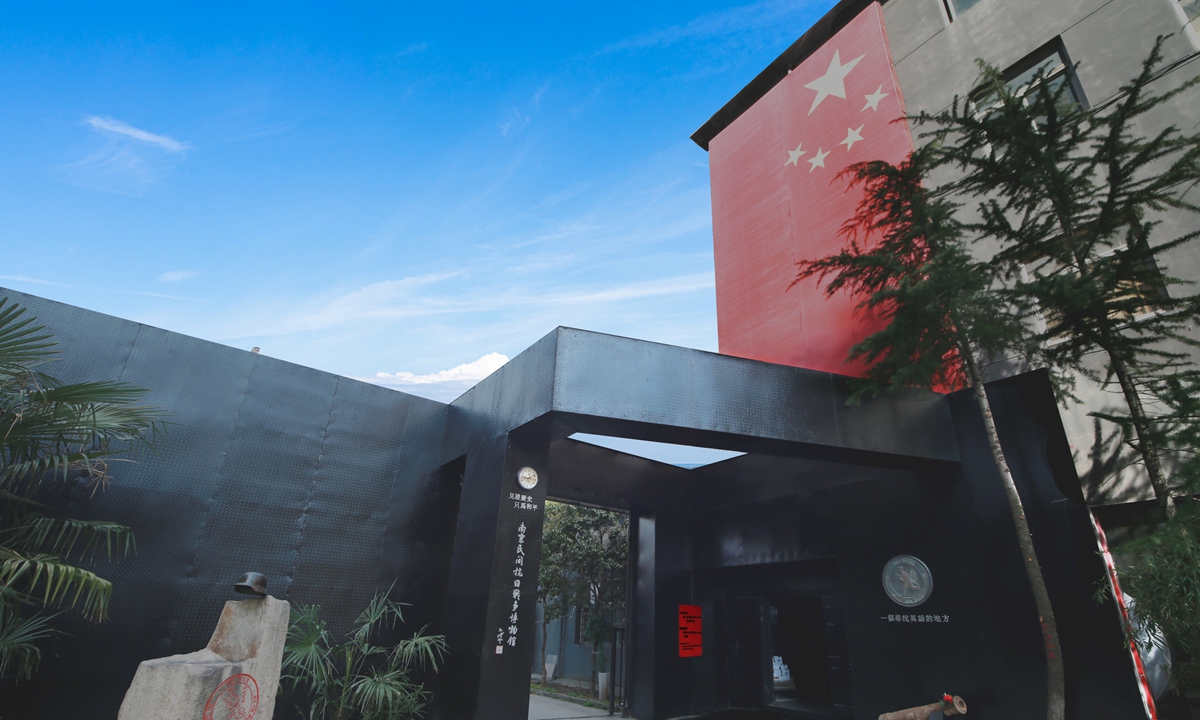
The Nanjing Folk Anti-Japanese War Museum in Nanjing, East China's Jiangsu Province Photos on this page: Courtesy of Wu Xianbin
In the film Dead To Rights, there is one scene that depicts the Japanese army's theft of bricks from Nanjing's Ming Dynasty (1368-1644) City Wall, intending to transport them to Japan for the construction of the "Hakko Ichiu" Tower. In a pivotal scene, a Chinese soldier, undaunted by death, uses one of these bricks to fight back — an act that has resonated strongly with viewers. This scene in the film is, in fact, based on a true historical event.
In total, more than 200 stone bricks were looted from China by Japanese troops to build the "Hakko Ichiu" Tower in Niyazaki, including four from Nanjing, East China's Jiangsu Province.
Since 2015, Wu Xianbin, a Nanjing native and the director of the Nanjing Folk Anti-Japanese War Museum, has led delegations to Japan to demand the return of Nanjing's stones from the tower, delivering open letters to Miyazaki authorities. He told the Global Times that there has yet to be any official response from Japan. During his recent visit to Miyazaki in 2024, he was only able to bring back a replica of the stones — now displayed in his museum.
But he has not given up. "I will continue asking," he told the Global Times. "Sometimes the outcome is less important than the process. Through the act of demanding the return of the stones, we have helped more people know the crimes symbolized by the tower."
A seed planted early
Wu traces his calling back to a winter in 1983, when he was just in his 20s, working in the audiovisual room of Nanjing University. He came across a 14-minute film, filmed by an American pastor during the Nanjing Massacre, that left a deep and lasting impression. He described the experience as a seed taking root in his heart
In 2004, Wu, then already modestly successful in business, stumbled upon a tattered pictorial album about the Nanjing Massacre at an antique stall. The pages were yellowed and brittle. As he turned them, he was overcome by a chill. He spent 10,000 yuan ($1,405.54) to buy it.
It was from that album that he began his search for materials on the Nanjing Massacre and the Chinese People's War of Resistance Against Japanese Aggression (1931-45). "It felt like the seed in my heart had finally encountered sunlight and couldn't stop growing," Wu said, reflecting on how the album changed him.
Although it was two chance encounters that set Wu on the path to opening the museum, he sees them as inevitable. "I consider those coincidences a kind of necessity," he said. "Because I am a Nanjing native, and no matter which way I turn, I cannot avoid [this history]."
Starting with that photo album, Wu searched for items connected to the War against Japanese Aggression. "For these years, recycling depots, antique markets, junkyards, and swap stations were the places I visited most. Now, whenever something related to Nanjing's history surfaces, I'm the first to know."
By 2006, his collection had grown to more than 100 pieces. "The history of the War against Japanese Aggression is truly vast and epic, but when it comes to the specifics, there is still much to add. So I decided to found a folk museum."
"There were already many museums that present the grand narrative of the war , so I wanted to add a more micro-level perspective," he added.
On December 12 that year, his museum officially opened to the public. He chose a factory that had once been used for his timber business, and later transformed it into the museum.
"It was very small at first," he said, "but people still came in an endless stream." The museum offers free admission Tuesday through Sunday.
Nineteen years later, the collection has grown exponentially: More than 40,000 books, 6,000 artifacts, and countless photographs and personal items. What makes the museum unique is its insistence on a civilian perspective.
Visitors can even see the original front-page of Ta Kung Pao proclaiming "Japan Surrenders!"— a newspaper Wu searched 14 years to acquire; and the name card and a pair of eyeglasses of Iris Chang, the author of The Rape of Nanking. In addition, five videotapes filmed in 1995 when Chang came to Nanjing to interview massacre survivors are also collected here, according to Wu.
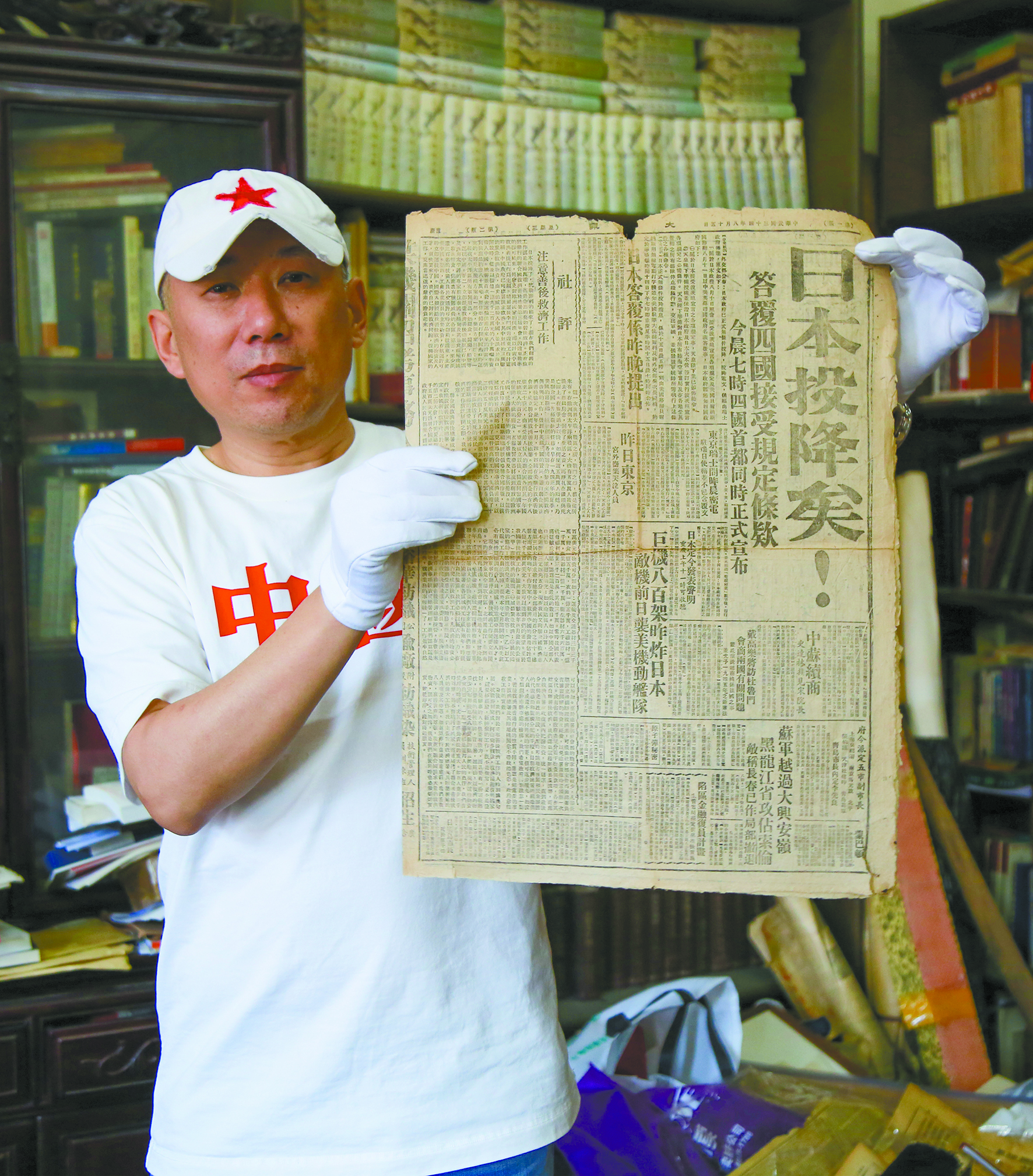
Wu Xianbin displays the original front page of Ta Kung Pao - which proclaims "Japan Surrenders!" - in 2022 at his museum. Photo: Courtesy of Wu Xianbin
Racing against time
On the third floor of the museum stands a wall, 16 meters long and 3 meters high. It bears the bright red handprints of 980 veterans of the War against Japanese Aggression along with their handwritten enlistment details. Beside them are the words in Chinese: "With me, China will not fall."
The handprints came from an oral history project the museum launched in 2012 to document the lives of veterans of the War against Japanese Aggression. Led by Wu, the team traveled across 28 provinces and regions, recording video interviews with 1,760 veterans and compiling more than 10 million words of transcripts.
For Wu, the project was like a "family letter" written by the veterans to the nation, and also a race against time. A veteran died less than a week after being interviewed; another passed away the day before the team arrived. One man, upon learning their purpose, rose to his feet and bowed deeply, saying, "Children, thank you for coming to see me."
"Thousands upon thousands of people were willing to fight for this nation to the very end. The history of the War against Japanese Aggression is made up of every detail, every individual, every single day." he said. "It is our blessing that the final footage of these veterans in their later years can be preserved in the museum."
Wu downplays the hardships of collecting. "People want me to tell some thrilling story — like driving a car, flipping over three times, crawling out of wreckage, and clutching an artifact. I've never done anything like that. Artifacts can only be found through a combination of patient searching and quiet waiting," he said.
As for the future, Wu has no grand ambitions but to "keep the museum going for a long time." Through it, a historical memory will remain vivid.
RELATED ARTICLES