Illustration: Xia Qing/GT
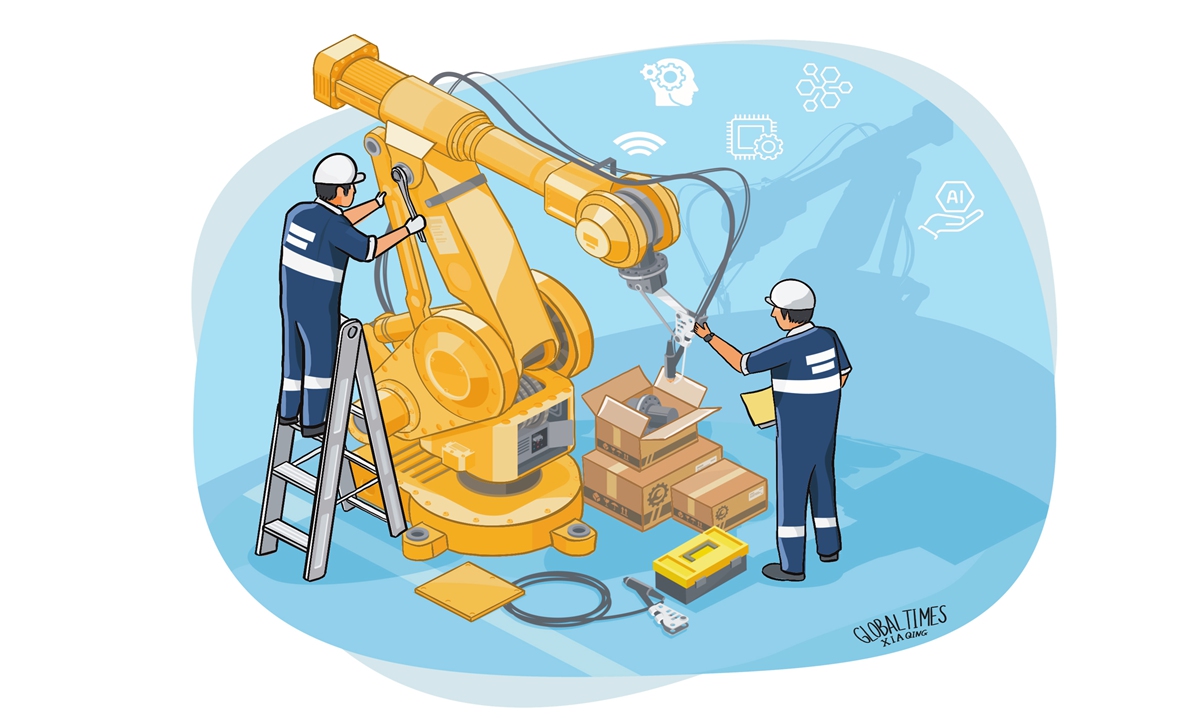
From September 19 to 23, the 3rd Vocational Skills Competition of the People's Republic of China was held in Central China's Henan Province, bringing together competitors from across the country. More than a contest, the event served as a window into how China is aligning its labor market with broader industrial transformation and technological progress.This year's competition featured 106 events, with more than half devoted to emerging fields such as intelligent manufacturing, industrial internet, and artificial intelligence (AI), according to the Xinhua News Agency. The prominence of these sectors underscores how China is positioning vocational skills as an important part of its transition toward a high-tech, innovation-driven economy. The emphasis is not only on raising the profile of technical training, but also on preparing a workforce capable of supporting the growth of advanced industries.
Xinhua reported that in May, China's human resources authorities unveiled 17 newly recognized professions, ranging from cross-border e-commerce operations manager to drone swarm flight planner and electronic circuit designer. The list, spanning both AI-related roles and emerging services-sector specialties, reflects how technological change is steadily reshaping the labor market. Many emerging occupations were showcased at this year's competition, underscoring the growing convergence between policy priorities and the practical skills being developed on the ground.
China's push to upgrade its industries is shining a spotlight on the crucial role of high-skilled talent in driving high-quality economic growth. China has more than 200 million skilled workers, with over 60 million recognized as highly skilled, the People's Daily reported last September. This pool of engineers, senior technicians, and technical specialists is increasingly vital as industries from intelligent manufacturing to semiconductors compete for high-skilled talent.
China has attached great importance to high-skilled talent development. As the Xinhua News Agency reported, in 2022, policymakers released the Guidelines on Strengthening the Construction of the High-Skilled Talent Team in the New Era, which laid out plans to modernize training systems, expand technical education, and boost the supply of urgently needed specialists. Two years later, fresh guidelines on reforming the industrial workforce emphasized tailoring skills development to new forms of industrialization and closing gaps in advanced manufacturing capabilities.
Driven by policy support and the surging demand from industrial upgrading, the development of high-skilled talent in China today enjoys significant advantages. As the social status and wage levels of high-skilled workers are improving, technical careers have become more attractive, reinforcing a virtuous cycle of talent development. As China pursues high-quality development, its ability to nurture and retain skilled talent may prove just as decisive as breakthroughs in technology or investment.
The rapid emergence of new occupations inevitably brings challenges, particularly for the education and training systems. Many of these roles require interdisciplinary expertise. Some fast-growing sectors are so new that instructors themselves often lack firsthand industry experience, making it harder to translate cutting-edge practices into effective teaching.
In response to these emerging challenges, China has been expanding its training infrastructure, ranging from technical schools to industry-education integration hubs and corporate training centers. Local governments and enterprises alike are investing in skilled talent development programs to align talent supply with industrial demand. This is particularly evident in growth sectors such as new energy and intelligent manufacturing, where shortages of skilled technicians could otherwise constrain expansion.
Another challenge lies in shifting mindsets. The steady emergence of new professions suggests that China's system of credentialing and employment is gradually moving away from a "diploma-first" culture toward a skills-oriented approach. For individuals, the implication is clear: building practical capabilities and engaging in lifelong learning after graduation are becoming ever more critical.
At this year's Vocational Skills Competition, more than half of the events focused on emerging fields - a clear indication of the speed at which change is unfolding. The rapid rise of new professions is injecting momentum into cutting-edge industries. At the same time, the pace of transformation in the labor market is pushing those working in relevant sectors to adapt more quickly to the challenges that such shifts inevitably bring.
The author is a reporter with the Global Times. bizopinion@globaltimes.com.cn
RELATED ARTICLES