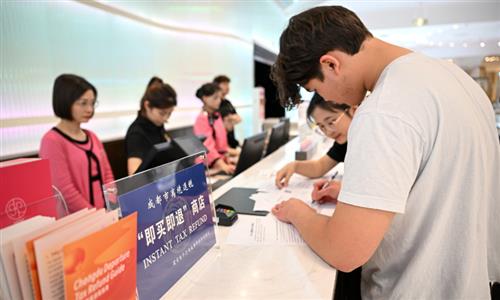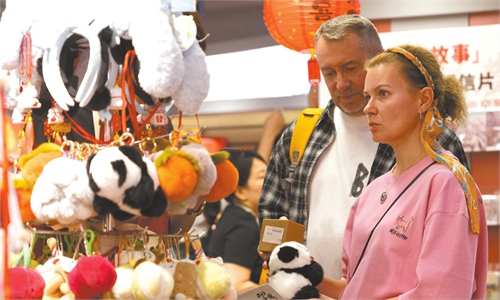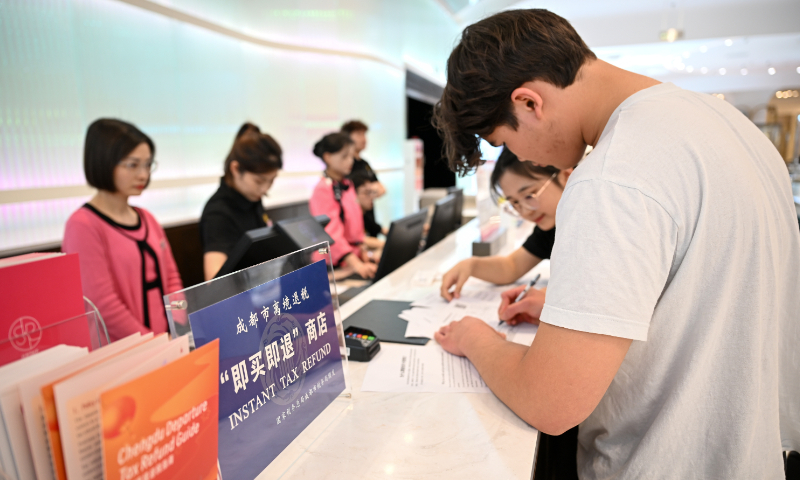
A Dutch consumer (right) handles tax refund procedures at a shopping mall in Chengdu, Southwest China's Sichuan Province, on April 27, 2025. Photo: VCG
In the first eight months of 2025, Shanghai Customs verified 96,600 departure tax refund applications, a year-on-year increase of 168 percent, with a total merchandise value of 2.07 billion yuan ($290 million), up 83 percent. Both figures topped the full-year totals in 2024, emerging as a fresh highlight in consumption growth, data released on Tuesday showed.
The customs office at Shanghai Hongqiao International Airport also verified 3,329 departure tax refund applications during the summer travel peak, up 40 percent, with a verified refund amount of 125 million yuan, up 31 percent year-on-year.
This surge aligned with broader national efforts to refine and expand tax refund mechanisms, and it got a boost from the increasing number of inbound tourists. Since the start of 2025, the departure tax refund policy in many cities has continued to unleash significant benefits, serving as a key measure to ignite inbound travelers' consumption enthusiasm and enhance their cross-border shopping experiences, analysts said.
Shanghai was only one of the many Chinese cities that witnessed a surge in departure tax refund applications and value. Nationwide, the policy's momentum has accelerated.
In the first eight months of this year, the number of people enjoying tax refunds increased by 247.8 percent year-on-year. The sales of tax-refundable goods increased by 97.5 percent year-on-year, while the refund value increased by 96.9 percent, according to the State Taxation Administration (STA).
As of the end of August, the number of tax refund stores catering to foreign visitors nationwide exceeded 10,000, a threefold increase from the end of 2024, official data showed.
Adding to the excitement, the first and only downtown duty-free store in Chengdu, Southwest China's Sichuan Province, is set to open on Thursday.
Targeting outbound travelers holding valid entry-exit documents and tickets for flights or international cruises departing within 60 days, the new store will offer duty-free shopping exclusively for those leaving from Chengdu ports.
This opening fits into a wave of urban duty-free expansions, following an official statement in late August, saying that outbound travelers will be able to explore downtown duty-free shopping in more Chinese cities and more easily access consumer goods of fashionable Chinese brands, according to the Xinhua News Agency.
A duty-free store will be opened in each of eight cities -- Guangzhou, Chengdu, Shenzhen, Tianjin, Wuhan, Xi'an, Changsha and Fuzhou -- as required by recently released interim measures for the administration of duty-free shops in cities, read the August statement.
Cities that have set up duty-free stores have already witnessed significant growth. Hangzhou in East China's Zhejiang Province, for example, now has 267 duty-free stores, up 126.3 percent year-on-year. So far this year, the sales for goods eligible for departure tax refunds is up 2.5 times year-on-year. Among them, there were 124 "refund-upon-purchase" stores, an increase of 785.7 percent compared with last year, according to a report by the STA.
From "Travel to China" to "Shopping in China," the nation has adeptly turned its tourism appeal into a surge in consumer spending, strengthening the inbound tourism industry while affirming its resolve to deepen openness and address the varied preferences of global travelers with premium offerings and enhanced services, Wang Peng, an associate research fellow at the Beijing Academy of Social Sciences, told the Global Times.
On April 27, China introduced measures to optimize the policy, including lowering the minimum purchase threshold for refunds, raising the cash refund ceiling, expanding the network of participating stores, and broadening the range of products covered, said Xinhua.
"From tax refunds on departure to visa-free policies, and from the diversification of consumption scenarios to the internationalization of the consumption environment, we will strive to make global consumers' journeys more convenient, their experiences more enjoyable, and their purchases more cost-effective, allowing them to discover a China that is more open, inclusive, diverse, and innovative," Chinese Vice Minister of Commerce Sheng Qiuping said on September 17 at a press conference.
RELATED ARTICLES