ARTS / CULTURE & LEISURE
High-tech bridges inheritance at 2025 Beijing Culture Forum
Efforts to merge culture, technology highlighted
By Published: Sep 23, 2025 11:13 PM


2025 Beijing Culture Forum Photo: Courtesy of organizers
The 2025 Beijing Culture Forum kicked off on Tuesday with "inheritance, creativity, mutual learning" as its theme, gathering some 800 domestic and international guests from 58 countries and regions to explore how digital innovation can boost cultural creativities, enhance public cultural services and promote civilizational exchanges, said organizers of the event on Tuesday.During the main forum, participants from both China and abroad highlighted China's efforts to develop effective mechanisms for merging culture and technology. They noted that digital empowerment of cultural development is critical to turning cultural resource advantages into developmental strengths, emphasizing that deep integration of culture and technology amid the new technological revolution can reshape how cultural content is produced and spread.
Echoing these sentiments, Lazare Eloundou Assomo, director of UNESCO World Heritage, stressed the forum's alignment with his organization's core mission.
"This gathering resonates deeply with UNESCO's mission: To build peace through intercultural dialogue and safeguarding humanity's heritage," he said at the forum. Assomo added that the World Heritage List now includes over 1,200 sites spanning 4.8 million square kilometers that are home to one-fifth of the world's documented species.
People's shared World Heritage faces growing threats, including climate change, overtourism and biodiversity loss, Assomo warned. "In this context, digital technologies have become indispensable allies. They allow us to document, monitor and manage heritage in ways unimaginable a generation ago."
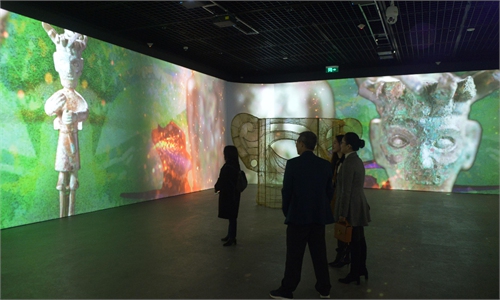
Shifting to the forum's afternoon parallel sessions, one of which focused specifically on digital empowerment for cultural heritage, global experts shared practical applications of tech in conservation.
Douglas Comer, president of ICOMOS US National Committee, cited satellite remote sensing and other high-tech means as effective tools for monitoring visitor flow and protecting uninhabited heritage areas.
Also weighing in on digitalization's role in engaging younger generations was Paolo Giulierini, director of Italy's Etruscan Academy Museum of the City of Cortona. He underscored that digital tools are vital for modern museums, noting two key benefits: enhancing tourism via reconstructions like virtual models of ancient ruins, and connecting with youth who "see the world through the digital." "It is important that museums speak the language of young people," Giulierini told the Global Times during the forum.
He also praised Chinese digital projects, such as the chariot reconstruction at Beijing's Capital Museum, for making cultural heritage more accessible. Looking ahead, he anticipated deeper collaboration between Italy and China, noting their status as global leaders in cultural heritage. Italy's strengths in conservation and restoration, paired with China's advancements in digitalization, he said, lay a promising foundation for joint projects.
Beyond international perspectives, Chinese cultural institutions also shared their digital heritage practices.
Yu Tianxiu, a vice deputy director of the Dunhuang Academy, highlighted Dunhuang's leading role in using digital technology to safeguard heritage and foster global cultural exchange. He told the Global Times that the academy plans to launch a new digitalization partnership this year with Russia's State Hermitage Museum in St. Petersburg, a significant step in international cultural preservation efforts.
Zhu Hongwen, a deputy director of the Palace Museum, shared another key update with the Global Times: 2025 marks the museum's centenary. "Over 100 years, our conservation philosophy has evolved from 'physical protection' to 'digital activation,' digitalization has been a milestone," Zhu said.
The Palace Museum has already built digital infrastructure and aims to complete data collection for all its artifacts within 10 to 20 years. Zhu also revealed that the new museum in the Palace Museum's northern section is scheduled for completion in the first half of 2026.
The forum, which runs through Wednesday, has convened a diverse lineup of participants, including officials from cultural institutions, renowned scholars, representatives of world-leading cultural institutions, executives of major cultural enterprises, and industry leaders, according to the press release issued by the organizers.
In addition to a main plenary, six parallel forums, and over 20 professional salons, the event included a highlight session on Tuesday evening: A special results release that unveiled key cultural outcomes, including the 2024 Report on China-Foreign Cultural Exchanges and Top 10 Events in the Construction of China's National Cultural Center (2024), the document noted.
RELATED ARTICLES