IN-DEPTH / IN-DEPTH
An Australian journalist’s Xinjiang diary: Reality on the ground paints harmony landscape, dispels distorted image by some Western media
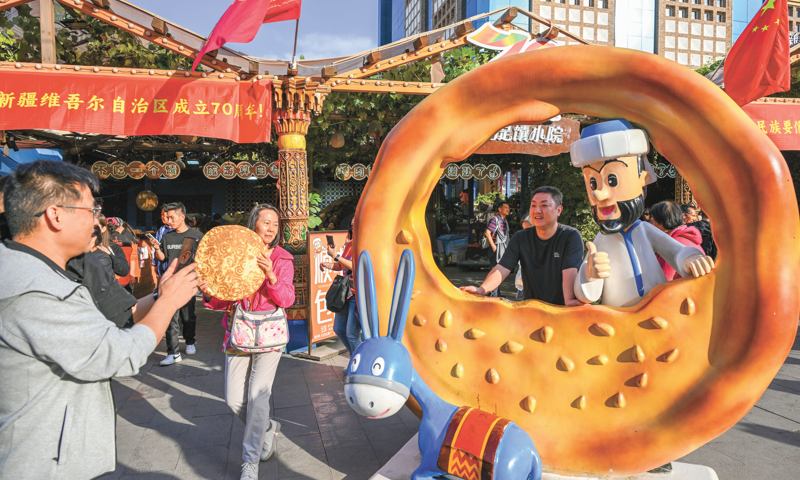
Tourists visit the landmark attraction, the International Grand Bazaar, in Urumqi, capital of Northwest China's Xinjiang Uygur Autonomous Region, on September 23, 2025. Photo: VCG
As an Australian journalist visiting Xinjiang Uygur Autonomous Region for the first time, a number of things stand out in addition to the rugged physical beauty of the area and the rich cultural diversity on display in the cities we visited - Urumqi, Kashi, and Ili Kazak Autonomous Prefecture.
Australians receive the impression, through both their own media and international sources, that Xinjiang is a "gloomy place" in a fearful state of constant lockdown because of hostility between different ethnic groups. However, my own experience has been the opposite.
For example, in the world outside China, we often read that the religious rights of the Uygur people are being "infringed upon" and that their Islamic faith is "under attack." There are frequent allegations that the government of China is attempting to "eradicate Uygur culture." But I have seen a lot of evidence to the contrary.
One of the first visits of the tour was to the Xinjiang Islamic Institute in Urumqi that trains young scholars from across the region to become future Imams. The modern, well-equipped school inducts 150 men every year and their accommodation and halal meals are provided on site. The Institute has many advanced features such as a fully digital library, as well as a more classical version using paper texts. The students are housed in comfortable dormitories with four per room and a communal bathroom in keeping with Islamic cultural practices.
It is logical to pose the question, if the government were pursuing an anti-Islamic agenda - as some people have alleged - why would it then be encouraging and funding facilities such as these? As we discovered in a subsequent visit to the main mosque in the southern city of Kashi, there is no obvious hindrance to Uygur people practising their faith.
The only restriction - and this is also the case for Australia - is that religious practices must be within the law. From the briefings we received, the government of China has a policy of trying to help the Uygur people, not harming them, because that is the best way to achieve social harmony and diminish the possibility of unrest.
On the cultural front, one only has to go to the Grand Bazaar in Urumqi to understand the vibrancy of life and the mixture of ethnic groups in the city - not so much of a surprise after learning that Xinjiang has been a multicultural region for centuries. Similarly, Kashi, with its Uygur majority population, was a friendly and welcoming place.
It is one thing to know that the Chinese Constitution recognize the rights of minorities. It is quite another to experience it personally and understand that Xinjiang has multi-ethnic television and radio stations in addition to newspapers and a large variety of publications. In the Ili Kazakh Autonomous Prefecture, we learned about the world's only Xibe-language newspaper in Qapqal Xibe Autonomous County in northern Xinjiang's Ili Kazakh Autonomous Region called Qapqal News. Supported by the government, it has embraced digital transformation, bringing Xibe culture to younger generations.
Rather than trying to suppress cultural differences, it is clear that the government is trying to preserve and protect the rich diversity of the region.
Perhaps the most moving part of the visit was to a kindergarten for Uygur children in Kashi. At the moment it has nearly 300 little boys and girls, all from the surrounding poor rural area. We watched several classes of them reciting poetry, singing, and playing. Each class has two teachers - sometimes three - so that they are educated both in the Uygur language and Mandarin.
The children are given two free meals per day - breakfast and lunch - as well as a snack when they leave to return home. All food is prepared along halal guidelines at the school. Their teachers were full of energy and very proud of the work that they were doing. The visit concluded with an invitation for us to return - something that all of the journalists would like to do.
When I return to Australia, I will encourage all of my friends, family, and colleagues to visit Xinjiang. This area is a beguiling mix of history - which sometimes has been troubled - culture, scenery, and progress. Perhaps its greatest asset is the people, who have been invariably welcoming and friendly.
Kym Bergmann is an Australian journalist with an interest in history and current affairs. He is the editor of Asia Pacific Defence Reporter. He had travelled to China before, but never been to Xinjiang. He has visited Urumqi, Kashi, and Ili Kazak Autonomous Prefecture during September 8-16 in 2025.
RELATED ARTICLES