ARTS / CULTURE & LEISURE
Folk song genre Hua’er mirrors Ningxia’s distinct agropastoral blend and ethnic harmony
Flower of tradition
By and Wu Jie Published: Sep 24, 2025 10:07 PM

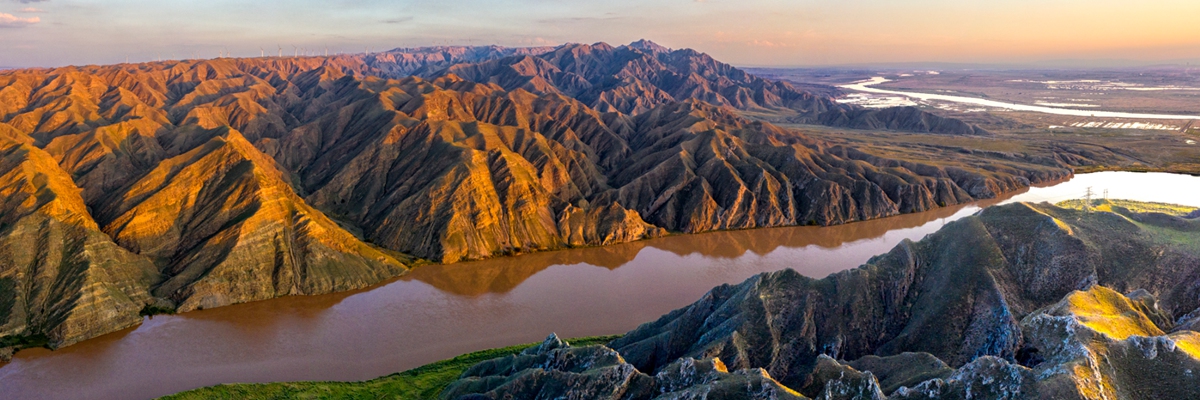
A section of the Yellow River in Northwest China's Ningxia Hui Autonomous Region Photo: VCG
Editor's Note:The Yellow River, which began to form 1.25 million years ago, gave birth to the roots and soul of the Chinese nation. As it meanders through nine provinces and autonomous regions, the river not only shapes breathtaking natural landscapes but also nurtures the core wisdom and cultural richness of the nation. The intangible cultural heritages that have developed along the Yellow River - ranging from the folk song Hua'er of Ningxia Hui Autonomous Region to the Weifang kite-making techniques of Shandong Province - serve as compelling evidence. In this series, the Global Times culture desk guides readers on a journey exploring how these living traditions embody the enduring spirit and evolving identity of the Yellow River civilization, where the UNESCO-listed Hua'er, also known as a type of "mountain songs," embodies the land's distinct agropastoral blend and ethnic harmony.
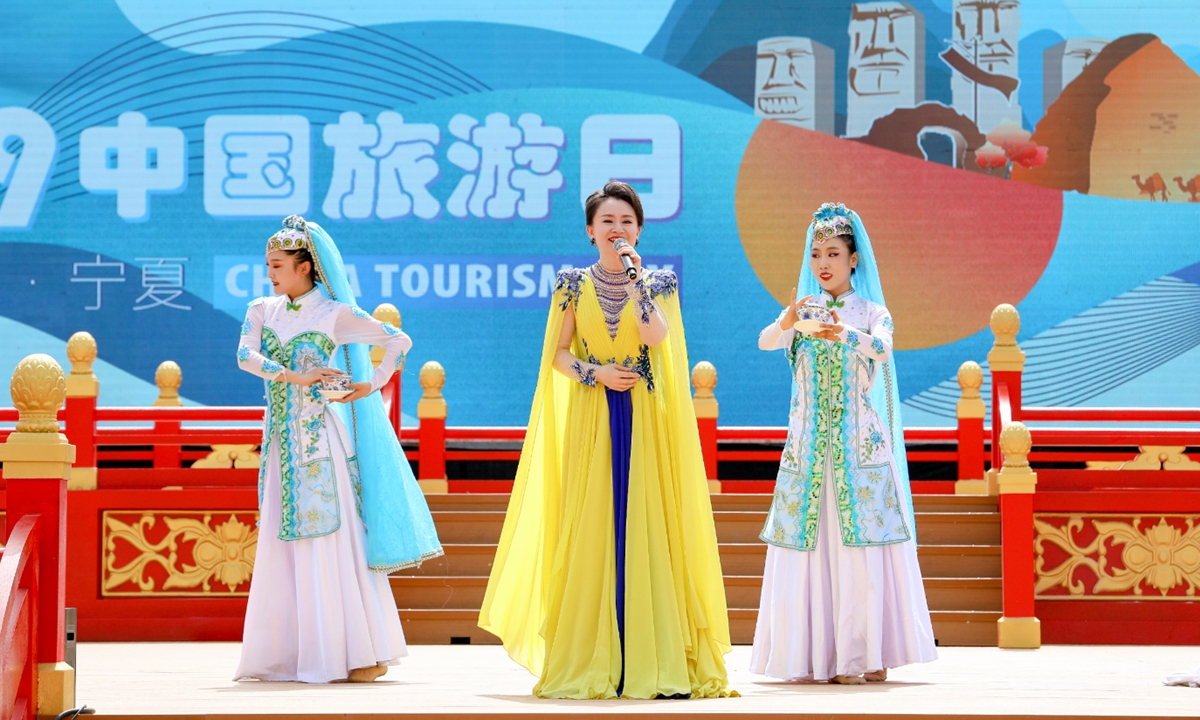
Sa Lina (center), an inheritor of the intangible cultural heritage of Hua'er, a type of folk song, performs onstage. Photo: Courtesy of Sa Lina
The sun dips behind the Helan Mountains as the rhythmic beat of drums echoes across an archery theme park in Northwest China's Ningxia Hui Autonomous Region. Onstage, a woman in traditional attire unleashes a soaring, inspiring melody that seems to capture the joy of life today. Farmers who have spent the day harvesting in the fields under the autumn sun now cheer, their faces illuminated by the stage lights.This was no ordinary performance, but one called the "Autumn Village Gala," during which the ancient folk tradition called Hua'er was performed.
Hua'er, which means "flower" in Chinese, is a 600-year-old folk song recognized by UNESCO in 2009 as an Intangible Cultural Heritage of Humanity. This high-pitched mountain song, created and shared by multiple ethnic groups across northwestern China, represents one of the most vivid oral traditions along the Yellow River basin.
In Ningxia, a region entirely encompassed by the Yellow River basin, Hua'er has developed distinct characteristics known as "mountain Hua'er." It is an important vehicle for expressing personal feelings in a social setting and cultural exchange across ethnicities, as well as a popular form of rural entertainment. Songs may sing of young love, the hard work and weariness of farming life, the foibles of men and women or the joy of song, according to the official website of UNESCO.
The Flower Song Festival is the primary cultural space for singing Hua'er. During the summer slack season, these festivals kick off across Northwest China. They are usually held in picturesque mountains and rivers, with locals, old and young, dressing up and gathering in circles of varying sizes amidst the woods, grasslands, and streams. From the first light of dawn until night falls, the resounding songs rise and fall one after another, with continuous cheers merging into a sea of joy. The singing is characterized by its high-pitched, penetrating, and melodious quality, a trait shaped by the high-altitude environment of the Loess Plateau, allowing the sound to travel across the valleys .
Sound of renewal
"Hua'er is a 'flower' from the heart, and the Yellow River is its soil," Sa Lina, a 39-year-old Ningxia intangible cultural heritage inheritor, told the Global Times.
Sa's love for Hua'er began in Haiyuan county, a small town in southern Ningxia known as the "cradle of Hua'er." "I grew up hearing the elders sing Hua'er everywhere, by the well while drawing water, in the fields while planting wheat, even while herding sheep up the hills," she recalled, a soft smile playing on her lips.
After studying music in her late teens, Sa joined the Haiyuan County Art Troupe where she crossed paths with Ma Handong, a revered Hua'er inheritor that passed away in 2018. "He told me, 'This isn't just singing. It's carrying the stories of everyone who's lived by the Yellow River here.' That's when I knew I will dedicate myself to this."
Her master's tireless teaching style sealed Sa's dedication. By 2013, at just 27 years old, Sa made history by becoming Ningxia's youngest provincial-level Hua'er inheritor.
For Sa, Hua'er's survival hinges on three pillars, which are preserving its roots, innovating its form, and sharing it widely.
"To preserve is to keep Hua'er from losing its soul," she said firmly. That soul, she argues, lies in three non-negotiables: the dialect, the "swing notes" that mirror the Yellow River's twists and turns, and the unaccompanied, unpolished style of field performances.
"When I sing 'Jiuqu Huanghe Wo de Jia' [Lit: My Home on the Great Bend of the Yellow River] in the Ningxia dialect, the notes climb like the river surging through Qingtong Gorge and fall like when it meanders through the Yinchuan Plain," she said, demonstrating with a soft trill.
"However, if I used bel canto or pop vocals, it would lose the 'earthiness,' the part that connects to our ancestors who sang these songs while working at the river's banks. That's not Hua'er anymore."
Despite its deep roots, Hua'er faces serious challenges in the 21st century. Sa told the Global Times that accomplished Hua'er singers have become rare, while most practitioners are advanced in age.
This challenge sparked a multifaceted preservation movement. In 2006, Ningxia passed an Intangible Cultural Heritage Protection Regulation, listing mountain Hua'er as a protected tradition, with the local cultural center as its primary guardian. Since 2007, Hua'er has been integrated into music curricula in southern Ningxia's rural schools, training 50 specialized teachers to pass on its techniques.
Events like the Western Folk Song (Hua'er) Festival provide modern stages for traditional arts. The recent 19th edition featured competitions in original ecology, professional, and non-professional categories, attracting participants from students to retirees.
Sa, meanwhile, is also leading innovation to win over young people. She has experimented with blending traditional Hua'er melodies with modern instruments, such as drums, electric guitars, and even pianos, wrapping the raw vocals in contemporary arrangements.
"Young people used to say Hua'er was 'old-fashioned,' like something their grandparents listened to," she said. "Now, when they hear a guitar riff under a Hua'er tune, they say, 'This is cool! I want to learn it.'"
She has also pushed Hua'er onto bigger stages, integrating it into operas and musicals. Most notably, she lent her voice to Minning Town, a production staged at Beijing's National Centre for the Performing Arts that tells the story of Ningxia's poverty alleviation efforts.
"In Minning Town, we used Hua'er's loud, fiery notes to show migrants breaking through the hard loess, and soft, winding melodies to sing about their new lives where 'the Yellow River's water tastes sweet,'" Sa said.
Sharing Hua'er beyond the stage is equally vital. Sa runs an art school in Yinchuan, where she teaches Hua'er to children as young as 5 years old and adults alike. She also posts short videos of her performances on social media, where clips of her singing Hua'er in the fields or by the Yellow River have garnered thousands of views.
"As a local, singing it lets me pass on the ethnic warmth woven into the music, a warmth shaped by the Yellow River's waters, which have sustained our people for centuries," she said.
Flower of the Yellow River
Sa's connection to Hua'er is deeply tied to the Yellow River, a link echoed by scholars who see the river as the tradition's cultural bedrock.
The deep connection between Hua'er and the Yellow River is not just lyrical but geographical and historical, as explained by Yang Zhanwu, director of the Ningxia Hui Autonomous Region Committee for Cultural History and Learning.
"To understand the soul of Hua'er, one must first understand the unique environment of the Yellow River Basin, particularly the Loess Plateau," he told the Global Times.
Hua'er's distinctive high-pitched and resonant singing style, Yang argues, is a direct product of the high-altitude terrain through which the Yellow River flows.
"When you stand on a mountain over 1,000 or even 2,000 meters high and sing, you naturally have to 'strain your voice' to be heard across the valleys. This geographic imperative shaped the very vocal genes of Hua'er, giving it that open, soaring quality that contrasts with the gentle, delicate tunes of the plains." This is not an art form that could have been born anywhere else as its voice was sculpted by the land the Yellow River traverses.
Beyond geography, the Yellow River served as a corridor for the human migrations that forged Hua'er's unique character.
Yang points to centuries of population movements from Central China into the northwestern regions of Ningxia, Gansu, and Qinghai.
"This was a process of cultural blending," he explains, adding that the agricultural artistic traditions brought by Han ethnic migrants, such as elements of Qinqiang opera, interacted with the local cultures, including those of nomadic peoples. The result was not a simple overlay but a true "localization."
This fusion is evident in the content of the songs, which touch on both farming and herding, reflecting the "semi-agricultural, semi-pastoral" lifestyle that emerged along the river. The lyrics often retain the rhythm of Chinese dialects, yet the rhythms absorbed a sense of nomadic freedom. This historical convergence, facilitated by the Yellow River, made Hua'er a living witness to ethnic and cultural integration.
Furthermore, the specific cultural ecology of the Yellow River Basin's agro-pastoral zone endowed Hua'er with its emotional complexity.
Yang describes this zone not as a simple mix of farming and herding, but as a distinct way of life that produced a unique cultural temperament, one that is both bold and refined, a characteristic vividly reflected in the music.
"It's like the local folk saying, 'having great spirit, keeping promises, daring to fight, engaged in farming and herding, and well-versed in rites,'" he says, quoting an ancient local record. "This temperament, shaped by the river's environment, translates into Hua'er as a vocal style that is both powerfully robust and delicately nuanced. The melodies are vast and open, yet the lyrics are full of tender emotion, seamlessly merging the 'heroic' and the 'graceful.'"
In this sense, Hua'er is a profound expression of the cultural identity formed along the Yellow River.
Wan Yaping, president of the Ningxia Intangible Cultural Heritage Safeguarding Association, added that the Yellow River's nourishment extends to all of Ningxia's intangible heritages. He noted that among the nine provinces (regions) along the Yellow River, Ningxia is the only one whose entire territory is covered by the Yellow River basin.
"It is the nurturing of the Yellow River that has given birth to Ningxia's rich and diverse intangible cultural heritage. All of Ningxia's intangible cultural heritages are intricately connected with the Mother River and constitute an integral part of Yellow River culture," Wan said.
The establishment of the association in June highlighted a key step in breaking through the bottlenecks in the development of intangible cultural heritage protection in Ningxia. It not only provides a platform for inheritance and innovation, but also attracts industry talent and promotes the protection, transmission and development of intangible cultural heritage, according to Wan.
"Leveraging digital technologies, we are currently working on creating perceptible and immersive interactive spaces and scenarios for intangible cultural heritage, in order to attract more young people to participate in its preservation and transmission, and to inject new vitality into its development," said Wan.
Back at the village gala, the Hua'er performances continue into the night. The songs that once expressed the sorrows of harsh landscapes now voice the aspirations of a new era, the same melodic structures that lamented drought now celebrate ecological restoration, the cries of poverty transformed into odes to rural revitalization.
"This is the power of Hua'er," reflects inheritor Sa. "It flows like the Yellow River itself, sometimes gentle, sometimes powerful, but always moving forward, always carrying the stories of our people."
As the gala concluded, vendors offered local wines alongside traditional foods, embodying the evening's theme of celebrating autumn harvests while honoring heritage. The Yellow River flowed nearby, its waters, like the songs they inspired, continuing their eternal journey toward new horizons.
RELATED ARTICLES