China unveils measures to boost services exports, foster new drivers of trade growth

Foreign visitors discuss pop toys at Letsvan's pavilion during CIFTIS on September 12, 2025. Photo: Courtesy of CIFTIS
China's Ministry of Commerce (MOFCOM), together with eight other government departments, on Wednesday unveiled measures targeting services export promotion, the Xinhua News Agency reported.
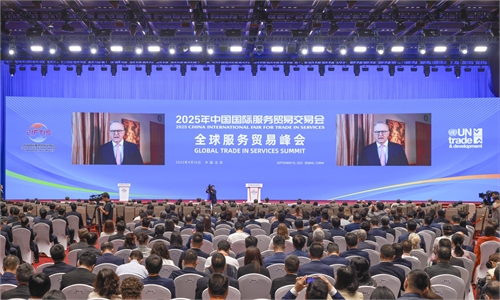
The measures came after the 2025 China International Fair for Trade in Services (CIFTIS) wrapped up on September 14 in Beijing, with officials emphasizing that accelerating the development of trade in services is an important step to expand high-level opening-up and foster new drivers of foreign trade growth.
The 13-point measures cover financial supports, favorable taxation and credit services, personnel visa facilitations and international data flow promotion.
The measures direct local authorities to fully utilize existing central and local funding channels to further support new models of services exports, including digital services, supply chains, and intellectual property, while actively cultivating key export enterprises and projects in areas such as energy-saving services, carbon footprint accounting, and carbon trading management.
They support the guidance fund to increase investment in services trade, mobilize more private capital for services trade and digital trade, and revise relevant catalogs to strengthen investment direction.
With the growth of digital technologies and green trade, services have become a new trend in the global market, Li Yong, a senior research fellow at the China Association of International Trade, told the Global Times on Wednesday. "Digitalization has made it possible to deliver services across borders that were previously non-tradable, and the newly introduced measures align with China's efforts to upgrade its services trade while keeping pace with global trends, making [the measures] release particularly timely."
Regarding tax incentives, the measures call for optimizing the zero-tax-rate declaration procedures for services exports, enhancing interdepartmental coordination and information sharing, and promoting the use of electronic information to replace paper certificates to improve efficiency. They also aim to improve bonded supervision systems and streamline approval processes for white-listed enterprises. Eligible integrated circuits and consumer electronics used solely for domestic testing will be subject to bonded supervision, according to the measures.
The measures propose optimizing visa and entry-exemption policies for foreign-invested enterprise personnel, researchers, and high-level talent, expanding the scope of unilateral visa exemptions for entry into China, and enhancing convenience for various inbound consumption activities, including tourism, visiting relatives, medical treatment, attending conferences and exhibitions, studying abroad, and retirement travel.
The measures support the development of international data services in free trade zones and free trade ports, regulate cross-border data flows, promote the conversion and trading of intellectual property, and leverage services trade intermediary organizations to provide legal and intellectual property support for enterprises expanding into international markets.
In the first seven months of 2025, China's services trade reached 4.58 trillion yuan ($643.97 billion), up 8.2 percent year-on-year, with exports reaching nearly 2 trillion yuan, up 15.3 percent and imports up 3.3 percent to 2.58 trillion yuan, resulting in a deficit of 581.56 billion yuan, according to the Xinhua News Agency, demonstrating the nation's steady services exports.
China is now the world's largest goods trading nation, but there is still significant room for growth in services. Especially against the backdrop of export structure optimization and industrial upgrading, the share of services trade exports in total trade is expected to continue rising, Hu Qimu, a deputy secretary-general of Forum 50 for Digital-Real Economies Integration, told the Global Times on Wednesday.
China's robust services trade was reflected during the recently concluded 2025 CIFTIS. This session of the CIFTIS attracted nearly 2,000 companies for on-site participation and about 5,600 companies online. During the event, more than 900 achievements were reached across sectors such as construction, information technology, and finance, Xinhua reported.
Hu pointed out that the measures, unveiled after the 2025 CIFTIS, will boost confidence in services firms, stressing that the government's approach is holistic, promoting both cross-border trade and domestic services consumption.
Last week, Chinese authorities rolled out measures to augment services consumption, as part of broader efforts to spur domestic demand and unleash consumption potential, Xinhua reported on September 16.
The measures, comprising 19 items in five areas, were jointly released by nine government departments, including the MOFCOM. In efforts to advance high-level opening-up in the services sector, China will promote the orderly opening-up of areas such as the internet and culture, while expanding pilot programs in telecommunications, healthcare and education, said the report.
"Overall, in the future, the tertiary sector — particularly the services industry — will play an increasingly strong role in driving economic growth from the supply side," said Hu, noting that the introduction of policies related to services trade is part of China's broader strategic plan to advance the development of the tertiary sector.
"China not only has the capability and potential to expand services exports but also benefits from a large, stable, and predictable market — key foundations for driving services export growth," Li noted.
In response to a media question on the recently concluded 2025 CIFTIS, Chinese Foreign Ministry spokesperson Lin Jian said on September 15 that China will, as always, act as a promoter of economic globalization, a defender of the multilateral trading system, and a contributor to stable and unimpeded industrial and supply chains. It will share the long-term benefits of greater institutional opening-up with other countries, and provide stability and new impetus for the world economy.
RELATED ARTICLES