An aerial drone photo taken on May 9, 2025 shows farmers operating tractors equipped with Beidou navigation system in the fields in Horqin Left Wing Rear Banner of Tongliao City, north China's Inner Mongolia Autonomous Region. (Xinhua/Lian Zhen)
An official industry report showed that by the end of 2028, the number of new terminals and devices supporting China's domestic BeiDou Navigation Satellite System (BDS) nationwide will exceed 400 million, the People's Financial News reported on Wednesday. Insiders stressed that this trend is of great significance for enhancing the nation's independent navigation capability and strengthening the security of industrial technologies.
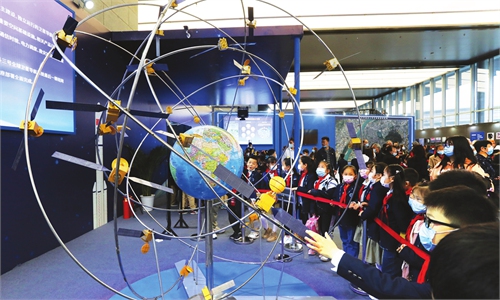
The impressive result was released during the achievement announcement session of the 4th International Summit on BDS Applications on Wednesday.
The report said that China's satellite navigation and location-based services industry, driven by the BDS, recorded an output value of 575.8 billion yuan ($79.2 billion) in 2024.
BDS applications will form a market of hundreds of millions of users, with new terminals and devices supporting the system in China expected to top 400 million by the end of 2028, according to the blue book on BDS industry development (2025) issued by the China Academy of Information and Communications Technology.
Smartphones and wearable devices are expected to be the main drivers of this growth, the blue book said.
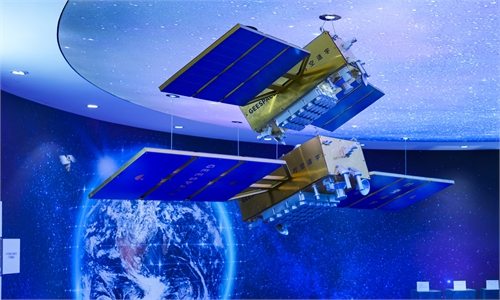
The BDS is a global satellite navigation system independently built and operated by China to meet national security and socio-economic development needs. It serves as a key national infrastructure for positioning, navigation and timing, providing all-weather, round-the-clock and high-precision services to users worldwide, according to its official government website.
The BDS has entered a stage of full maturity, and its current industry scale of more than 500 billion yuan marks only an initial achievement, with no doubt it will expand into the trillion yuan range and beyond, said Wang Yanan, chief editor of Aerospace Knowledge magazine.
BDS is both a high-tech industry and a component of national infrastructure, serving as a safeguard and a key measure for economic security, according to Wang. He stressed that its significance is on par with expressways, high-speed rail and aviation networks, while its scope of application is even broader.
The BDS is no longer remote, but has become part of everyday life.
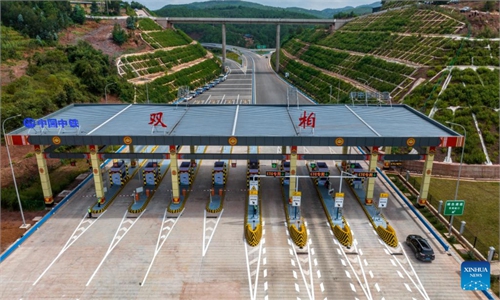
As of the end of 2024, electronic navigation maps made an average of 600 billion calls a day to BDS positioning services, while more than 13.5 million BDS terminals were in use across the transport sector, data reported on Tuesday by a media outlet under the Ministry of Transport showed.
In the same period, lane-level navigation powered by BDS' high-precision technology covered more than 99 percent of urban and township roads nationwide, according to the report.
With the rapid development of smart transportation, demand for high-precision applications has surged, extending BDS' coverage from travel navigation to vehicle supervision and highway maintenance across the country.
Since the launch of the 14th Five-Year Plan (2021-25), key application targets for the BeiDou satellite system in China's transport sector have been met ahead of schedule. As one of the system's most vital civilian fields, transportation has leveraged BeiDou's capabilities in centimeter-level positioning, nanosecond-level timing and integrated short-message communication, injecting strong momentum into smart logistics, precision public transit and autonomous driving.
As its application potential continues to expand, BDS is expected to play a role in areas with stringent precision requirements such as telemedicine and advanced manufacturing, Wang noted. "By integrating positioning, route planning and short-message communication, the system can meet diverse needs, and it will increasingly penetrate other industries, significantly enhancing both efficiency and safety."