ARTS / CULTURE & LEISURE
Chinese cultural heritage inspires press-on nail art
Painting on fingertips
By Published: Sep 25, 2025 09:08 PM

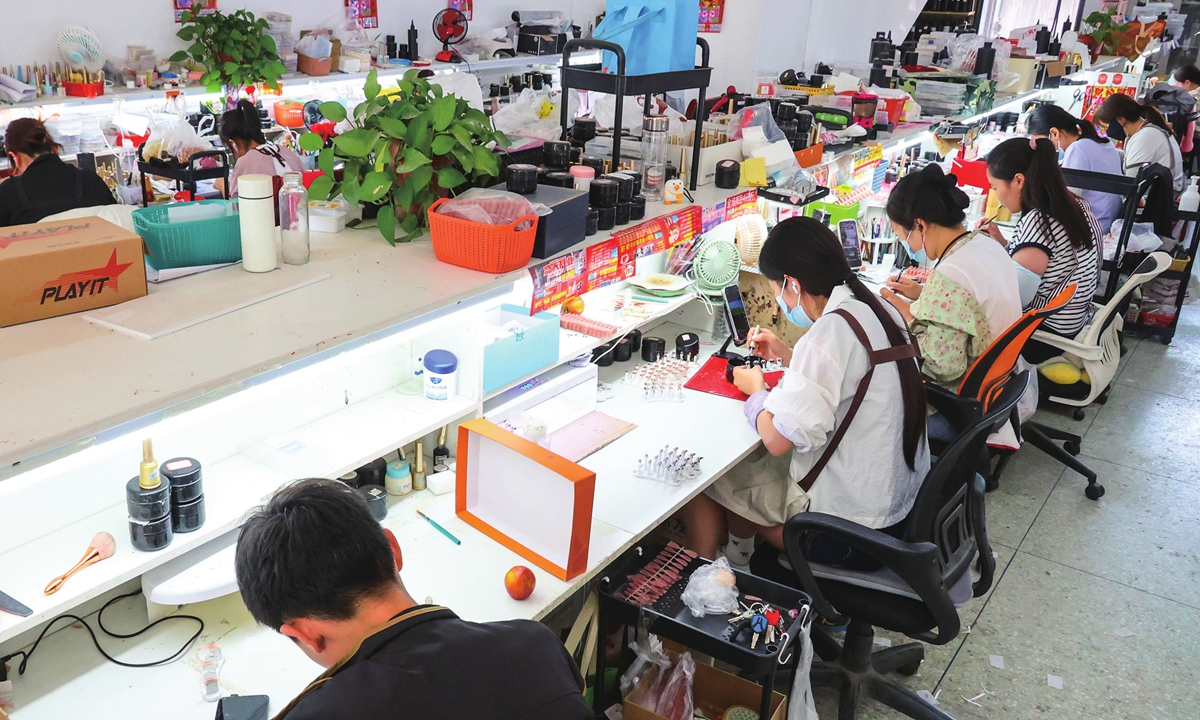
Workers process wearable nail products in Baitabu township, East China's Jiangsu Province, on June 17, 2025. Photo: VCG
On a transparent nail piece just a few centimeters long, a designer first brushes on a deep indigo blue. With an even finer brush, she paints drifting white clouds - a kind of auspicious pattern in Chinese tradition, then uses tweezers to place a row of tiny metallic beads, piecing together a delicate floral motif. In the viral video with thousands of likes on social media RedNote, every stroke, every bead, and every layer is meticulously repeated. Five press-on nails, each featuring a unique design, come together in a perfect harmony of blue and white, intricate patterns, and ornate accessories that instantly evoke the timeless beauty of Chinese blue-and-white porcelain.But blue-and-white porcelain is just one wellspring of inspiration for China's booming press-on nail scene. As nail designer Yang Ye told the Global Times, infusing traditional Chinese culture and intangible heritage crafts into nail design has become more than a trend - it has become the new normal. Designers across the country are mining history to rediscover ancient relics, architecture, clothing, mythological tales. They distill these time-honored elements, reimagine them, and paint them onto fingernails - transforming each set of press-on nails into a one-of-a-kind wearable artwork.
This artistic trend is not confined to China's borders. Press-on nails have found a global fanbase. According to the local industry association in Donghai county of Lianyungang, East China's Jiangsu Province - a major production hub - about 80 million original press-on nail sets crossed oceans in 2024, letting beauty lovers worldwide enjoy a "feast of fingertip aesthetics." Notably, Chinese-style sets with distinctive cultural flair have seen sales numbers soar. As China Central Television reported, a standard set of press-on nails might cost just $1-5, but when traditional craftsmanship is added, the price can climb to $15-70 and some bespoke designs fetch hundreds of dollars apiece.
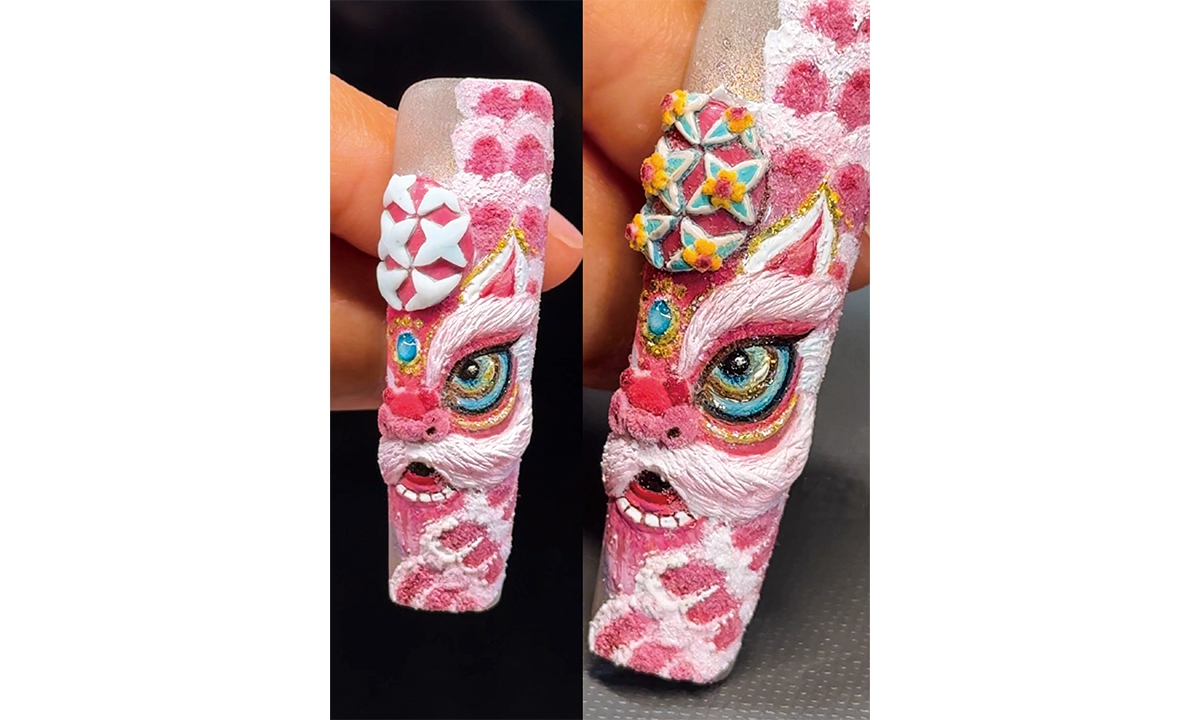
A press-on nail inspired by the Chinese lion dance Photos: Courtesy of Yang Ye
Art in miniatureWith Mid-Autumn Festival approaching, Yang designed a set of press-on nails themed around the legendary "Moon Palace." "Mid-Autumn is a time for beautiful wishes and reunion for Chinese people everywhere. Even with such a familiar theme, I always consider current tastes, combining tradition and creativity in my designs," she explained.
Yang's artistic roots run deep. She studied landscape design and Chinese architectural history in school, fostering a special fondness for traditional architecture. For the "Moon Palace" set, she focused on capturing the palace's imagined grandeur: classical lattice windows, colonnades, and roofs, all delicately rendered on tiny nail canvases.
Before crafting a set like this, Yang started by decoding ancient paintings or modern illustrations that fit the theme, studying composition, contrasts, and spatial layout. Then came the color palette: for the "Moon Palace," she incorporated vermilion, moon white, indigo, and autumn yellow, hues drawn from traditional Chinese clothing and architecture. "With both Chinese composition and colors, the set naturally takes on an unmistakably Chinese character," she said.
Creating such elaborate, micro-scale masterpieces is not easy, often taking dozens of hours to complete a whole set. "The nail's surface is so small, but the scenes we reference are often much larger. We cannot just copy them directly, we have to refine and transform, finding a miniature vision that still reads clearly," Yang noted. "For example, the palace in my reference painting might take up just a quarter of the image. But on the nail, I need to adjust it so it stands out immediately and you can see both the main subject and the details with the naked eye, like the architectural lines. Mastering the right scale for this is crucial."
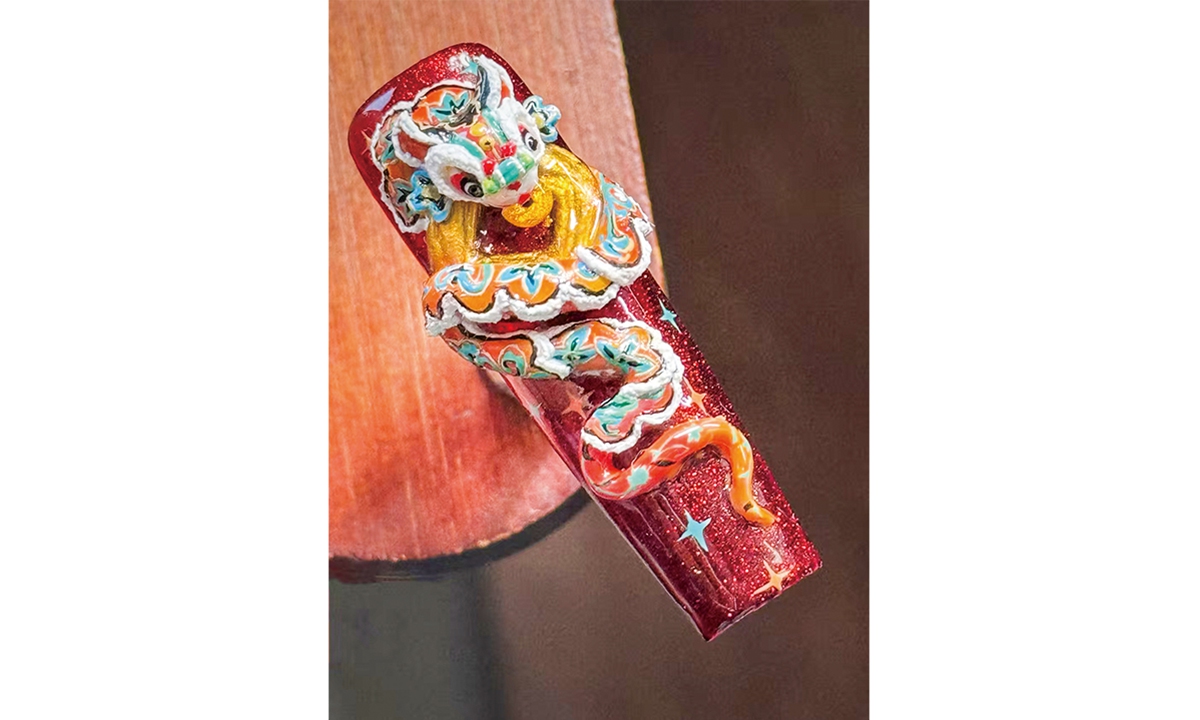
A press-on nail design featuring the image of a Chinese dragon
Chinese aestheticsAll that hard work is paying off. Yang said her posts on RedNote regularly attract overseas fans who praise her ingenuity and style, and ask how they can purchase her designs. The demand has inspired her to consider launching her own account on international platforms.
In Shanghai, there is even a nail art museum, home to many pieces that showcase the beauty of Chinese design, including one of Yang's works. In these miniature masterpieces, the allure of Chinese aesthetics is distilled into the space of a fingernail.
Take, for example, a set inspired by classic Chinese paintings of court ladies. The artist selected sections from scrolls, using a fine brushwork to recreate the women's elegant postures, attire, and expressions on the tiny canvases. On each fingertip unfurls a scene reminiscent of the springtime revels of the Tang Dynasty (618-907): ladies riding on horseback, waving fans, chatting in clusters, all radiating the grace and refinement of ancient China. Far from simple reproductions, these nails reinterpret classical art, compressing sprawling scenes onto the limited space of a nail. The result is both a technical challenge and a fresh, intimate way to reinterpret the grandeur of the past.
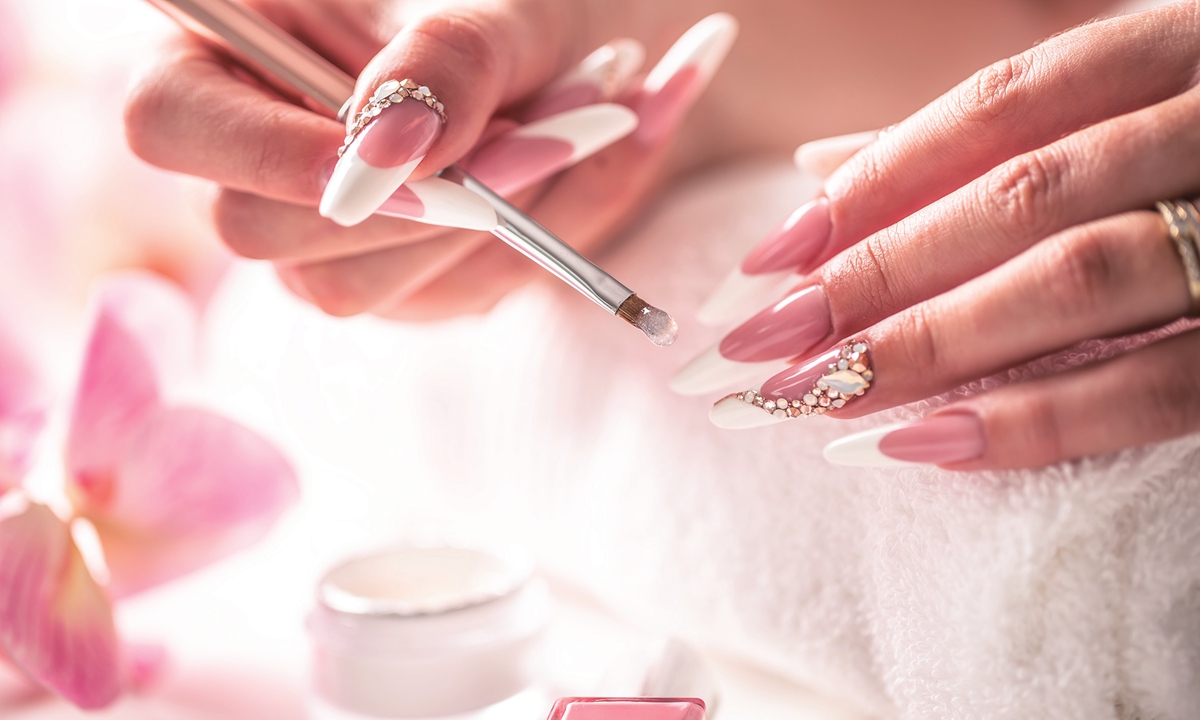
A nail service session Photo: VCG
Chinese nail art's influence is not limited to domestic designers. International artists are also drawing inspiration from China's rich heritage. Jan Arnold, for instance, created a set featuring blue-and-white porcelain, palace lanterns, and ancient coins - infusing the work with the weight and elegance of Chinese tradition. And the industry itself is rapidly evolving. The press-on nail sector in places like Donghai county has become a powerhouse, blending traditional craftsmanship with modern manufacturing and global e-commerce. More and more, Chinese designers are not just following trends - they are setting them, reimagining heritage for a new generation and sharing it on the world stage.From a single brushstroke of indigo to the careful placement of a gold bead, every press-on nail tells a story. In the hands of designers like Yang, China's ancient beauty is reinterpreted, worn, and admired anew, one fingertip at a time.
RELATED ARTICLES