China launches cultural, tourism consumption month, offering $66m subsidies
Services spending to emerge as trend, key driver of economic growth: expert
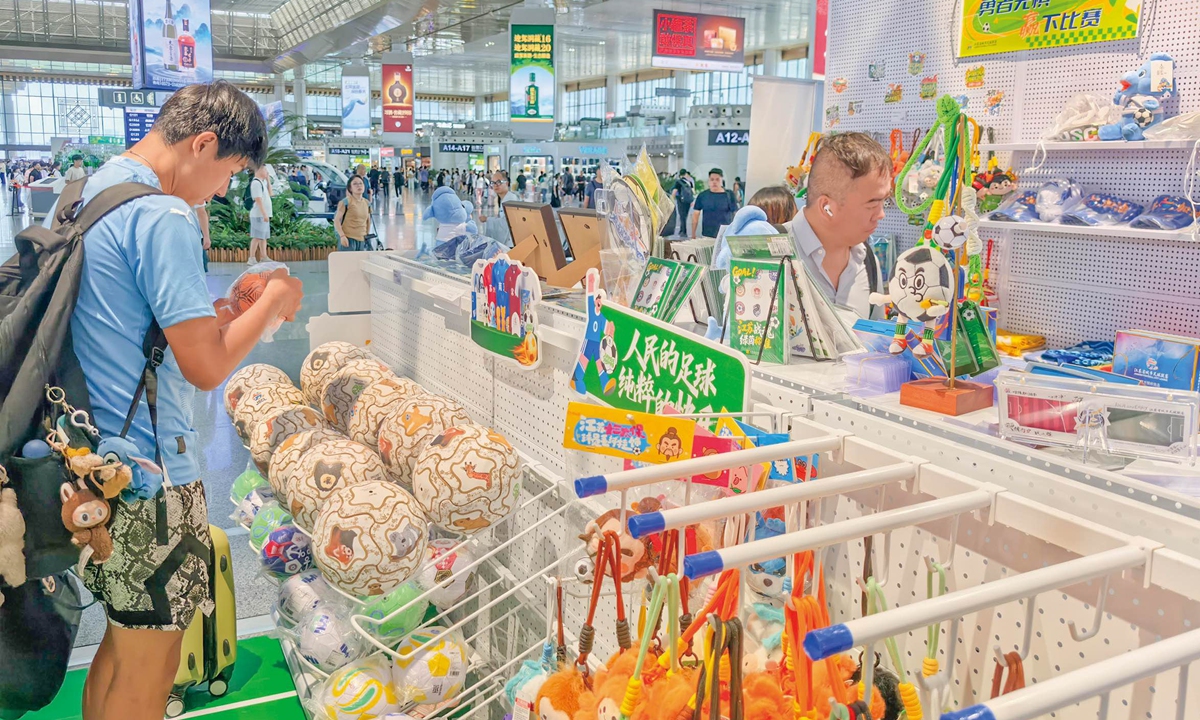
Tourists shop at the official licensed merchandise store of the "Su Super League" in Nanjing, East China's Jiangsu Province, on August 14, 2025. Photo: VCG
China on Thursday launched the National Cultural and Tourism Consumption Month for the upcoming National Day holiday, with more than 480 million yuan ($66 million) in subsidies expected to be issued, the Xinhua News Agency reported. Subsidies targeting services consumption are gradually emerging as a new trend.
The event's main ceremony was held on the same day in Chengdu, Southwest China's Sichuan Province. A series of cultural and tourism consumption activities are scheduled to run from late September to late October to stimulate holiday spending.
The promotion campaign extends beyond the traditional National Day holiday, which runs from October 1-8.
During the campaign, more than 29,000 cultural and tourism events will be staged nationwide, covering highlights such as theatrical performances, sightseeing tours, Mid-Autumn Festival family gatherings, cultural experiences, red tourism, major national achievements, and contemporary lifestyles, according to the report.
The initiative also aims to strengthen synergies between cultural and tourism spending and related sectors, including dining, accommodation, retail, sports and health services, which cover many main services sectors.
As China's industrial structure evolves, experts expect the services sector to account for a growing share of GDP and become a key driver of economic growth.
At the main event of the consumption month, the Department of Industrial Development of the Ministry of Culture and Tourism and China UnionPay jointly launched a three-year "hundred cities, hundred districts" action plan to boost cultural and tourism consumption, China Travel News reported on Thursday.
Regional cooperation initiatives were also announced, with the Beijing-Tianjin-Hebei region and Sichuan introducing joint cultural tourism programs and distinctive consumption scenarios. Meanwhile, financial institutions such as the Agricultural Bank of China and the Bank of China introduced preferential financial services to support cultural and tourism spending, along with measures to make inbound consumption more convenient, according to the report.
Strong ticket demand has boosted expectations for cultural and tourism consumption during the holidays. Railway authorities have so far sold 70 million tickets for National Day and Mid-Autumn Festival travel.
Recently, the Ministry of Commerce and eight other government departments jointly issued measures to expand services consumption. The policy package covers all key sectors of services consumption and emphasizes improving the consumer environment while promoting quality and affordability, according to the ministry.
The goal is to create conditions for these industries to prosper, allowing people to enjoy experiences that are affordable, enjoyable, innovative and of high quality, China Media Group commented.
The measures have received active responses from local governments in the run-up to the National Day holiday.
Hangzhou announced on Wednesday that three districts in the city, in partnership with major Chinese online travel platforms Meituan, Fliggy and Trip.com, will distribute cultural and tourism accommodation vouchers worth a total of 2 million yuan from Wednesday until the end of October.
Beijing Municipal Commerce Bureau, together with relevant departments and districts, on Tuesday guided and coordinated market players in commerce, culture, tourism and sports to launch more than 500 themed consumption events, offering residents and tourists diverse, affordable and trendy experiences, Beijing Business Today reported.
China's pro-consumption policies are increasingly focused on services. As the country's industrial structure evolves, the services sector has grown to account for more than half of its GDP and is expected to approach 70 to 80 percent, in line with advanced economies, making it a key driver of future growth, said Hu Qimu, a deputy secretary-general of Forum 50 for Digital-Real Economies Integration.
The focus of services consumption policies is not only aimed at boosting end demand, but also at stimulating the development of high-quality supply, such as dining, cultural tourism, the creative industries, medical and health services, thereby driving industrial upgrading and economic transformation, Hu told the Global Times on Thursday.
On the relationship between central and local coordination, experts noted that while the central government has set an overall framework, local authorities will tailor concrete measures to their industrial structures.
As the central and western regions find it harder to attract manufacturing, they lean on sectors such as cultural tourism and creative industries to drive their transformation. Unlike manufacturing, revenue from ticket sales, lodging and dining stays largely local, providing more direct fiscal benefits, Hu said, adding that demand-side policies to spur services consumption essentially serve to cultivate and expand local services industry chains.
According to the National Bureau of Statistics, per capita spending on services last year accounted for 46.1 percent of per capita consumption, with services contributing 63 percent to overall consumption growth. Vice Minister of Commerce Sheng Qiuping told a press conference that from January to August this year, services retail sales rose 5.1 percent, outpacing goods retail sales by 0.3 percentage points.
Boosting consumer confidence is essential, and improving social security is also key to easing households' need for precautionary savings and unlocking more consumption potential, an expert said.
"Greater high-quality supply is needed to meet increasingly personalized and experience-driven demand. In the longer term, sustained consumption growth hinges on high-quality industrial development that creates jobs and raises incomes, supported by stronger social services to foster a virtuous cycle," according to Hu.
RELATED ARTICLES