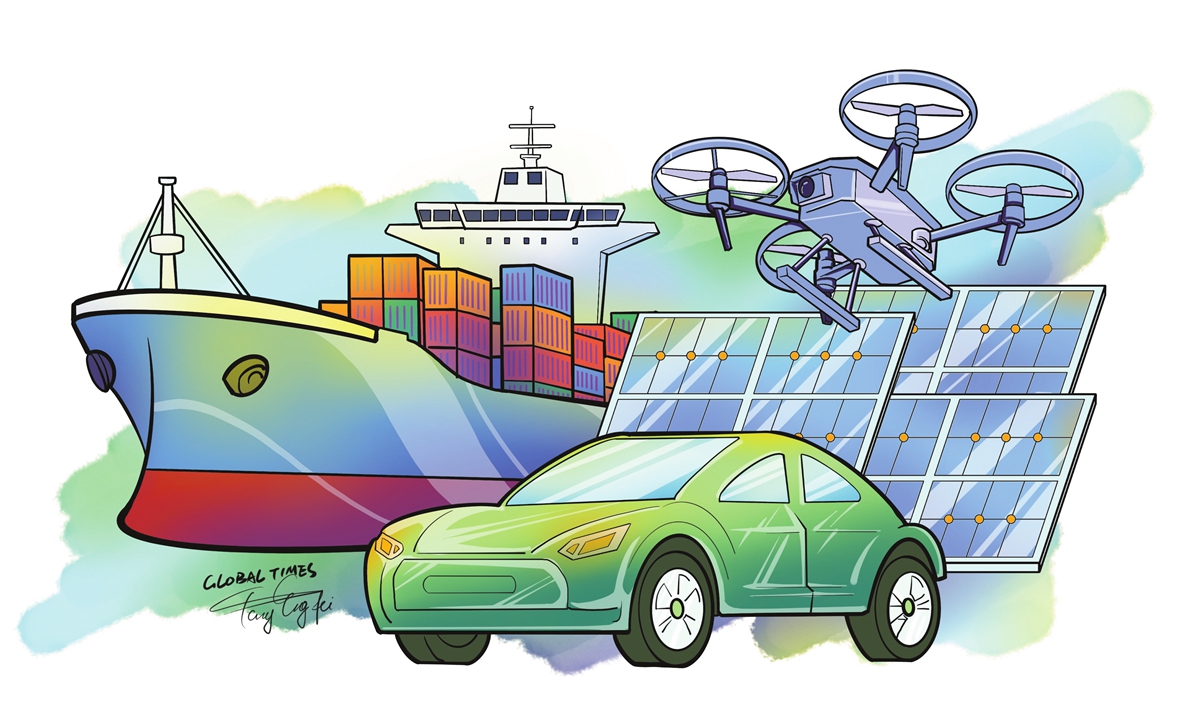
Illustration: Tang Tengfei/GT
The latest figures confirm that China remains the EU's largest source of high-tech products. This is not a passing development but a structural reality of the global economy, with Europe's technology supply chains increasingly intertwined with those of China. The data highlight the pressing industrial demand within Europe, while also pointing to significant untapped potential in the development of this relationship.In 2024, the EU imported 478 billion euros ($561 billion) worth of high-tech goods. Of that total, 141 billion euros - about 30 percent - came from China, compared with 23 percent from the US, according to Eurostat. The scale and persistence of this gap underline China's central role as a supplier of advanced products to Europe.
These trade flows are unfolding against the backdrop of rapid technological progress and increasingly complex global supply chains. In recent years, both China and Europe have seen fast-growing technological sectors, with their industrial ecosystems becoming ever more interwoven. The figures from Eurostat not only highlight Europe's strong and immediate demand for Chinese high-tech products, but also point to the deep integration of the two economies across technology value chains.
According to Eurostat, electronics-telecommunications products accounted for the largest share of high-tech imports from non-EU countries, for which China was the largest trading partner. For Europe, the benefits are tangible. Affordable Chinese high-tech products have helped reduce costs for consumers, accelerated the digitalization of small and medium-sized enterprises, and bolstered the competitiveness of entire sectors. From electronics-telecommunications to office machines, Chinese technology has become embedded in Europe's economic fabric, making advanced digital tools more widely accessible to both households and businesses.
Yet the relationship is far from one-sided. China also views Europe as an important source of advanced technology, particularly in areas where European firms hold a distinct competitive edge, such as precision machinery, high-end manufacturing equipment, and lithography machines.
China offers European high-tech companies sustained market opportunities that extend beyond exports. Many European firms have deepened their presence in China through long-term investment, treating the country not only as a manufacturing base but also as an important market. From industrial equipment makers to medical technology leaders, these companies view China's scale and growing demand as an integral part of their global strategies. This steady flow of investment underscores how Europe's technological strengths and China's market potential reinforce each other, adding another layer of resilience to the shared technology value chain.
The pattern of mutual demand points to broader complementarity between China and Europe in the technology value chain. Europe's strengths in precision engineering, advanced manufacturing, and research capacity align with China's advantages in emerging sectors such as telecommunications and green technologies, as well as in the rapid commercialization of these innovations. This combination has opened space for steady collaboration, whether in developing industrial equipment, applying digital technologies, or advancing green innovation. While competition is inevitable in certain areas, the overall structure of the relationship indicates scope for further growth through pragmatic cooperation.
Yet cooperation in high-tech is not without challenges. The US' frequent resort to export controls has disrupted the free flow of trade and investment in advanced industries. Europe has inevitably felt pressure, with geopolitical considerations playing an increasing role in its approach to technology exchange with China. This is particularly evident in sensitive, cutting-edge fields, where restrictions have narrowed the scope for collaboration. As a result, the potential for deeper integration of the China-EU technology value chain has been constrained, especially in Europe's exports of high-tech products to China, such as lithography machines.
It will be important for Europe to recognize the potential embedded in its technological ties with China and to translate that potential into tangible gains in trade and investment. Creating a more supportive environment for high-tech exports to China would not only benefit Europe's own companies but also help maintain more balanced growth in the bilateral relationship. By encouraging greater openness in this area, both sides could deepen cooperation along the technology value chain while ensuring that commercial interests are not eclipsed by short-term political pressures.
The author is a reporter with the Global Times. bizopinion@globaltimes.com.cn
RELATED ARTICLES