Overseas airlines ramp up efforts to woo travelers for coming holidays
By Published: Sep 25, 2025 11:09 PM

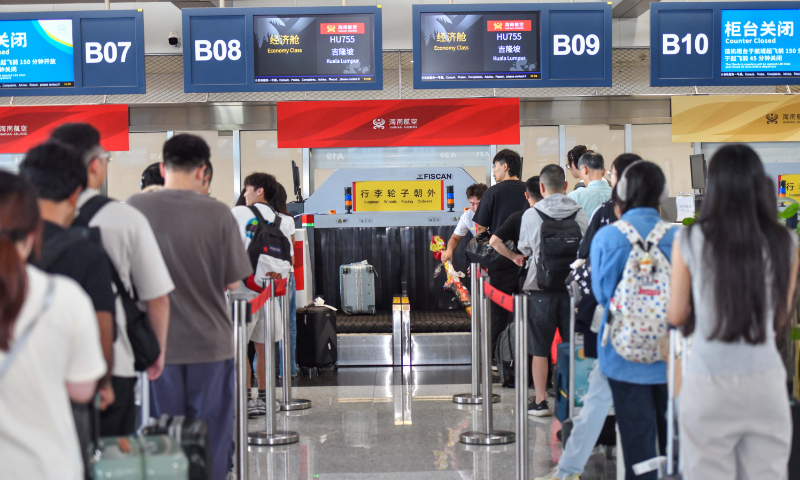
Passengers queue up to check in for a flight to Kuala Lumpur at Haikou Meilan International Airport in Haikou, South China's Hainan Province, on May 30, 2025. Photo: VCG
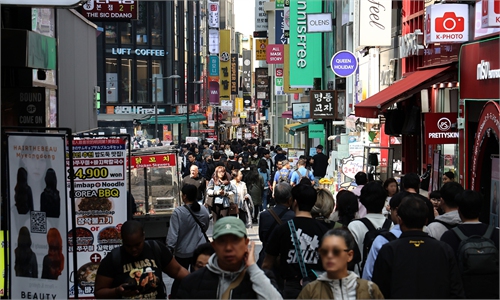
Starting from September 29, South Korea will implement a visa-free entry policy on a trial basis for Chinese group tourists, allowing a stay of up to 15 days.
As a result, this policy has already significantly boosted the popularity of flights to South Korea. Data from Tongcheng Travel showed that, as of September 11, the search popularity for international flights during the National Day holidays increased by over 60 percent year-on-year. Among these, the search popularity for outbound flights to destinations such as Seoul and Jeju Island in South Korea more than doubled compared with the same period last year.
This is a latest example of the travelling fever for the outbound trips as overseas carriers are intensifying their efforts to attract customers for the upcoming holiday peak season.
Currently, the flight volume on the China-South Korea route has recovered to about 86 percent of pre-pandemic levels, while routes to other regions have basically returned to pre-pandemic levels, Hwang Sung Won, head of the passenger network and vice president of Korean Air, told the Global Times.
The National Day holiday is right around the corner, and tickets of the flights these days are almost all sold out, he added.
Korean Air is currently the largest carrier on the China-South Korea air route, followed by China Eastern Airlines and Asiana Airlines.
Notably, in late 2024, Korean Air announced its acquisition of Asiana Airlines, making Asiana its subsidiary. Upon completion of the merger, the combined airline group will boast a fleet of more than 200 aircraft. It will serve 24 cities in China across 33 routes, becoming the foreign airline group with the highest number of flights to China.
Korean Air is not alone. Cathay Pacific also told the Global Times that the during this year's National Day holidays, flight bookings have seen a significant year-on-year increase, indicating a strong rebound in travel demand.
Although the company did not reveal the exact figure, it said a notable difference from last year is that while outbound travel declined starting from the second day of the 2024 holiday, passenger volume remained strong on day 3 and 4 this year, demonstrating sustained and robust demand throughout the entire period.
Demand from first-tier cities like Beijing, Shanghai and Guangzhou surged year-on-year. Cities such as Hangzhou, Nanjing and Wuhan also saw a significant rise in flight bookings, the Hong Kong-based carrier said.
Such move came amid the background as the National Day and Mid-Autumn Festival coincided this year, creating an extended 8-day holiday that offered travelers more options.
Statistics industry information provider Umetrip sent to the Global Times showed that the bookings for inbound and outbound flights surpassed 1.4 million for the coming holidays, with the average daily volume growing by about 16 percent year-on-year.
Market watchers attributed the rising demand to the fact that Chinese tourists now enjoy visa-free access to a growing number of destinations, making international travel easier than ever, such as Central Asian nations like Kazakhstan and Uzbekistan offer visa-free entry to Chinese citizens.
Currently, holders of Chinese passports can enter more than 90 countries and regions visa-free or with a visa on arrival, according to the National Immigration Administration.
As of the South Korea market, although both passenger traffic and the number of flights between China and South Korea have not yet returned to pre-pandemic levels, the growth stimulated by the visa-waiver policy is expected to become more apparent next year.
The passenger traffic on China-South Korea routes in the first half of this year was approximately 7.81 million, an increase of 1.52 million year-on-year, a growth of 24.3 percent. However, this still only represents about 80 percent of the 2019 level, news portal yicai.com reported, citing data from the South Korea aviation industry.
It is expected that passenger volume between the two nations will reach 8 to 9 million this year and return to the 2019 level by 2027, Hwang said, attributing this mainly to the tourism demand driven by the visa-free policies implemented by both countries.
On November 8, 2024, the Chinese government implemented a visa-free policy for South Korean tourists, after which the number of South Korean visitors to China significantly increased. There was a notable rise in South Korean tourists traveling to geographically proximate cities like Qingdao, as well as to Shanghai, Xiamen, Shenzhen and Guangzhou.
Hwang explained that on Korean Air's China-South Korea routes, 30 percent of passengers are business travelers, and 30 percent are independent tourists. The most popular Chinese city for South Korean tourists is Shanghai, from where they gradually extend their trips to Qingdao, Xiamen and more western cities.
Following the visa-free policy for Chinese group tours to South Korea, the passenger load factor on Korean Air flights has increased by about 10 percentage points compared to 2024, with a more pronounced growth effect expected next year, he added.
Cathay Pacific said that it will also increase the flying capacity from October 26. In Beijing, the Cathay Group will operate a total of nine daily round flights to Beijing's two major international airports. In Shanghai, the Cathay Pacific will operate close to 70 return flights per week between Hong Kong and Shanghai's two international airports.
China remains one of VFS Global's the most important source markets, with visa applications experiencing a rapid growth. The first half of this year has demonstrated a steady increase in application volume, reflecting growth trends compared with the same period in 2024, according to the information the company sent to the Global Times.
While Beijing, Guangzhou and Shanghai remain to be top source cities, emerging hubs like Hangzhou, Shenzhen, Wuhan and Xi'an are experiencing particularly strong year-on-year growth. These trends highlight an ongoing shift in Chinese outbound travelers' preferences, with growing emphasis on personalized, privacy and high-quality travel experiences.
RELATED ARTICLES