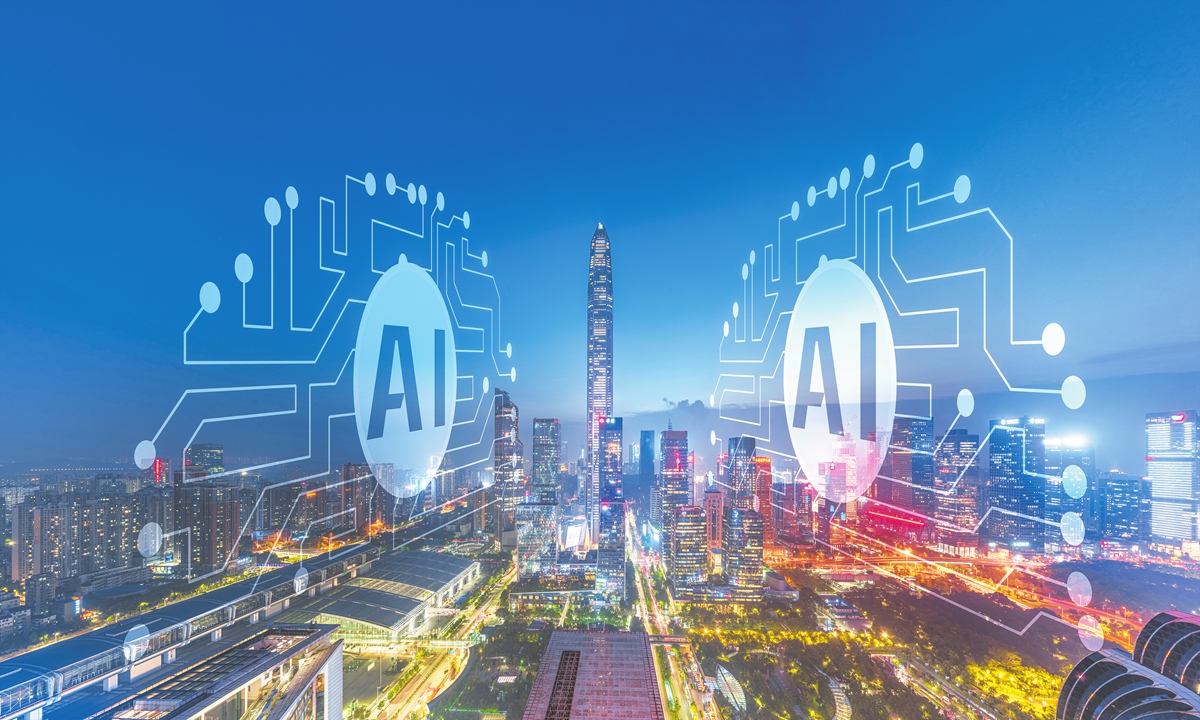
An AI conceptual city in Shenzhen File photo: VCG

As the National Day and Mid-Autumn Festival holidays approach, innovative "black technologies" are emerging as new highlights in the cultural and tourism consumption market across China.
In Beijing, robotic dogs roam the ancient courtyards of the centuries-old Tanzhe Temple, delivering supplies while entertaining visitors. At Baihua Mountain, intelligent mountaineering exoskeleton robots have been introduced, helping tourists reach the summit with ease.
In Hangzhou, technologies such as AI, VR, and 3D printing are being applied to traditional cultural tourism. Unmanned stores, AI-powered outfit customization, and VR experiences have emerged in major business districts, bringing fresh experiences to residents and tourists.
These tech-driven scenes inject new vitality to the holiday season while contributing to China's broader consumption upgrade. Against the backdrop of a booming digital economy, digital consumption is no longer confined to mobile phone screens, and more diverse interactive experiences are emerging at an accelerated pace. This change not only reshapes people's consumption habits but also exerts great influence on the entire industrial ecosystem.
The rapid rise and integration of cutting-edge technology into consumption scenarios stems from the rapid development of China's digital infrastructure. As the cornerstone of the digital economy, continuous investment in 5G network construction, data center deployment, and computing power has provided high-speed, stable support for the application of these advanced technologies. It is this robust infrastructure that has enabled digital consumption to transcend geographical and technical limitations, becoming increasingly accessible to the general public and driving the market toward higher quality and smarter transformation.
China's ability to build a "black tech" consumption ecosystem lies in its vast market scale and mature industrial chain. With a vast domestic market of over 1.4 billion people, demand is diverse, personalized, and oriented toward high quality. This vibrant and varied demand provides an extensive testing ground and consumption space for "black tech" products. This is also why more and more enterprises are allocating funds and human resources to the field of "black tech", continuously promoting technological breakthroughs from the optimization of artificial intelligence algorithms to the iteration of hardware equipment.
More importantly, Chinese consumers readily embrace new products and are willing to actively try and experience "black tech" products. This positive consumption attitude, in turn, stimulates enterprises to further increase their innovation efforts, continuously expanding and deepening the ecosystem.
Furthermore, the integration of "black tech" into consumption scenarios has become an important pathway for upgrading traditional industries and injecting new vitality into consumption. Robotic assistants in Tanzhe Temple and exoskeletons in Baihua Mountain free visitors from passive sightseeing, offering interactive and assisted experiences that make cultural tourism more engaging and accessible. This integration breaks down industrial barriers, enabling digital and traditional sectors to complement each other. It not only creates new consumption demands and business models but also drives traditional sectors toward intelligent, digital, and experiential transformation, providing new momentum for sustained market growth.
In the long term, "black tech" consumption plays a significant role in driving China's economic growth. This driving effect is reflected not only on the consumption side but also penetrates into the production side. On the consumption side, these technologies continuously generate new demand. On the production side, their application enhances efficiency and reduces costs.
The author is founding director of the China Institute of New Economy. bizopinion@globaltimes.com.cn
RELATED ARTICLES