The significance of China-South Korea visa-free entry extends beyond economic dimension: Global Times editorial
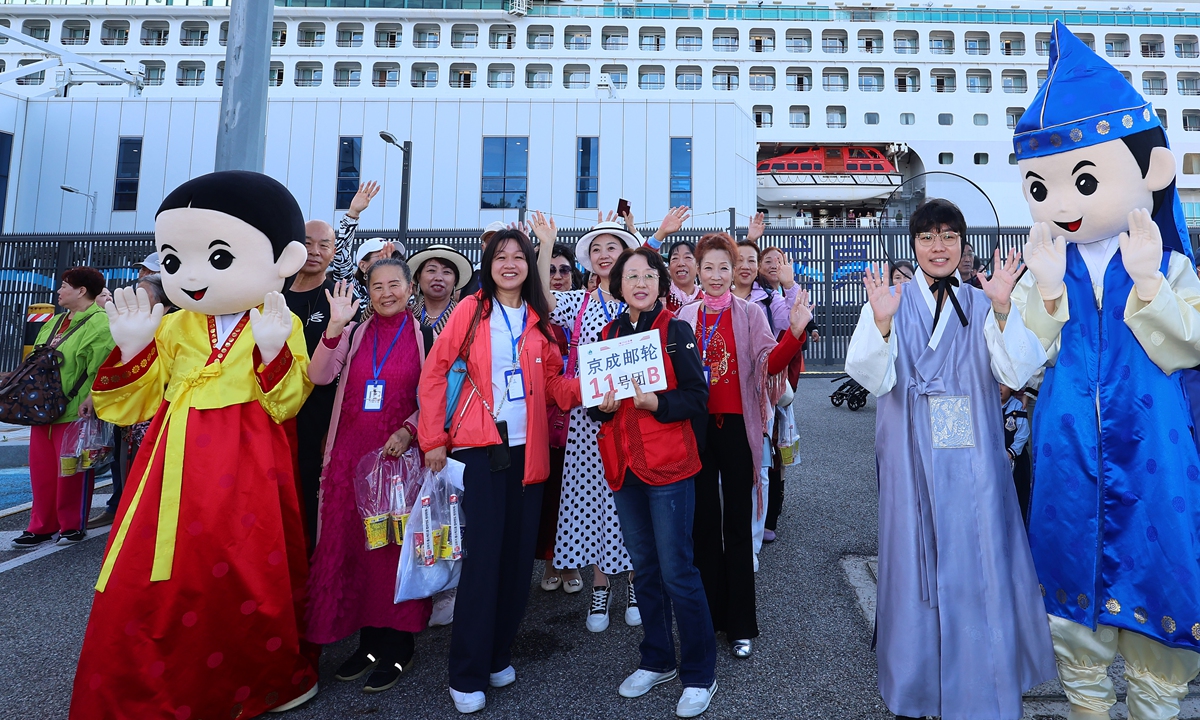
Chinese tourists arrive by a cruise ship on the first day of South Korea's visa-free entry for Chinese group tourists at the port of Incheon in South Korea on September 29, 2025. Photo: VCG
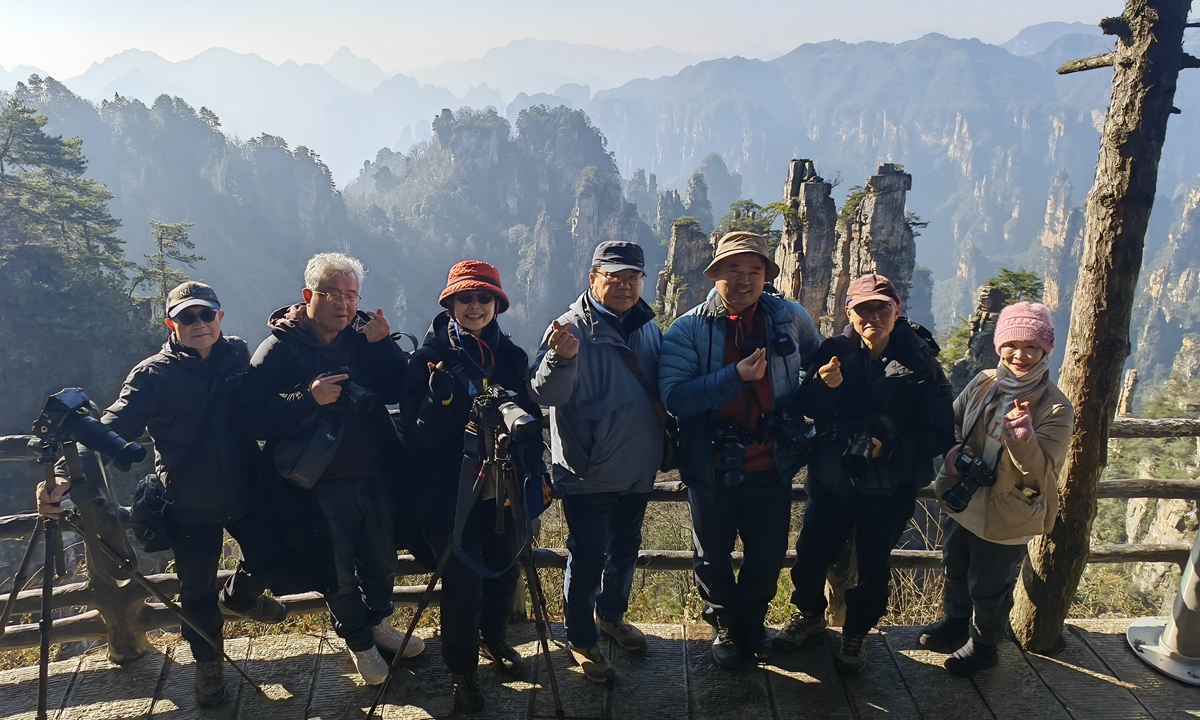
Zhangjiajie National Forest Park in Central China's Hunan Province welcomes its first South Korean photography tour group of the new year on January 5, 2025. Photo: VCG
Starting Monday, the South Korean government began implementing a trial visa-free entry policy for Chinese group tourists, which has drawn widespread attention in both countries. This move coincided with China's National Day and Mid-Autumn Festival holidays, dubbed "Golden Week." Many South Korean media outlets believe it could inject new momentum into the South Korean economy, which is facing downward pressure, noting that "businesses across South Korea are actively striving to attract Chinese tourists." It is also seen as a new positive development for the recently stabilizing and improving China-South Korea relationship.Since last year, influenced by multiple factors such as the global economic downturn and internal structural contradictions, South Korea's economic growth has shown signs of fatigue. As a key engine for boosting domestic demand and creating jobs, the revival of the tourism industry has been given high expectations. Among South Korea's inbound tourism market, Chinese tourists are undoubtedly the largest group. In the first half of this year, Chinese visitors accounted for 28.6 percent of all foreign tourists visiting South Korea, ranking the first. According to analysis by the Bank of Korea, in 2019, the average per capita spending of Chinese tourists in South Korea was $1,689, far higher than that of US and Japanese visitors. To welcome Chinese tourists, South Korea's tourism and retail sectors have acted swiftly, launching a series of promotional activities and "tailor-made" services designed around the travel preferences and payment habits of Chinese tourists. South Korean media outlet Chosun Ilbo noted that South Korea's "transportation and tourism industries are making every effort to seize the 'special demand' from China." The implementation of the new visa-free policy has been regarded by South Korea's tourism industry as a tangible and significant boon.
It should be pointed out that this visa-free initiative by the South Korean government is also a response to China's move last November to grant visa-free entry to South Korean citizens. As part of its broader effort to expand and deepen opening-up, China has already implemented unilateral visa-free policies for more than 40 countries. Many countries have responded positively by granting visa-free entry or easing visa requirements for Chinese citizens. As China opens its door wider, more Chinese people are going abroad, while at the same time, more foreign tourists are coming to China. The expansion of such large-scale people-to-people exchanges will undoubtedly play an irreplaceable role in enhancing mutual understanding between Chinese and foreign peoples. South Korea's decision to grant visa-free entry to Chinese group tourists, promoting people-to-people exchanges and political trust through pragmatic action, is the first of its kind among major developed economies and carries symbolic significance as a demonstration.
China and South Korea are close neighbors, and people-to-people exchanges and firsthand experiences through tourism are effective ways of breaking out of the information cocoon and dissolving misunderstandings and prejudices. Since China granted visa-free entry to South Koreans last year, an increasing number of ordinary South Korean tourists and people from various sectors have come to China. In 2025, China surpassed Japan and Thailand to become the top overseas travel destination for South Koreans. In many Chinese cities and tourist attractions, the presence of South Korean tourists has become more visible, to the extent that topics such as "South Korean youths visit Shanghai on weekends" and "South Korean tourists crowd Zhangjiajie" have trended on Chinese social media. Many South Korean visitors have witnessed China's rapid development, experienced the convenience of mobile payment and the vitality of the digital economy, as well as enjoyed the diverse landscapes of China's magnificent mountains and rivers. This has greatly altered outdated perceptions of China.
The recent moves in visa policies between China and South Korea to meet each other halfway are wise decisions based on practical interests and long-term development. This is not merely an economic decision, but also a strategic step to enhance friendship, promote cooperation, and advance regional integration. Visa facilitation is only the first step; the key in the future is how to transform "trial implementation" into "normal practice." This requires South Korea to improve the quality of tourism services, ensure the safety of Chinese tourists' lives and property, properly handle potential conflicts, so as to truly turn the dividends of people-to-people exchanges into deeper mutual trust and cooperation. Only when the spirit of good-neighborliness and friendship takes deep root, and win-win cooperation becomes the main theme of bilateral relations, can China-South Korea ties enter a new period of maturity and stability.
What is concerning, however, is that in recent days some far-right groups in South Korea have frequently staged anti-China protests in places like Seoul's Myeongdong, and certain politicians have incited anti-China conspiracy theories. These acts have had a malignant effect, seriously damaging the atmosphere of China-South Korea relations and harming South Korea's own image. The Chinese Embassy in South Korea has already issued safety alerts, reminding Chinese tourists to enhance safety precautions. We have noted that the Lee Jae-myung administration has stated it will take measures to contain such incidents. We hope the South Korean side will effectively provide security for Chinese visitors and foster a sound social environment for the improvement of China-South Korea relations.
"No mountains can stop the surging flow of a mighty river." As the door of exchanges between China and South Korea opens wider, we believe that the few countercurrents of anti-China sentiment will eventually be swept away by the tide of history. Granting visa-free entry to Chinese group tourists marks an important step taken by the new South Korean government in improving relations with China, and we look forward to seeing this step taken even further.
RELATED ARTICLES