China's manufacturing PMI stands at 49.8% in Sep, up 0.4 percentage points from Aug: NBS
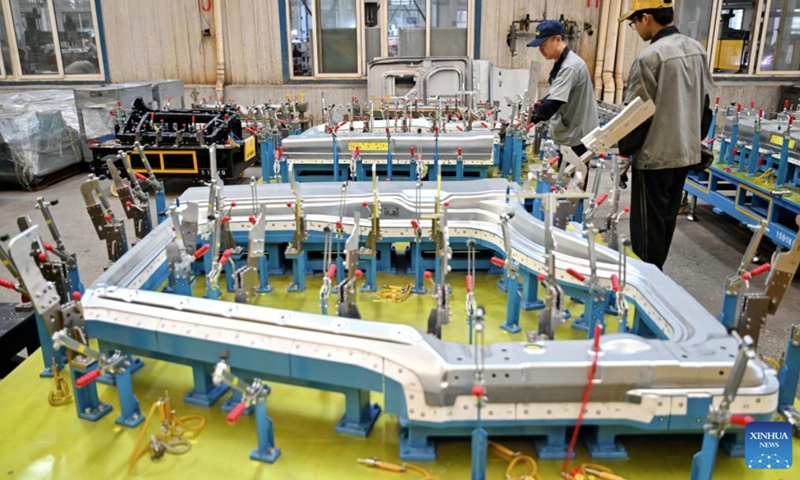
Technicians check product quality at a mold company in Botou, north China's Hebei Province, Sept. 24, 2025. (Photo: Xinhua)
China's National Bureau of Statistics (NBS) and the China Federation of Logistics and Purchasing jointly released the Purchasing Managers' Index (PMI) for September on Tuesday, showing that the manufacturing PMI, which gauges activity in the sector, reached 49.8 percent in September, up 0.4 percentage points from the previous month, indicating a continued improvement in manufacturing activity.
Specifically, the production index stood at 51.9 percent, up 1.1 percentage points from August, indicating an accelerated expansion in manufacturing output.
The new orders index came in at 49.7 percent, up 0.2 percentage points, suggesting continued recovery in market demand for manufacturing.
Moreover, the raw materials inventory index came in at 48.5 percent, rising 0.5 percentage points, indicating that the decline in key raw material inventories has further narrowed.
The employment index registered at 48.5 percent, an increase of 0.6 percentage points, reflecting better labor conditions in manufacturing firms.
The manufacturing PMI is already close to the boom-bust line, reflecting continued recovery, Li Changan, a professor at the Academy of China Open Economy Studies at the University of International Business and Economics, told the Global Times on Tuesday.
Although external factors have had an impact, the sector is still improving steadily, Li said, noting that the most important driver remains strong policy support. Macroeconomic measures, including fiscal and financial policies, continue to prioritize the development of the real economy.
At the same time, despite global trade protectionism trend, Chinese manufacturers are actively seeking various channels to diversify exports, which has created favorable conditions for recovery, Li said.
Meanwhile, the services sector, a key engine of economic growth, remained resilient. In September, the non-manufacturing business activity index was 50 percent, down 0.3 percentage points from August, according to the NBS.
"Supported by demand-expansion and consumption-stimulus policies, the service sector has remained generally dynamic, laying a solid foundation for overall economic stability," Li said.
RELATED ARTICLES