ARTS / CULTURE & LEISURE
Rise of ‘Chicken Cutlet Brother’ shows power of warm, human exchanges
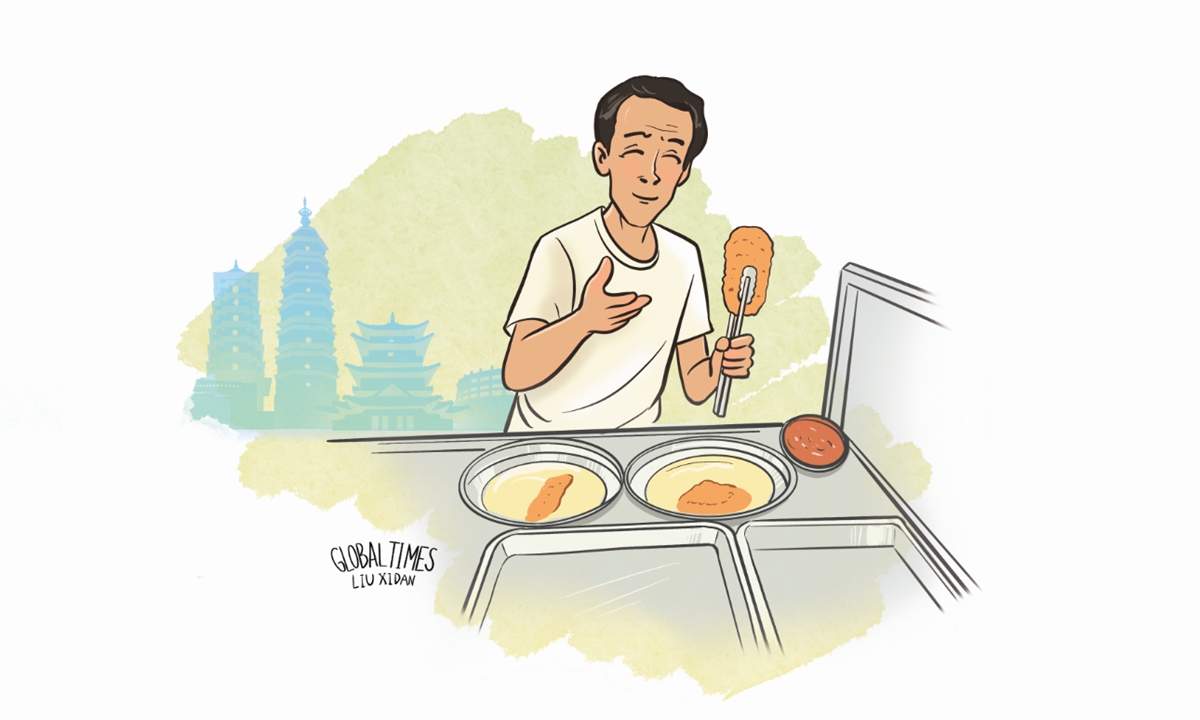
Illustration: Liu Xidan/GT
Known for his charismatic selling style, reminiscent of a talk show host, combined with an upbeat attitude, a chicken cutlet vendor in Jingdezhen, East China's Jiangxi Province, became a sensation on Chinese social media during the National Day holidays as visitors from across China queued for hours to try his snacks. The simple food stall has injected new vitality into the ancient porcelain capital and sparked discussions on how to translate a momentary trend into an enduring civic allure.Li Junyong, a Jingdezhen native who has been selling chicken cutlets for five years, has said via his personal social media account on Douyin that he would take a day off on Thursday due to several consecutive days of intense work during the holidays. At peak times, visitors were waiting up to four hours to try his 6-yuan (84 cents) chicken cutlet that some have joked is "worth 60 or even 600 yuan in emotional value."
Data from travel platform Qunar showed that on October 1, hotel occupancy in Jingdezhen increased by 30 percent year-on-year. It's also reported that hotels near Li's stall saw a surge in prices during the holidays, with some raising their rates by two to three times. Some tourists said they came specifically for Li, who has earned the nickname "Chicken Cutlet Brother."
Bu Xiting, an associate researcher with the School of Cultural Industries Management at the Communication University of China, told the Global Times that the phenomenon essentially reflects a shift in cultural and tourism consumption from mere sightseeing to seeking "emotional connection."
The rise of "Chicken Cutlet Brother" is no coincidence. In recent years, there have been many cases of "one person making an entire city go viral," such as the barber Li Xiaohua in Huaihua, Central China's Hunan Province, Bu said.
Individual charm or internet fame is increasingly transcending traditional attractions to become a new form of "cultural tourism magnet." This trend reveals deeper social and psychological needs emerging under the new dynamics of cultural tourism, he said.
"Give me a chance to serve you." "You can say no to me, but please don't refuse something delicious." "I'll fry it to perfection. If I don't get it right, I won't forgive myself." His sincere remarks and impromptu interactions with customers satisfy people's craving for warm, human exchanges amid the rush of modern life.
Bu noted that this trend also aligns closely with the evolving travel motivations of Generation Z.
Young travelers are no longer content with superficial, checklist-style tourism. They actively seek destinations that offer cultural warmth and immersive experiences. They visit intangible cultural heritage markets, take part in pottery workshops, and join in local ethnic celebrations. More and more travelers are transforming from mere "sightseers" into "life participants." Travel itself is moving beyond simply "seeing the scenery" toward truly "immersive engagement," said the researcher.
It is not gimmick or spectacle, but a yearning for sincerity that makes Li and other ordinary workers phenomenal. Li Junyong's success isn't just about his witty one-liners - it's about his integrity. He offers discounts to students, insists on product quality, and serves each customer with genuine care.
His warmth and diligence remind people of a deeper value often missing in fast-paced urban life: sincerity itself is contagious. In the era of algorithms and monetized popularity, authenticity remains the most powerful form of influence. He embodies a life attitude that finds personal meaning and value in an ordinary job.
What's equally remarkable is how quickly Jingdezhen's cultural and tourism authorities embraced this viral phenomenon.
Li was soon named a "Cultural Tourism Promotion Ambassador" of Jingdezhen by local authorities. A small team was deployed by the local urban management and law enforcement bureau to maintain order around the stall as crowds continued to grow. This swift, measured response reflects the government's efforts to turn a personal story into collective value.
Bu pointed out that the government has played the role of an "invisible facilitator," providing baseline protection for public order and citizens' safety through minimal necessary intervention. This kind of moderate support and gentle guidance can transform individual popularity into public goodwill, creating a virtuous cycle in governance.
"Jingdezhen's core competitiveness lies in its thousand-year porcelain-making history," said Bu. "Tourists may come for the chicken cutlet, but they are ultimately drawn in by the 'craftsman spirit' of the porcelain capital."
He emphasized that city managers should make good use of, but not rely on, the influence of internet celebrities. Viral fame is only a starting point; the long-term strength of cultural tourism must return to steady, sustainable development.
The rise of "Chicken Cutlet Brother" shows a quiet truth about city branding in the digital age. The ultimate appeal of cultural tourism lies in the sincere connections between people. A city's most enduring charm does not come from fleeting excitement, but from steadfast dedication day after day. When authenticity meets good governance, and when individual warmth resonates with a city's cultural soul, a momentary fame can transform into enduring civic allure.
The author is a reporter with the Global Times. life@globaltimes.com.cn
RELATED ARTICLES