China's 'worldwide flow' during National Day and Mid-Autumn Festival holidays thought-provoking: Global Times editorial
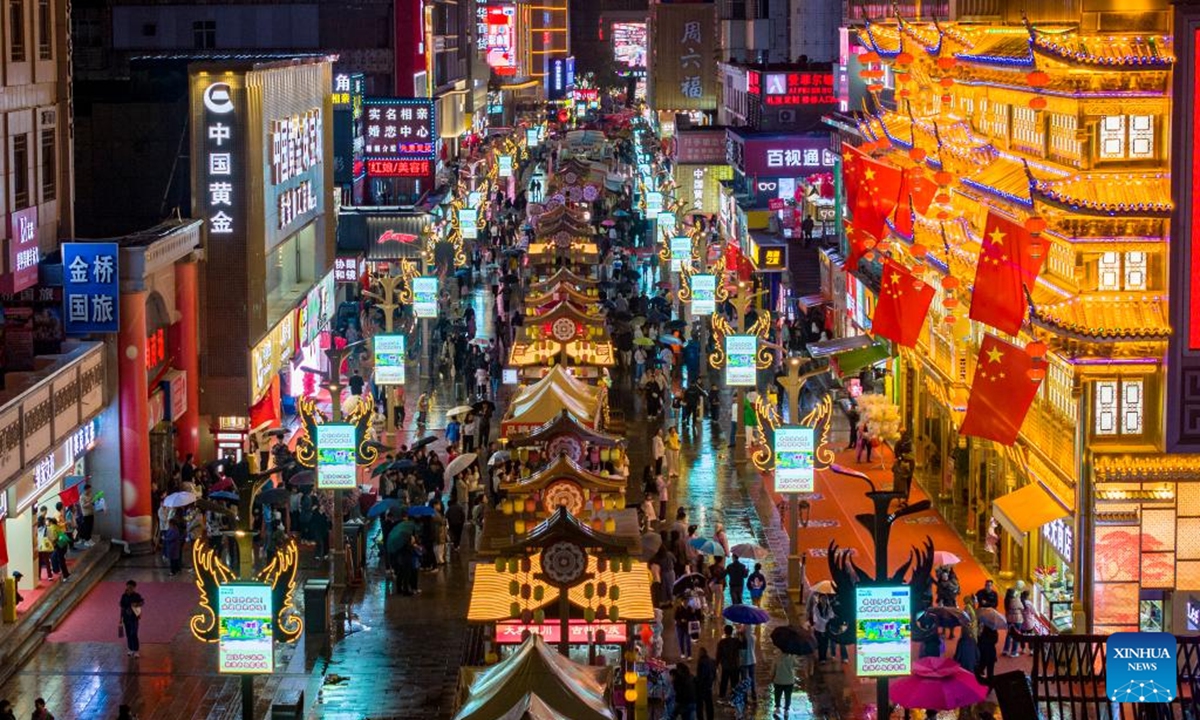
An aerial drone photo taken on Oct. 5, 2025 shows people visiting the Drum Tower pedestrian street in Yinchuan, capital city of northwest China's Ningxia Hui Autonomous Region. Photo: Xinhua
During the just-concluded National Day and Mid-Autumn Festival holidays, China witnessed an unprecedented scale of movement and tourism consumption, with record-breaking figures across the board.
According to estimates from the Ministry of Transport, China is expected to see about 2.432 billion passenger trips nationwide from October 1 to 8, up about 6.2 percent year-on-year. Data from Douyin showed that local cuisine group-buying sales rose by 76 percent, autumn beverages by 57 percent, and accommodations by 50 percent during the holidays. Meanwhile, as of 6:40 pm on Tuesday, the National Day box office (including pre-sales) exceeded 1.7 billion yuan.
The "two-way flow" between China and the rest of the world is also noteworthy. According to the National Immigration Administration, China is expected to record an average of 2 million daily border crossings during the holidays. With its distinctive rhythm and vitality, China's holiday economy is bringing confidence to the world.
China has pledged that it will only open itself ever wider to the outside world. The surge in inbound travel during the National Day and Mid-Autumn Festival holidays provides vivid proof of that commitment. Data from Qunar, a Beijing-based online travel agency, showed that the popularity of "China Travel" continued to climb, with the number of foreign passengers taking domestic flights on the first day of the holidays up more than 40 percent year-on-year, reaching 70 cities across the country. The expansion of visa-free access and facilitation measures for ordinary citizens from more countries reflects China's proactive and transparent approach to integrating with the world. Through these actions, China is fulfilling its promise of openness, injecting fresh momentum into global mobility and cultural exchange.
Every trip made by a foreign visitor to China is, in essence, a real-time sharing of China's development achievements. From convenient high-speed rail travel and easy mobile payments to the ubiquitous 5G connectivity, the tremendous improvements in infrastructure and living standards have provided visitors with a high-quality travel experience. Online ticket booking for tourist attractions, multilingual guidance in public transport, and instant tax-refund policies for overseas travelers have all allowed foreign visitors to experience the unique charm of China firsthand.
Equally vibrant is the outbound travel of Chinese tourists. Data from relevant travel platforms show that during the National Day and Mid-Autumn Festival holidays, outbound travel bookings increased by over 30 percent compared to the previous year. This year, whether it's joining a group tour to South Korea to enjoy the first batch of visa-free benefits, participating in niche birdwatching routes in Kenya, or experiencing the "brotherhood" between Serbia and China in Serbia, Chinese tourists have more diverse options for outbound travel than ever before.
To welcome Chinese tourists, the Tourism Authority of Thailand has launched the "China-Thailand Friendship Month" event, and many European countries have streamlined their visa processes for Chinese visitors. China's open stance of "inviting in and going out" enables Chinese travelers to receive more favorable treatment regarding visas and other aspects. The growth of Chinese outbound tourism conveys messages of peace, friendship, and positive energy to the world.
During the holidays, China's consumption potential was unleashed, with cultural and tourism consumption becoming important growth points. Foreign tourists in China purchase unique cultural and creative products and local specialties. They are also attracted by the Chinese way of life, experiencing the night economy and food culture, which in turn boosts the prosperity of China's consumer market.
Similarly, the outbound spending of Chinese tourists injects vitality into the global economy, especially with the new concepts embraced by young Chinese consumers, such as "in-depth travel" and "cultural tourism," which promote the development of niche attractions and the expansion of cultural preservation projects in destination countries. This "two-way flow" is significant beyond just the economic realm; it also facilitates exchanges and mutual learning among different civilizations. As Chinese tourists venture out into the world, more and more foreign tourists, through their personal experiences, are discovering a real, multi-dimensional, and comprehensive China.
One phenomenon worth noting is that nowadays, during major Chinese holidays such as the Spring Festival, May Day, and National Day, the whole world pays attention, and an increasing number of foreigners wish to share in the joy of Chinese celebrations. China's festivals are the world's festivals, and Chinese festivals are increasingly gaining global significance.
In the context of rising unilateralism and trade protectionism, China's "worldwide flow" during the National Day and Mid-Autumn Festival holidays is thought-provoking. As we have seen during these holidays, China's development has profoundly benefited from this unstoppable era of globalization, and the beautiful vision of shared development and mutual promotion of peace with China has been widely embraced by people around the world.
RELATED ARTICLES