IN-DEPTH / IN-DEPTH
Experiencing charm of China-Russia border city Heihe with vlogger Russian ethnic descent Petrov
By Global Times reporter and People’s Daily reporters Wangyuan, Zhou Zhou, and Guo Xiaolong in Heihe Published: Oct 09, 2025 09:37 PM

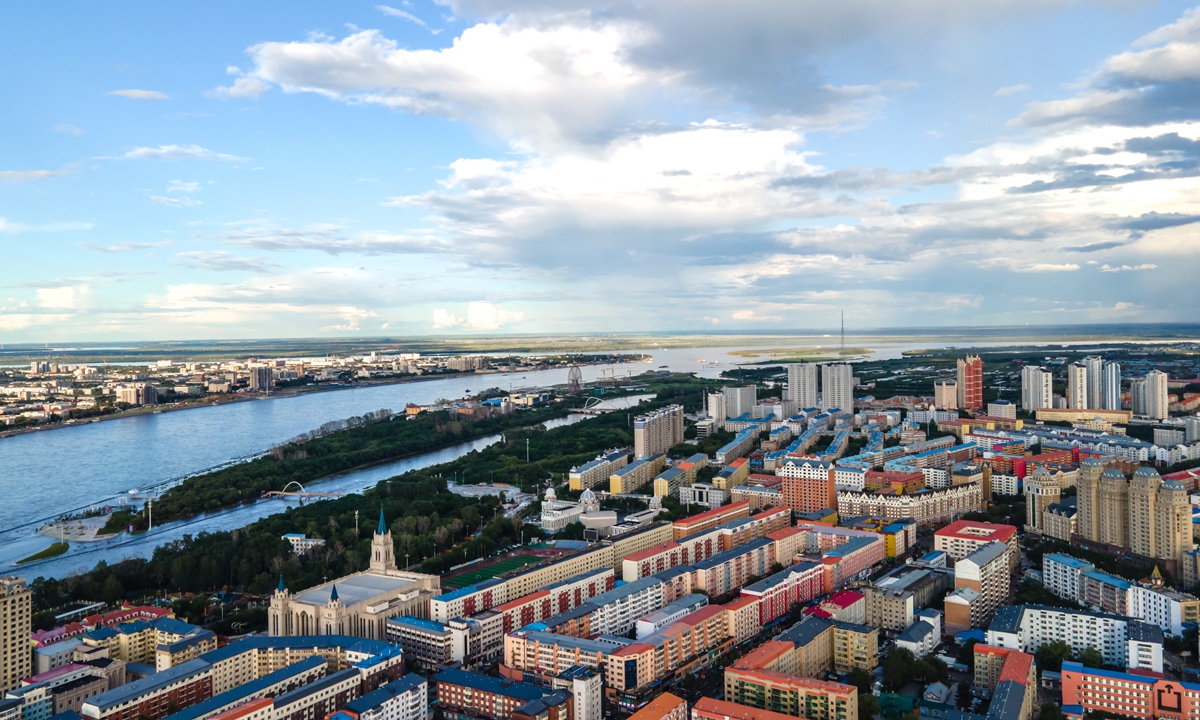
The aerial view of Heihe, Northeast China's Heilongjiang Province Photo: VCG
It sounds exaggerated, but "crossing the border to Russia in just 5 minutes" is a daily reality for residents of the China-Russia border city Heihe, Northeast China's Heilongjiang Province.
Heihe and Blagoveshchensk - the capital of Amur Oblast in Russia's Far East - face each other across the Heilongjiang River, also known in Russia as the Amur River, with the closest distance between the two cities being approximately 700 meters. By boat on the river, it takes only 5 minutes to reach the opposite bank.
During China's National Day and Mid-Autumn Festival holidays, inbound and outbound tourism in Heilongjiang Province boomed. The Heihe waterway tourism inspection port was abuzz with activity, as Chinese and Russian tourists traveled back and forth frequently. According to the China News Service, nearly 1,000 inbound and outbound passengers had passed through the port by the morning of October 1 alone.
Since September 15, China has implemented a trial visa-free policy for Russian citizens holding ordinary passports, which has boosted Russian tourists' willingness to travel to China. As Heilongjiang Province borders Russia, its inbound and outbound tourism market has been presented with a double boost.
In fact, cross-border tourism here is not just popular during this holiday period. All year round, the close ties between Heihe and Blagoveshchensk keep the tourism scene lively.
Before the river begins to flow with broken ice in early spring and after it freezes in winter, to ensure safety and speed, the international passenger terminal by the river also provides "cross-river magic" - hovercraft transportation. It takes even less time, around 2 minutes, to send passengers to the port terminal on the opposite bank of the river.
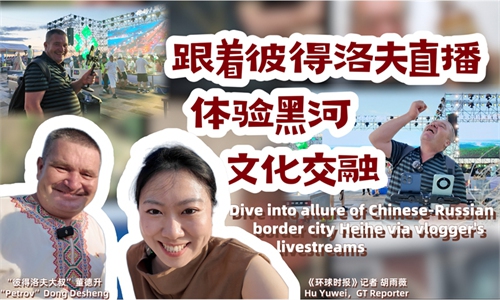
Heihe and Blagoveshchensk are the closest, largest in scale, and most fully functional paired port cities along the China-Russia border, known as the "China-Russia twin cities." In Heihe, reporters met a man of Russian ethnic minority descent living in Heihe who loves livestreaming. He invited us to follow his footsteps and experience the scenes of cross-border life and the deep cultural fusion between the two nations.

Dong Desheng, or Petrov, makes livestreaming at a Chinese-Russian food tasting event on July 27, 2025. Photo: Pang Yue/GT
A livestreaming packed with Chinese-Russian flavorsWhen meeting Dong Desheng in Xiadaogan village, Xunke county, Heihe, this robust man with deep-set eyes and a prominent nose had just finished working in the fields, his pant legs still dusted with freshly turned black soil. He enthusiastically showed off his newly acquired fully automatic pesticide-spraying tractor, speaking in an authentic northeastern Chinese dialect with infectious warmth.
Decades ago, Dong's great-grandfather fled the war on a horse-drawn sleigh from Russia and settled in China's Heihe. "When I was a child, I loved sitting on a small bench and listening to my grandfather tell stories about the family's past," Dong said. Today, his 75-year-old great-aunt - a second-generation descendant of Russian immigrants - still retains life habits such as baking "lieba" - a type of Chinese bread similar to Russian rye bread - and making borscht by herself.
"I love the black soil and the steady joy of planting in spring and harvesting in fall," Dong told reporters. In 2016, he unexpectedly gained fame through a reality show and began livestreaming under the name "Petrov," showcasing harvesting crops, fishing, and telling jokes, amassing over 6 million followers online.
In his livestreaming, Petrov sometimes leans against his tractor, munching on crisp green onions in golden fields, or energetically promotes local and foreign specialties. His online store features Northeast cornmeal, forest black fungus, Russian pickles, and craft beer. The striking contrast of his "foreign face" and fluent northeastern Chinese dialect captivates viewers.
Xunke county is home to several Russian ethnic villages, where Russian-style fences, gates, Baroque-style houses, and matryoshka dolls are commonplace. Villagers with "foreign faces" chatting in northeastern Chinese dialect are a familiar sight.
Feng Jiawen, the publicity committee member of the Party branch of Bianjiang village in Xunke, explained that about one-third of the village's 1,000 residents are of Russian descent. Strolling through the village, Russian-style wooden cabins (made of logs) stand side by side with Chinese brick houses, and sunflowers on windowsills complementing paper-cuttings on window frames, creating a cultural dictionary where every page tells a story of fusion.
When reporters visited Bianjiang village, it happened to be the Basque Festival that was celebrated by the Russian ethnic group. Villagers dressed in bright costumes and various kinds of jewelry; traditional Russian foods such as sausages, roasted meat, sour cucumbers, and painted eggs were laid out on a long table. Everyone greeted each other and tasted the delicacies. In the evening, villagers danced around a bonfire in the village's cultural square decorated with matryoshka dolls and painted eggs.
Taking advantage of the Basque Festival's buzz, a Chinese-Russian food tasting event was held in Xunke. Petrov turned his livestreaming camera to a dazzling array of foods: Russian-style creamy mustard fish fillets glistening golden, smoked salmon skewers exuding aroma, and translucent ice-flower salmon dumplings.
With a shift of the lens, Oroqen-style willow bud soup and hand-torn meat filled the air with fragrance, sparking excitement in the livestreaming chat. Some netizens commented, "Just watching makes me hungry! I want to visit the Russian ethnic village in border with Uncle Petrov and feel the unique ethnic vibe."
Joy of interaction in everyday life
At 6 am, Petrov took the reporters to the international morning market in Heihe's Aihui district for a livestreaming.
As dawn broke over Aihui district, the morning market buzzed with steam from bamboo steamers, the sizzle of frying pans, vibrant Chinese-Russian bilingual signs, and the lively calls of vendors.
In Petrov's lens, freshly picked willow buds, vegetables, and colorful fruits lined the stalls. Among the bustling crowd, many Russian shoppers weaved through, searching for Chinese flavors.
At the "Koukouxiang Egg Burger" stall, owner Wang Shuqing flipped egg burgers on a griddle while shouting in Russian, promoting three types of meat fillings favored by Russians. She said that many Russian customers visit, and chatting with these customers in self-taught Russian is a daily joy for her.
Aksana, a Russian lady who just arrived from Blagoveshchensk by boat, held an egg burger and tofu pudding, stepping into Petrov's frame with a beaming smile. "We don't have such lively morning markets back home. The breakfast options here are so rich!" she said.
"We love China!" said Russian tourist Valigina and her friends, visiting Heihe for the first time. Despite their limited Chinese, their excitement was palpable. They stopped at every stall, marveling at the variety of vegetables and fruits, many unfamiliar to them. "There are so many types we've never seen, and we don't know how to eat them, but we want to try everything," Valigina said.
As evening fell, in Petrov's lens, another international scene unfolded at Heihe's night market, awaiting Chinese and foreign foodies. The darker the night, the livelier the 600-meter-long "Heihe Aihui International Night Market" became. "Cheaper, please!" "Kharasho (Russian for 'good')!" Russians spoke Chinese, Chinese vendors used Russian, bargaining in two languages with knowing smiles, sealing deals with ease.
Ilya, from Vladivostok, Russia, carried a bag full of "treasures." Having visited Heihe five times, she never misses the morning and night markets. "The fruits here are cheap and delicious, and the clothes are high-quality and affordable," she said. Each trip back, she brings bags of Chinese goods, recommending Heihe to friends and family.
At a roasted silkworm chrysalis stall, Sergei from Chelyabinsk, Russia, hesitated to try the unfamiliar dish. "I bought grilled tofu and squid skewers, but this is my first time seeing silkworms cooked like this," he said. Visiting Heihe for dental care, he added, "The night market is famous, so I had to come taste it! I love everything here!"
The ease of cross-border night market strolls and snack sampling owes much to Heihe's year-round port operations and the robust transportation between the "Chinese-Russian twin cities." In winter, when the river freezes, a fixed ice channel supports trade and logistics; during the floating ice period, hovercrafts with over 30 years of history serve as "water buses;" in summer and autumn, roaring passenger ships carry up to 240 passengers at a time.
"The hovercraft is incredibly fast. Many Blagoveshchensk tour companies promote it as a hot attraction. I tried it myself, and it's super cool!" Aksana told reporters.
From 'Russian zone' to 'teaching Chinese'
In front of the Aihui Library by the riverbank in Heihe, Petrov panned his phone camera, his eyes filled with curiosity and joy. The brick-red building, blending classical Roman columns and arched windows with Chinese-style eaves and plaques, stands as a vibrant cultural landmark of Heihe.
Sunlight streamed through the library's floor-to-ceiling windows, illuminating rows of bilingual Chinese-Russian books. Library director Huang Shi'e pointed to The Bronze Horseman: Selected Poems of Alexander Pushkin on the shelf, explaining that as a cultural hub on the border, the library boasts a unique collection, including a "Russian literature zone" with books ranging from Russian classics to modern scientific works. "Amur Oblast has donated Russian books to us multiple times. We have also established an information-sharing mechanism, allowing online access to each other's book collections," Huang said.
The Aihui Library hosts annual Chinese-Russian bilingual reading events and cultural salons, and in 2024, it organized the Chinese-Russian library cooperation and development conference. "When a Moscow delegation visited, we introduced them to intangible cultural heritage activities like Manchu ethnic paper-cutting and fish-skin crafting, and they were thrilled," Huang said. The library now welcomes nearly 1,000 Russian visitors annually.
"I recommend everyone visit this place; it's amazing," said Moscow tourist Kalilov, who adores the Aihui Library. "It has a rich collection, abundant sunlight, a serene and cozy atmosphere, and an open view, brimming with cultural vibes."
Across the river, another cultural venue carries the mission of cultural exchange.
At the Confucius Institute of Blagoveshchensk State Pedagogical University, a plaque inscribed in Russian with "Teaching Chinese with the right approach" reflects the commitment to Chinese-Russian language and cultural exchange. "This campus is small but steeped in history," said Russian director of the Confucius Institute Nikolay Kukharenko with a smile. "As student numbers grow, we're pushing for more classrooms to serve those eager to learn Chinese."
Established in 2007 through a partnership between Heihe University and Blagoveshchensk State Pedagogical University, the Confucius Institute started with about 70 students and now serves 450 learners of all ages, the youngest being just 8 years old. Kukharenko noted that beyond regular classes, the institute collaborates with local hospitals and associations to host Chinese culture lectures and activities like tea ceremonies and paper-cutting, which are warmly received.
When asked how many times he has visited China, Kukharenko replied, "Five passport books' worth." "I've been to more Chinese cities than Russian ones," he said. "With frequent Chinese-Russian exchanges, there's almost a monthly event, making trips to China a 'just-go' affair." He observed that Chinese traditional medicine, like acupuncture, is gaining popularity in Russia, and "the Confucius Institute must keep up, serving as a bridge for cross-cultural exchange."
Since 2022, Amur Oblast has promoted Chinese language courses in all primary and secondary schools in Blagoveshchensk, with the Confucius Institute deeply involved in curriculum planning. This innovative initiative is expected to expand to more cities, fostering the institute's growth across Russia.
During the off-season, one of Petrov's favorite pastimes is casting nets for "island fish" by the riverbank while livestreaming. The wide, calm Heilongjiang River in his phone lens witnesses his joyful life and the frequent interactions of Chinese and Russian border residents, weaving an enduring tale of cultural fusion across the ages.
(Global Times reporter Pang Yue contributed to this story.)
RELATED ARTICLES