Gold File photo: VCG
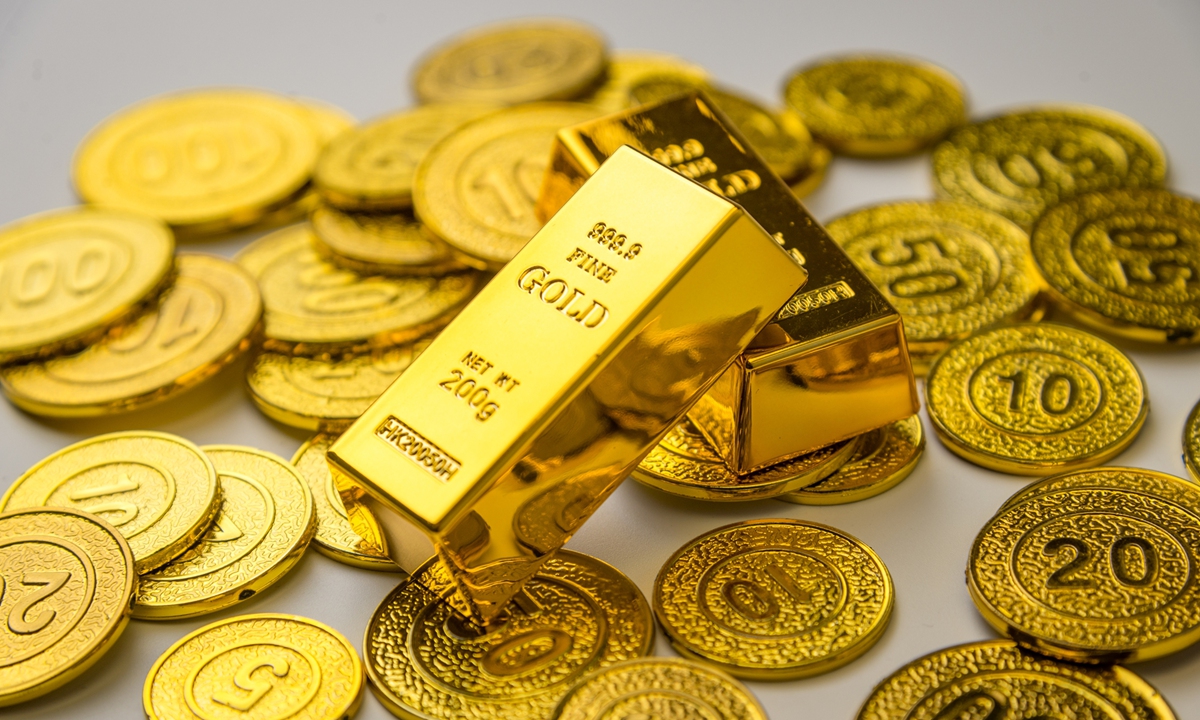
The recent sustained rally in gold prices has captured widespread market attention. On Wednesday, the price soared to a historic high, crossing $4,000 per ounce and extending a rally that has sent prices up more than 50 percent this year.The record-breaking surge signals deepening uncertainty in the global economy and rising international demand for safe-haven assets. As a classic safe-haven asset, gold has long been a favored "safe harbor" for investors when the global economy faces multiple challenges. IMF Managing Director Kristalina Georgieva said in a speech at the Milken Institute think tank on Wednesday that "Uncertainty is the new normal, and it is here to stay."
A convergence of factors - weakening confidence in the US dollar, the sheer scale of US debt, mounting geopolitical tensions, and fears of artificial intelligence (AI)‑driven asset bubbles - has amplified gold's safe‑haven appeal and underscored the market's urgent search for stability.
Expectations of interest rate cuts, combined with the reality that the US national debt has exceeded $37 trillion, are eroding the credibility of US dollar-denominated assets. Various central banks in August continued to increase their gold reserves, according to the World Gold Council. This collective action reflects a cautious international stance toward the existing monetary system.
Beyond monetary factors, concerns about potential risks within the US economy, particularly fears of a stock market collapse triggered by the AI bubble, are also driving gold prices higher.
US GDP growth in the first half of 2025 was almost entirely driven by investment in data centers and information processing technology, according to Harvard economist Jason Furman, Fortune reported on Tuesday. In a post in late September, Furman said that GDP growth would have been just 0.1 percent on an annualized basis, a near standstill that underlines the increasingly pivotal role of high-tech infrastructure in shaping macroeconomic outcomes.
This growth structure has sparked widespread concerns: US tech giants are continuously raising funds to expand data centers, yet the feasibility of this business model remains unproven, and it is still unknown whether revenue from AI products can cover the escalating costs. Should revenues fail to meet expenses and the AI bubble burst, the US economy could face cascading risks including a stock market crash and stalled growth, adding another layer of uncertainty to an already fragile world economy.
Moreover, persistent geopolitical tensions have injected further uncertainty into the global economy. Conflict in the Middle East continues to affect international energy markets, while the Russia-Ukraine conflict is still disrupting trade and industrial chains. The trade tensions between China and the US, including frequent unilateral measures by the US, further highlight the increasingly political nature of international economic interactions. As economic logic increasingly gives way to political considerations, uncertainty in the international trade environment has risen significantly.
In reaction, developing and emerging economies have turned to rebalancing their reserve portfolios toward gold, reflecting a broader shift of strategic reserve management that aims to reduce risks in response to the international climate.
Amid this global rush for safe-haven assets, the certainty offered by China's economy has become increasingly prominent. China has a population of more than 1.4 billion, including more than 400 million middle-income earners, and is rapidly emerging as the world's largest consumer market. China possesses the most comprehensive industrial system globally, with evident economies of scale derived from its super-sized market, making it the largest testing ground for innovative technologies around the world.
More importantly, the certainty of China's macro policies ensures that the Chinese economy is well-positioned for stable operation. No matter how complex and volatile the external environment becomes, China's macro policies have always adhered to the general principle of "seeking progress while maintaining stability" and abided by economic laws. These macro policy adjustments focus on long-term and strategic considerations, rather than merely prioritizing short-term, immediate interests or partial gains.
As the world navigates through uncertainty, efforts to strengthen the certainty of China's economy are not only essential for its own development needs but will also serve as a key effort to safeguard the resilience and recovery of the global economy.
RELATED ARTICLES