‘China speed’ helps South Korean fashion brands explore in Chinese market
By and Yang Shasha Published: Oct 10, 2025 11:17 PM


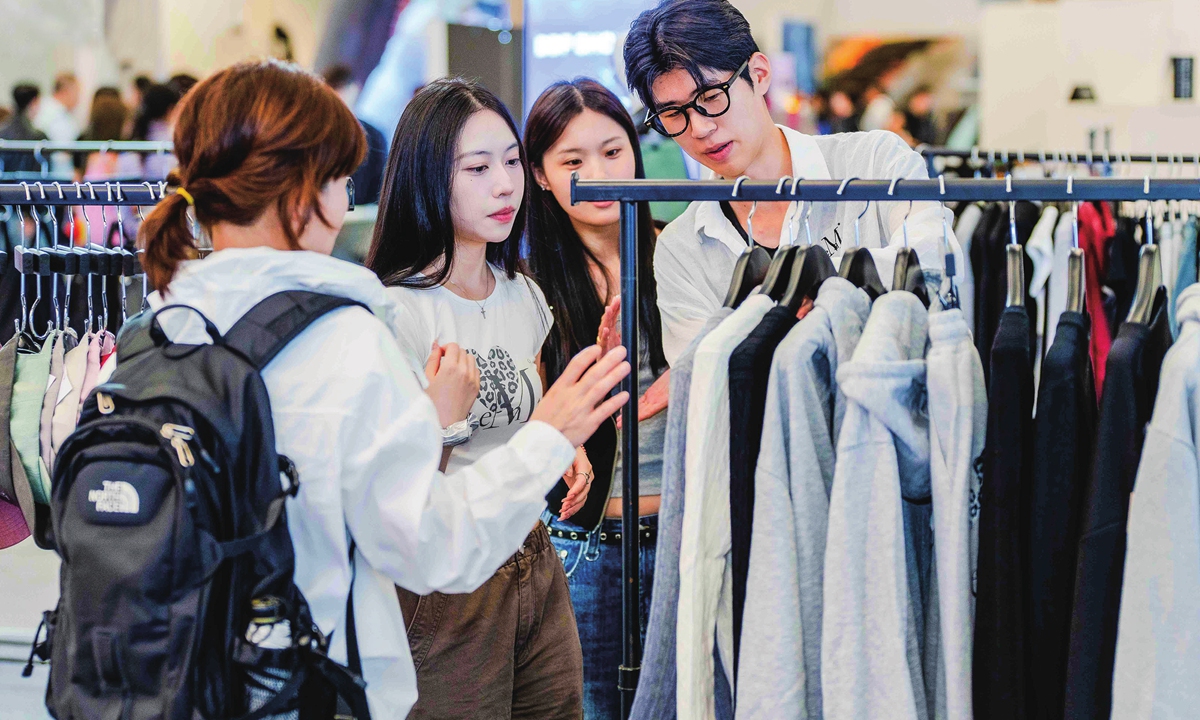
A Tmall Global merchant recruitment team attends an offline exhibition in Seoul, South Korea on September 8, 2025. Photo: Courtesy of Tmall Global
Editor's Note: Amid the ongoing warming of South Korea-China relations, the Korean beauty industry is once again eyeing China as a key strategic market to drive its "second growth curve," according to recent South Korean media reports. Ahead of the 32nd APEC Economic Leaders' Meeting, the Global Times, in collaboration with a reporter from Maeil Business Newspaper, jointly interviewed key enterprises in the fashion industries of China and South Korea. The interviews traced the development trajectories of the fashion sectors in both countries over the past two decades and explored future strategies for the China-South Korea market.
During China's just-concluded eight-day-long holiday, various regions in South Korea actively welcomed Chinese tourists to visit and spend. Amid the influx, Li Jinshi, who oversees South Korean merchant recruitment for Tmall Global, closely monitored the consumption habits of Chinese consumers in South Korea.
Li followed users' posts, their recommended products, and agency information on social media platforms like Xiaohongshu.com and WeChat, in her hope to "discover" high-quality South Korean fashion brands that are little known in China, and bring those brands to Tmall.com.
According to recent data released by Tmall Global, over 1,700 overseas brands opened their first stores on the platform in the first three quarters of this year. Among them, the number of newly-opened South Korean brands saw a 110% year-on-year increase in the second quarter, while the third quarter also saw the fastest growth in the number of new brands from South Korea.
However, as a matter of fact, South Korean fashion brands have not performed very well in the Chinese market in recent years.
Evolving market
Taking cosmetics as an example, South Korean statistics show that, in 2021, South Korean cosmetics exports to China accounted for about 50 percent of its total cosmetics exports. Starting from 2022, the proportion of South Korea's cosmetics exports to China has fallen sharply.
A recent report from South Korea's Administration of Food and Drug Safety said that, in the first half of 2025, South Korea's cosmetics exports to China was valued at $1.08 billion, taking a market share of less than 20 percent for the first time.
What has caused South Korean cosmetic products to fall so sharply in the Chinese market? Some South Korean media outlets have attributed this partly to COVID-19 and challenges in bilateral ties.
Shi Fenglei, head of the Beauty and Personal Care at Tmall Global, also noted that in the past few years, China's own cosmetics brands have risen steadily.
Why have Chinese brands been able to rise so rapidly? A core factor, according to Shi, is "China Speed" - compressing the cycle from R&D to product launch to just six months — powered by China's robust supply chain and innovation ecosystem.
Information provided by Endata revealed that, in 2024, the market share of China's domestic beauty products reached 55.2 percent, marking a year-on-year increase of 2.9 percent, surpassing that of all foreign brands for the first time.
Cosmax, a South Korean ODM, develops and supplies cosmetic products for over 4,500 corporate clients worldwide, including L'Oréal, Estée Lauder, and Johnson & Johnson. Lee Sang-in, general manager of Cosmax China, said in a recent interview with reporters from the Global Times and South Korea's Maeil Business Newspaper that, when they entered the Chinese market in 2004, Chinese brands such as Zheng Mingming and Dabao focused on low-priced offline channels and third- and fourth-tier cities, while foreign cosmetic brands held most of the market.
Today, many foreign brands have faded at the Chinese market, with some being acquired by foreign rivals.
Lee believes that from the early dominance of international brands to the current stage where domestic and international brands compete on the same stage, China is not only one of the world's largest beauty markets but also an innovative market force evolving rapidly with an online-centric focus.
'Growing together'
In the past two to three years, South Korean cosmetic brands seem to have entered a recovery phase in China. Data from the China Chamber of Commerce for Import & Export of Medicines & Health Products showed that, after three consecutive years of decline, China's imports of cosmetic products from South Korea grew by 4.9 percent in the first half of 2025.
South Korea's Asia Daily reported that leading Korean beauty company Amorepacific recently decided to fully resume operations at its nearly idle Shanghai factory. This move is seen as a strategic adjustment by the company. Additionally, Amorepacific's recent financial report showed improving sales in China, with Chinese market sales increasing by 23 percent year-on-year in the second quarter, becoming a major growth driver for the company.
The Asia Daily reported in May that Amorepacific decided to fully boost the operational capacity of its Shanghai factory, which had nearly stalled. The move is seen as a strategic adjustment by the company, judging that the Chinese market is rapidly recovering.
In August this year, Amorepacific's quarterly financial report showed stronger sales in Chinese market, with China sales increasing by 23 percent year-on-year in the second quarter, becoming an important engine for the group's performance growth.
And, Aekyung Industrial, one of South Korea's beauty makers, is accelerating its return to the Chinese market. The Asia Daily reported that, according to Aekyung Industrial's Q2 2025 financial report, the company's sale in the Chinese market showed a steady recovery trend through Douyin live-streaming and the re-launch of its star products. The company noted that it would regard China as one of its core markets.
"We have observed in recent years that South Korean cosmetic brands have entered a critical stage of repositioning themselves in the Chinese market," Shi said.
Head of Paris Baguette China, Yu Seung Hwan, recently said in a joint interview with South Korea's Maeil Business Newspaper and China's Global Times that localization strategy has been the primary factor behind the brand's successful establishment in the Chinese market. He noted that in the early stages of entering China, over 80 percent of raw materials had to be imported, whereas now more than 80 percent are sourced locally.
"By leveraging the unique advantages of different regions, we are able to procure high-quality ingredients, thereby enhancing the taste of our products," he said.
Leveraging solid R&D capabilities in cosmetics technology, some South Korean brands have accelerated their product iteration. The lasting imprint of South Korean cosmetics, reinforced by K-dramas and K-idols, remains attractive to young Chinese consumers, Shi added.
Li from Tmall Global also found that, under the influence of social media, the consumption trends of Generation Z (those born between 1995 and 2009) in China and South Korea are now converging, who tend to emphasize individuality, pursue originality, and buy products with high emotional value.
Against this backdrop, Li noted that the fashion industries of China and South Korea are not simply of "competitive relationship" but more of a "complementary relationship."
"Based on our observations, once a cosmetic product gains traction in the South Korean market, it will inevitably become a fashion trend in the Chinese market too within a year or two," Li said. Relying on the Chinese market, many South Korean brands have also built strong supply chains, with robust capabilities in R&D and OEM manufacturing.
"Rather than emphasizing pulling ahead, we place more importance on 'growing together'," Li noted. "We hope to work with our partners to make 'China-Beauty' globally recognized and truly become a mainstream force in the world."
RELATED ARTICLES