ARTS / CULTURE & LEISURE
Large settlement dating back over 5,000 years unearthed in Shaanxi
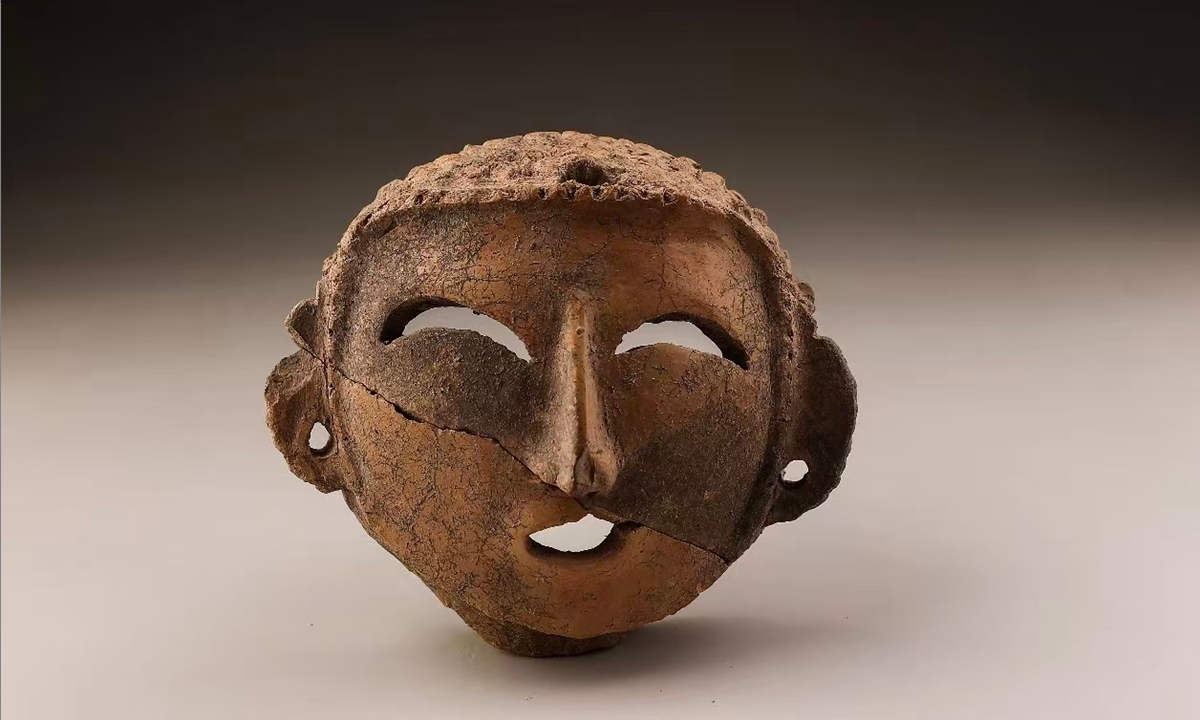
A clay human face sculpture resembles a "smiling emoji Photo: Courtesy of Shaanxi Academy of Archaeology
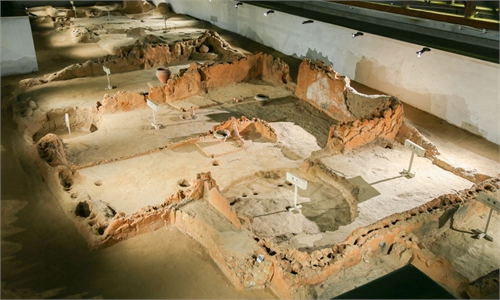
Archaeologists in Northwest China's Shaanxi Province have uncovered a large-scale settlement dating back to the Yangshao era. The site has a complete layout of large residential structures, pottery kilns, and tombs, suggesting that the settlement was built according to a unified plan, the Shaanxi Academy of Archaeology said during the weekend.
Originating around the middle reaches of the Yellow River and dating back 5,000 to 7,000 years, the Yangshao culture is considered to have been an important contributor to Chinese civilization and is widely known for its advanced pottery-making techniques.
The latest discovery was made at the Jiangjia site in Weinan, Shaanxi Province. Situated west of the Youhe River valley, about five kilometers north of the Weihe River and roughly 15 kilometers south of the Qinling Mountains, the area offers open terrain, fertile soil, and abundant water resources - an ideal environment for prehistoric human settlement and development.
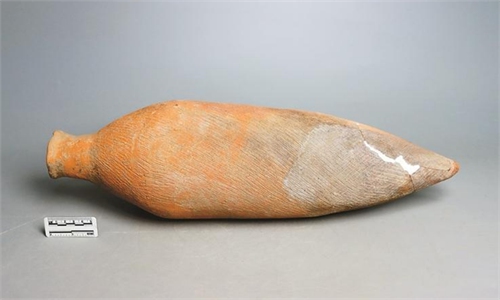
From 2024 to 2025, institutions including the Shaanxi Academy of Archaeology carried out excavations at the site, uncovering nearly 1,100 features, including double-ringed moats, large house foundations, ash pits, pottery kilns, and jar burials. Xin Yu, a curator with the academy, said pottery makes up the majority of the artifacts unearthed at the site, along with a rich collection of stone and bone tools. Most of the pottery is made of fine red clay, followed by sand-tempered red pottery and gray pottery, with a small amount of yellowish-brown clay pottery.
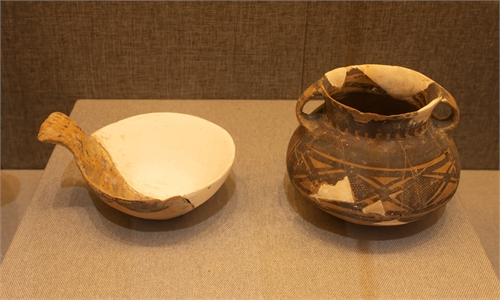
The decorations are mostly plain, though some pieces feature patterns. A notable number of painted pottery items were also found, primarily painted with black and brown pigments. Common designs include curved lines, dotted patterns, and simplified fish patterns. Among the finds, one of the clay human face sculptures is notably expressive, resembling a "smiling emoji."
Preliminary analysis suggests that the cultural remains at the Jiangjia site date mainly to the middle phase of the Miaodigou culture.
The Miaodigou culture refers to the archaeological culture of the middle Yangshao period, dating back to 5,900-5,400 years ago.
"The continuity of the Miaodigou culture is notably apparent," Liu Zheng, a member of the Chinese Society of Cultural Relics, told the Global Times on Sunday, adding that the Miaodigou culture was one of the most widely distributed prehistoric archaeological cultures in China, with traces found in the lower reaches of the Yellow River and the middle reaches of the Yangtze River.
According to Liu, the painted pottery from the Miaodigou period was primarily decorated in black, with other examples featuring red or white pigments. The painted pottery from the Jiangjia site fits the typical characteristics of the Miaodigou phase. The variety of forms and patterns shows the artistic sophistication and symbolic expression of that time.
During the Miaodigou culture phase, the inhabitants of the Jiangjia site took advantage of the natural terrain, combining it with the construction of wide, man-made moats to form a well-planned settlement.
RELATED ARTICLES